
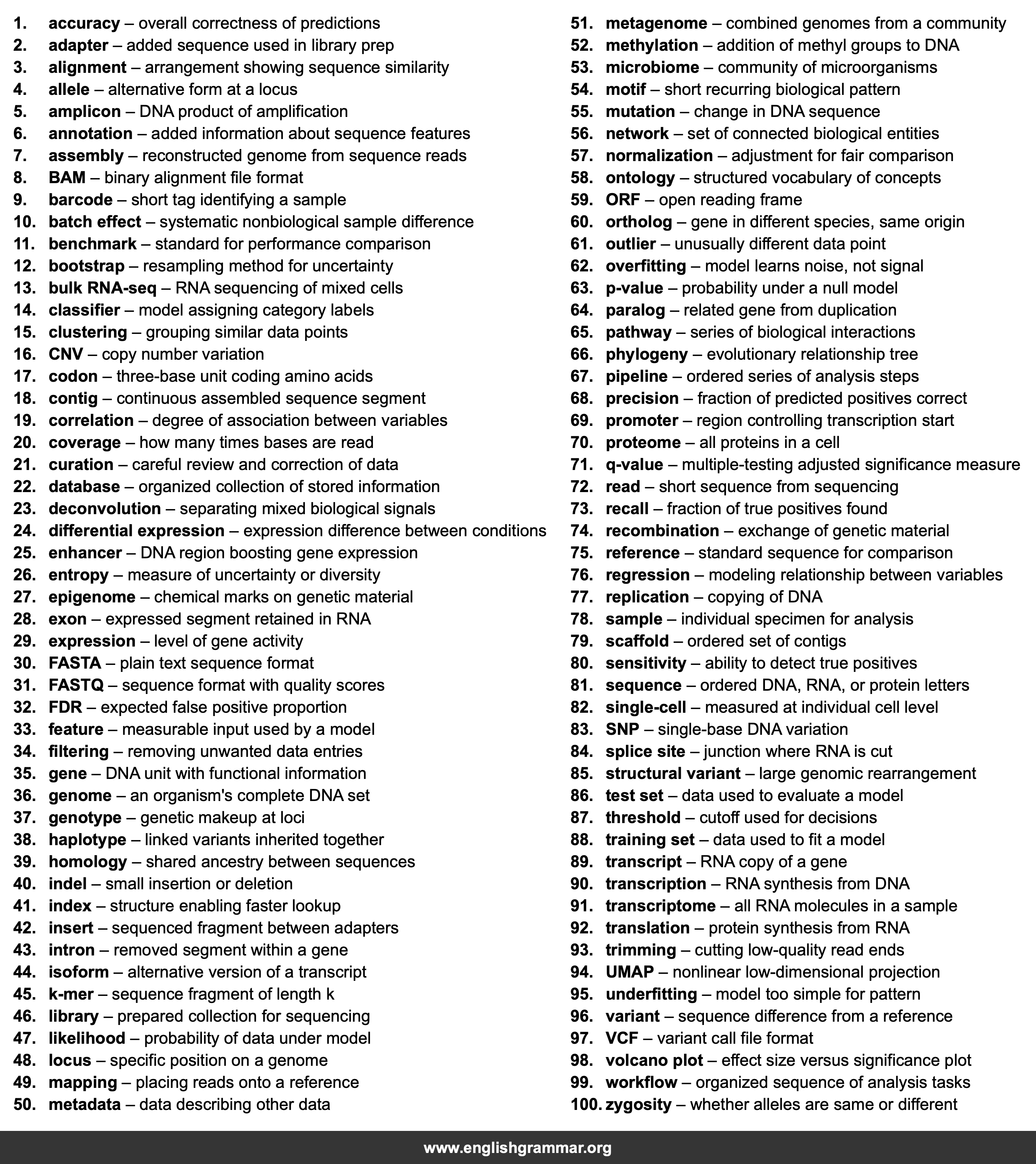
| No. | Item | Definition |
|---|---|---|
| 1. | accuracy | overall correctness of predictions |
| 2. | adapter | added sequence used in library prep |
| 3. | alignment | arrangement showing sequence similarity |
| 4. | allele | alternative form at a locus |
| 5. | amplicon | DNA product of amplification |
| 6. | annotation | added information about sequence features |
| 7. | assembly | reconstructed genome from sequence reads |
| 8. | BAM | binary alignment file format |
| 9. | barcode | short tag identifying a sample |
| 10. | batch effect | systematic nonbiological sample difference |
| 11. | benchmark | standard for performance comparison |
| 12. | bootstrap | resampling method for uncertainty |
| 13. | bulk RNA-seq | RNA sequencing of mixed cells |
| 14. | classifier | model assigning category labels |
| 15. | clustering | grouping similar data points |
| 16. | CNV | copy number variation |
| 17. | codon | three-base unit coding amino acids |
| 18. | contig | continuous assembled sequence segment |
| 19. | correlation | degree of association between variables |
| 20. | coverage | how many times bases are read |
| 21. | curation | careful review and correction of data |
| 22. | database | organized collection of stored information |
| 23. | deconvolution | separating mixed biological signals |
| 24. | differential expression | expression difference between conditions |
| 25. | enhancer | DNA region boosting gene expression |
| 26. | entropy | measure of uncertainty or diversity |
| 27. | epigenome | chemical marks on genetic material |
| 28. | exon | expressed segment retained in RNA |
| 29. | expression | level of gene activity |
| 30. | FASTA | plain text sequence format |
| 31. | FASTQ | sequence format with quality scores |
| 32. | FDR | expected false positive proportion |
| 33. | feature | measurable input used by a model |
| 34. | filtering | removing unwanted data entries |
| 35. | gene | DNA unit with functional information |
| 36. | genome | an organism’s complete DNA set |
| 37. | genotype | genetic makeup at loci |
| 38. | haplotype | linked variants inherited together |
| 39. | homology | shared ancestry between sequences |
| 40. | indel | small insertion or deletion |
| 41. | index | structure enabling faster lookup |
| 42. | insert | sequenced fragment between adapters |
| 43. | intron | removed segment within a gene |
| 44. | isoform | alternative version of a transcript |
| 45. | k-mer | sequence fragment of length k |
| 46. | library | prepared collection for sequencing |
| 47. | likelihood | probability of data under model |
| 48. | locus | specific position on a genome |
| 49. | mapping | placing reads onto a reference |
| 50. | metadata | data describing other data |
| 51. | metagenome | combined genomes from a community |
| 52. | methylation | addition of methyl groups to DNA |
| 53. | microbiome | community of microorganisms |
| 54. | motif | short recurring biological pattern |
| 55. | mutation | change in DNA sequence |
| 56. | network | set of connected biological entities |
| 57. | normalization | adjustment for fair comparison |
| 58. | ontology | structured vocabulary of concepts |
| 59. | ORF | open reading frame |
| 60. | ortholog | gene in different species, same origin |
| 61. | outlier | unusually different data point |
| 62. | overfitting | model learns noise, not signal |
| 63. | p-value | probability under a null model |
| 64. | paralog | related gene from duplication |
| 65. | pathway | series of biological interactions |
| 66. | phylogeny | evolutionary relationship tree |
| 67. | pipeline | ordered series of analysis steps |
| 68. | precision | fraction of predicted positives correct |
| 69. | promoter | region controlling transcription start |
| 70. | proteome | all proteins in a cell |
| 71. | q-value | multiple-testing adjusted significance measure |
| 72. | read | short sequence from sequencing |
| 73. | recall | fraction of true positives found |
| 74. | recombination | exchange of genetic material |
| 75. | reference | standard sequence for comparison |
| 76. | regression | modeling relationship between variables |
| 77. | replication | copying of DNA |
| 78. | sample | individual specimen for analysis |
| 79. | scaffold | ordered set of contigs |
| 80. | sensitivity | ability to detect true positives |
| 81. | sequence | ordered DNA, RNA, or protein letters |
| 82. | single-cell | measured at individual cell level |
| 83. | SNP | single-base DNA variation |
| 84. | splice site | junction where RNA is cut |
| 85. | structural variant | large genomic rearrangement |
| 86. | test set | data used to evaluate a model |
| 87. | threshold | cutoff used for decisions |
| 88. | training set | data used to fit a model |
| 89. | transcript | RNA copy of a gene |
| 90. | transcription | RNA synthesis from DNA |
| 91. | transcriptome | all RNA molecules in a sample |
| 92. | translation | protein synthesis from RNA |
| 93. | trimming | cutting low-quality read ends |
| 94. | UMAP | nonlinear low-dimensional projection |
| 95. | underfitting | model too simple for pattern |
| 96. | variant | sequence difference from a reference |
| 97. | VCF | variant call file format |
| 98. | volcano plot | effect size versus significance plot |
| 99. | workflow | organized sequence of analysis tasks |
| 100. | zygosity | whether alleles are same or different |