
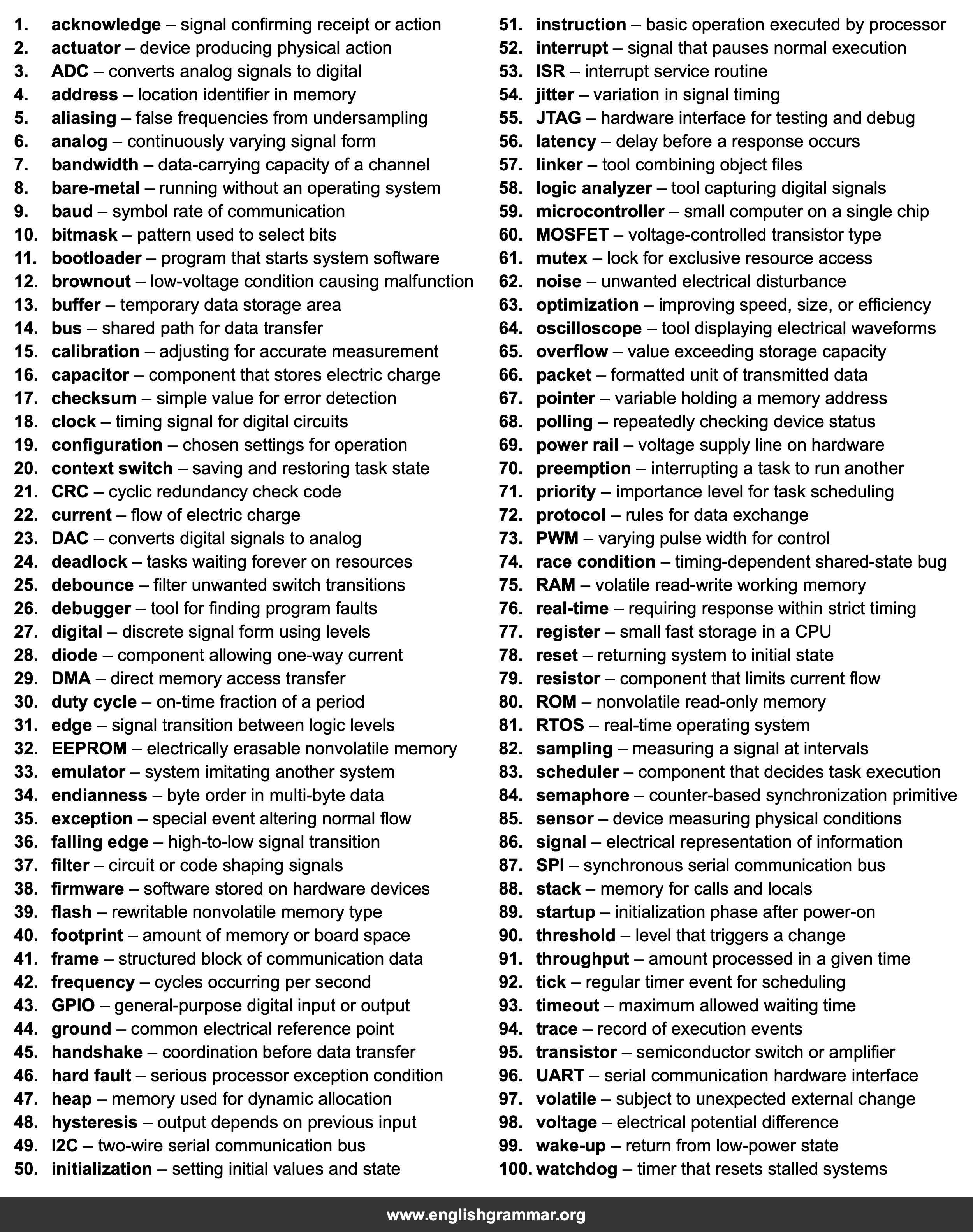
| No. | Item | Definition |
|---|---|---|
| 1. | acknowledge | signal confirming receipt or action |
| 2. | actuator | device producing physical action |
| 3. | ADC | converts analog signals to digital |
| 4. | address | location identifier in memory |
| 5. | aliasing | false frequencies from undersampling |
| 6. | analog | continuously varying signal form |
| 7. | bandwidth | data-carrying capacity of a channel |
| 8. | bare-metal | running without an operating system |
| 9. | baud | symbol rate of communication |
| 10. | bitmask | pattern used to select bits |
| 11. | bootloader | program that starts system software |
| 12. | brownout | low-voltage condition causing malfunction |
| 13. | buffer | temporary data storage area |
| 14. | bus | shared path for data transfer |
| 15. | calibration | adjusting for accurate measurement |
| 16. | capacitor | component that stores electric charge |
| 17. | checksum | simple value for error detection |
| 18. | clock | timing signal for digital circuits |
| 19. | configuration | chosen settings for operation |
| 20. | context switch | saving and restoring task state |
| 21. | CRC | cyclic redundancy check code |
| 22. | current | flow of electric charge |
| 23. | DAC | converts digital signals to analog |
| 24. | deadlock | tasks waiting forever on resources |
| 25. | debounce | filter unwanted switch transitions |
| 26. | debugger | tool for finding program faults |
| 27. | digital | discrete signal form using levels |
| 28. | diode | component allowing one-way current |
| 29. | DMA | direct memory access transfer |
| 30. | duty cycle | on-time fraction of a period |
| 31. | edge | signal transition between logic levels |
| 32. | EEPROM | electrically erasable nonvolatile memory |
| 33. | emulator | system imitating another system |
| 34. | endianness | byte order in multi-byte data |
| 35. | exception | special event altering normal flow |
| 36. | falling edge | high-to-low signal transition |
| 37. | filter | circuit or code shaping signals |
| 38. | firmware | software stored on hardware devices |
| 39. | flash | rewritable nonvolatile memory type |
| 40. | footprint | amount of memory or board space |
| 41. | frame | structured block of communication data |
| 42. | frequency | cycles occurring per second |
| 43. | GPIO | general-purpose digital input or output |
| 44. | ground | common electrical reference point |
| 45. | handshake | coordination before data transfer |
| 46. | hard fault | serious processor exception condition |
| 47. | heap | memory used for dynamic allocation |
| 48. | hysteresis | output depends on previous input |
| 49. | I2C | two-wire serial communication bus |
| 50. | initialization | setting initial values and state |
| 51. | instruction | basic operation executed by processor |
| 52. | interrupt | signal that pauses normal execution |
| 53. | ISR | interrupt service routine |
| 54. | jitter | variation in signal timing |
| 55. | JTAG | hardware interface for testing and debug |
| 56. | latency | delay before a response occurs |
| 57. | linker | tool combining object files |
| 58. | logic analyzer | tool capturing digital signals |
| 59. | microcontroller | small computer on a single chip |
| 60. | MOSFET | voltage-controlled transistor type |
| 61. | mutex | lock for exclusive resource access |
| 62. | noise | unwanted electrical disturbance |
| 63. | optimization | improving speed, size, or efficiency |
| 64. | oscilloscope | tool displaying electrical waveforms |
| 65. | overflow | value exceeding storage capacity |
| 66. | packet | formatted unit of transmitted data |
| 67. | pointer | variable holding a memory address |
| 68. | polling | repeatedly checking device status |
| 69. | power rail | voltage supply line on hardware |
| 70. | preemption | interrupting a task to run another |
| 71. | priority | importance level for task scheduling |
| 72. | protocol | rules for data exchange |
| 73. | PWM | varying pulse width for control |
| 74. | race condition | timing-dependent shared-state bug |
| 75. | RAM | volatile read-write working memory |
| 76. | real-time | requiring response within strict timing |
| 77. | register | small fast storage in a CPU |
| 78. | reset | returning system to initial state |
| 79. | resistor | component that limits current flow |
| 80. | ROM | nonvolatile read-only memory |
| 81. | RTOS | real-time operating system |
| 82. | sampling | measuring a signal at intervals |
| 83. | scheduler | component that decides task execution |
| 84. | semaphore | counter-based synchronization primitive |
| 85. | sensor | device measuring physical conditions |
| 86. | signal | electrical representation of information |
| 87. | SPI | synchronous serial communication bus |
| 88. | stack | memory for calls and locals |
| 89. | startup | initialization phase after power-on |
| 90. | threshold | level that triggers a change |
| 91. | throughput | amount processed in a given time |
| 92. | tick | regular timer event for scheduling |
| 93. | timeout | maximum allowed waiting time |
| 94. | trace | record of execution events |
| 95. | transistor | semiconductor switch or amplifier |
| 96. | UART | serial communication hardware interface |
| 97. | volatile | subject to unexpected external change |
| 98. | voltage | electrical potential difference |
| 99. | wake-up | return from low-power state |
| 100. | watchdog | timer that resets stalled systems |