
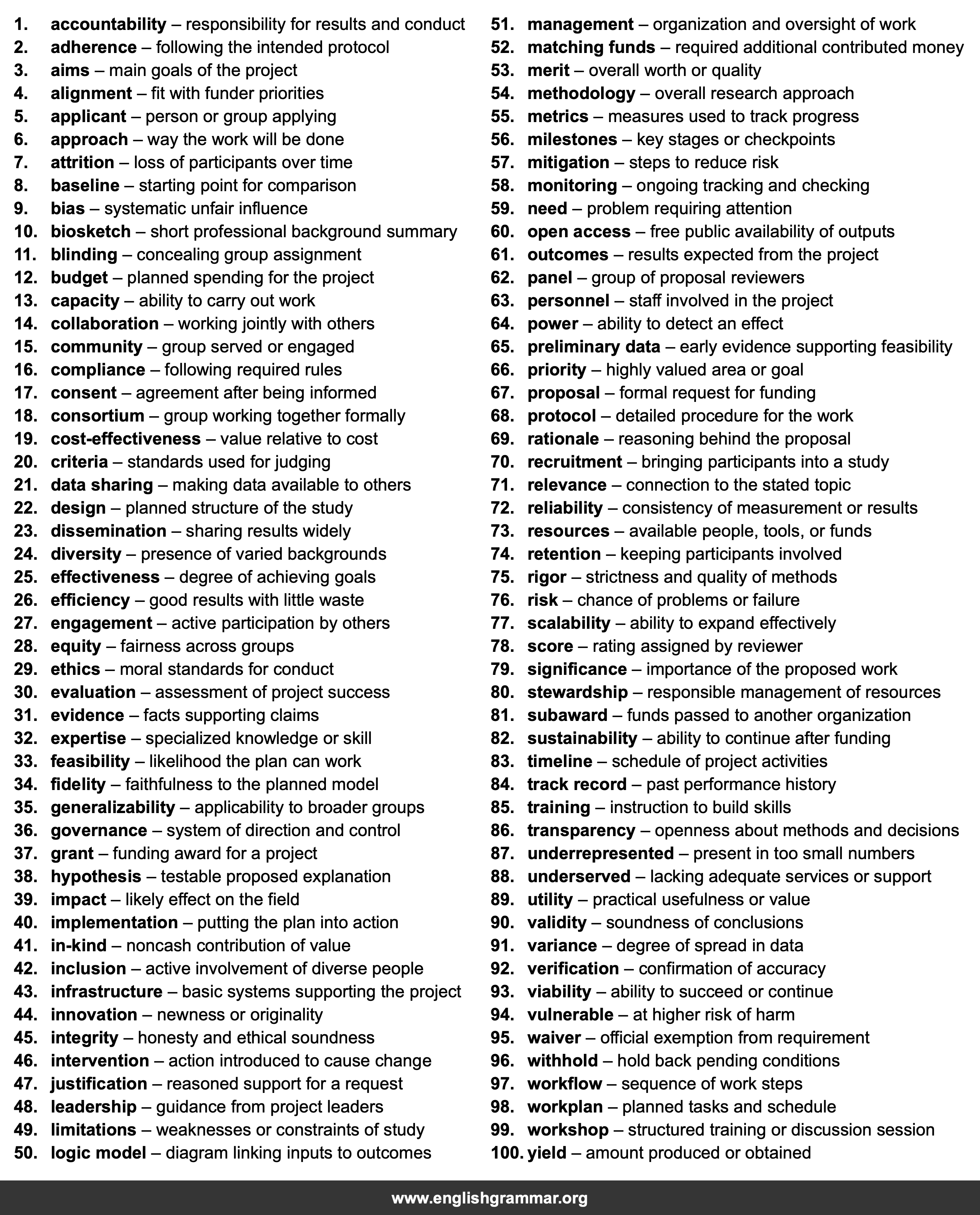
| No. | Item | Definition |
|---|---|---|
| 1. | accountability | responsibility for results and conduct |
| 2. | adherence | following the intended protocol |
| 3. | aims | main goals of the project |
| 4. | alignment | fit with funder priorities |
| 5. | applicant | person or group applying |
| 6. | approach | way the work will be done |
| 7. | attrition | loss of participants over time |
| 8. | baseline | starting point for comparison |
| 9. | bias | systematic unfair influence |
| 10. | biosketch | short professional background summary |
| 11. | blinding | concealing group assignment |
| 12. | budget | planned spending for the project |
| 13. | capacity | ability to carry out work |
| 14. | collaboration | working jointly with others |
| 15. | community | group served or engaged |
| 16. | compliance | following required rules |
| 17. | consent | agreement after being informed |
| 18. | consortium | group working together formally |
| 19. | cost-effectiveness | value relative to cost |
| 20. | criteria | standards used for judging |
| 21. | data sharing | making data available to others |
| 22. | design | planned structure of the study |
| 23. | dissemination | sharing results widely |
| 24. | diversity | presence of varied backgrounds |
| 25. | effectiveness | degree of achieving goals |
| 26. | efficiency | good results with little waste |
| 27. | engagement | active participation by others |
| 28. | equity | fairness across groups |
| 29. | ethics | moral standards for conduct |
| 30. | evaluation | assessment of project success |
| 31. | evidence | facts supporting claims |
| 32. | expertise | specialized knowledge or skill |
| 33. | feasibility | likelihood the plan can work |
| 34. | fidelity | faithfulness to the planned model |
| 35. | generalizability | applicability to broader groups |
| 36. | governance | system of direction and control |
| 37. | grant | funding award for a project |
| 38. | hypothesis | testable proposed explanation |
| 39. | impact | likely effect on the field |
| 40. | implementation | putting the plan into action |
| 41. | in-kind | noncash contribution of value |
| 42. | inclusion | active involvement of diverse people |
| 43. | infrastructure | basic systems supporting the project |
| 44. | innovation | newness or originality |
| 45. | integrity | honesty and ethical soundness |
| 46. | intervention | action introduced to cause change |
| 47. | justification | reasoned support for a request |
| 48. | leadership | guidance from project leaders |
| 49. | limitations | weaknesses or constraints of study |
| 50. | logic model | diagram linking inputs to outcomes |
| 51. | management | organization and oversight of work |
| 52. | matching funds | required additional contributed money |
| 53. | merit | overall worth or quality |
| 54. | methodology | overall research approach |
| 55. | metrics | measures used to track progress |
| 56. | milestones | key stages or checkpoints |
| 57. | mitigation | steps to reduce risk |
| 58. | monitoring | ongoing tracking and checking |
| 59. | need | problem requiring attention |
| 60. | open access | free public availability of outputs |
| 61. | outcomes | results expected from the project |
| 62. | panel | group of proposal reviewers |
| 63. | personnel | staff involved in the project |
| 64. | power | ability to detect an effect |
| 65. | preliminary data | early evidence supporting feasibility |
| 66. | priority | highly valued area or goal |
| 67. | proposal | formal request for funding |
| 68. | protocol | detailed procedure for the work |
| 69. | rationale | reasoning behind the proposal |
| 70. | recruitment | bringing participants into a study |
| 71. | relevance | connection to the stated topic |
| 72. | reliability | consistency of measurement or results |
| 73. | resources | available people, tools, or funds |
| 74. | retention | keeping participants involved |
| 75. | rigor | strictness and quality of methods |
| 76. | risk | chance of problems or failure |
| 77. | scalability | ability to expand effectively |
| 78. | score | rating assigned by reviewer |
| 79. | significance | importance of the proposed work |
| 80. | stewardship | responsible management of resources |
| 81. | subaward | funds passed to another organization |
| 82. | sustainability | ability to continue after funding |
| 83. | timeline | schedule of project activities |
| 84. | track record | past performance history |
| 85. | training | instruction to build skills |
| 86. | transparency | openness about methods and decisions |
| 87. | underrepresented | present in too small numbers |
| 88. | underserved | lacking adequate services or support |
| 89. | utility | practical usefulness or value |
| 90. | validity | soundness of conclusions |
| 91. | variance | degree of spread in data |
| 92. | verification | confirmation of accuracy |
| 93. | viability | ability to succeed or continue |
| 94. | vulnerable | at higher risk of harm |
| 95. | waiver | official exemption from requirement |
| 96. | withhold | hold back pending conditions |
| 97. | workflow | sequence of work steps |
| 98. | workplan | planned tasks and schedule |
| 99. | workshop | structured training or discussion session |
| 100. | yield | amount produced or obtained |