
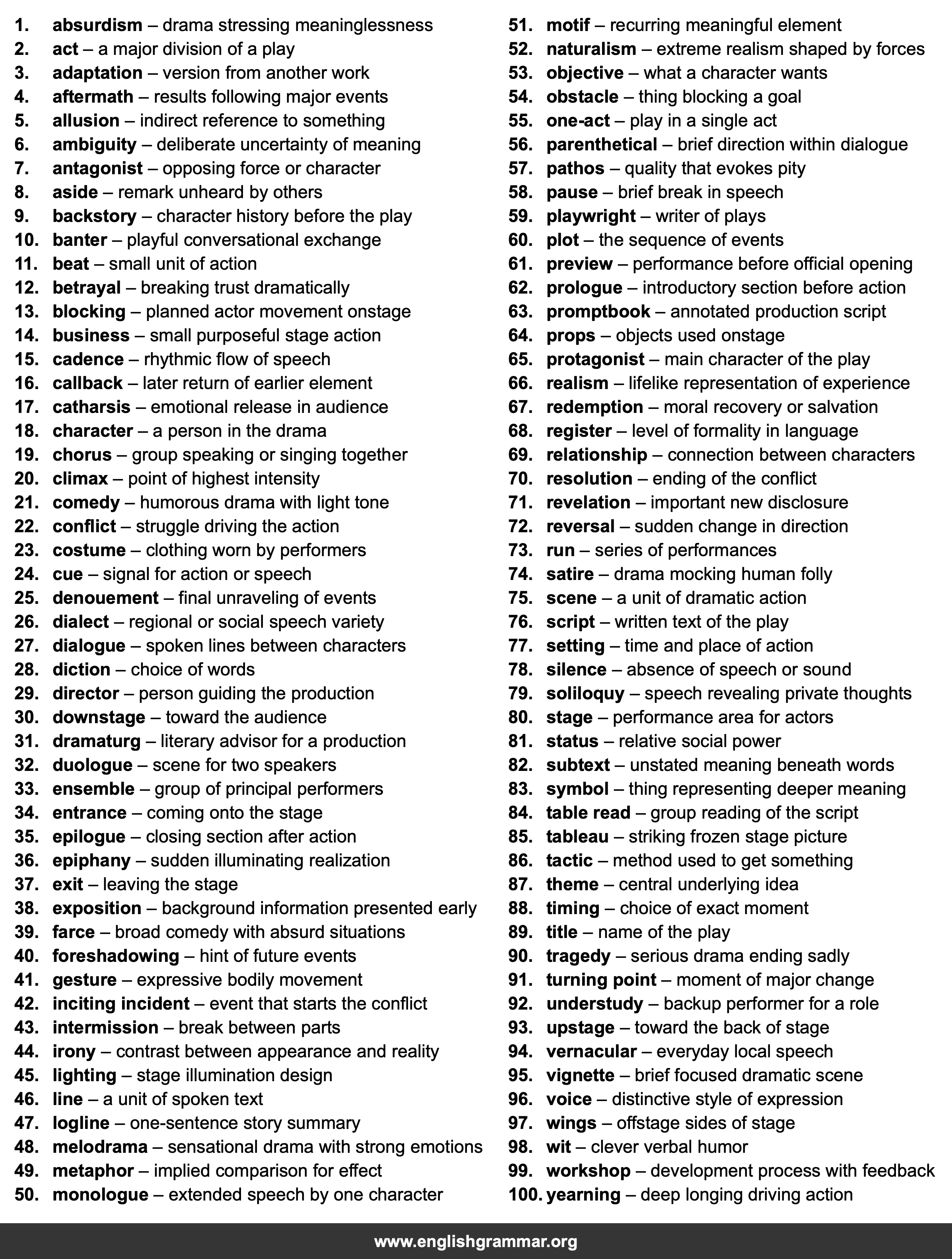
| No. | Item | Definition |
|---|---|---|
| 1. | absurdism | drama stressing meaninglessness |
| 2. | act | a major division of a play |
| 3. | adaptation | version from another work |
| 4. | aftermath | results following major events |
| 5. | allusion | indirect reference to something |
| 6. | ambiguity | deliberate uncertainty of meaning |
| 7. | antagonist | opposing force or character |
| 8. | aside | remark unheard by others |
| 9. | backstory | character history before the play |
| 10. | banter | playful conversational exchange |
| 11. | beat | small unit of action |
| 12. | betrayal | breaking trust dramatically |
| 13. | blocking | planned actor movement onstage |
| 14. | business | small purposeful stage action |
| 15. | cadence | rhythmic flow of speech |
| 16. | callback | later return of earlier element |
| 17. | catharsis | emotional release in audience |
| 18. | character | a person in the drama |
| 19. | chorus | group speaking or singing together |
| 20. | climax | point of highest intensity |
| 21. | comedy | humorous drama with light tone |
| 22. | conflict | struggle driving the action |
| 23. | costume | clothing worn by performers |
| 24. | cue | signal for action or speech |
| 25. | denouement | final unraveling of events |
| 26. | dialect | regional or social speech variety |
| 27. | dialogue | spoken lines between characters |
| 28. | diction | choice of words |
| 29. | director | person guiding the production |
| 30. | downstage | toward the audience |
| 31. | dramaturg | literary advisor for a production |
| 32. | duologue | scene for two speakers |
| 33. | ensemble | group of principal performers |
| 34. | entrance | coming onto the stage |
| 35. | epilogue | closing section after action |
| 36. | epiphany | sudden illuminating realization |
| 37. | exit | leaving the stage |
| 38. | exposition | background information presented early |
| 39. | farce | broad comedy with absurd situations |
| 40. | foreshadowing | hint of future events |
| 41. | gesture | expressive bodily movement |
| 42. | inciting incident | event that starts the conflict |
| 43. | intermission | break between parts |
| 44. | irony | contrast between appearance and reality |
| 45. | lighting | stage illumination design |
| 46. | line | a unit of spoken text |
| 47. | logline | one-sentence story summary |
| 48. | melodrama | sensational drama with strong emotions |
| 49. | metaphor | implied comparison for effect |
| 50. | monologue | extended speech by one character |
| 51. | motif | recurring meaningful element |
| 52. | naturalism | extreme realism shaped by forces |
| 53. | objective | what a character wants |
| 54. | obstacle | thing blocking a goal |
| 55. | one-act | play in a single act |
| 56. | parenthetical | brief direction within dialogue |
| 57. | pathos | quality that evokes pity |
| 58. | pause | brief break in speech |
| 59. | playwright | writer of plays |
| 60. | plot | the sequence of events |
| 61. | preview | performance before official opening |
| 62. | prologue | introductory section before action |
| 63. | promptbook | annotated production script |
| 64. | props | objects used onstage |
| 65. | protagonist | main character of the play |
| 66. | realism | lifelike representation of experience |
| 67. | redemption | moral recovery or salvation |
| 68. | register | level of formality in language |
| 69. | relationship | connection between characters |
| 70. | resolution | ending of the conflict |
| 71. | revelation | important new disclosure |
| 72. | reversal | sudden change in direction |
| 73. | run | series of performances |
| 74. | satire | drama mocking human folly |
| 75. | scene | a unit of dramatic action |
| 76. | script | written text of the play |
| 77. | setting | time and place of action |
| 78. | silence | absence of speech or sound |
| 79. | soliloquy | speech revealing private thoughts |
| 80. | stage | performance area for actors |
| 81. | status | relative social power |
| 82. | subtext | unstated meaning beneath words |
| 83. | symbol | thing representing deeper meaning |
| 84. | table read | group reading of the script |
| 85. | tableau | striking frozen stage picture |
| 86. | tactic | method used to get something |
| 87. | theme | central underlying idea |
| 88. | timing | choice of exact moment |
| 89. | title | name of the play |
| 90. | tragedy | serious drama ending sadly |
| 91. | turning point | moment of major change |
| 92. | understudy | backup performer for a role |
| 93. | upstage | toward the back of stage |
| 94. | vernacular | everyday local speech |
| 95. | vignette | brief focused dramatic scene |
| 96. | voice | distinctive style of expression |
| 97. | wings | offstage sides of stage |
| 98. | wit | clever verbal humor |
| 99. | workshop | development process with feedback |
| 100. | yearning | deep longing driving action |