
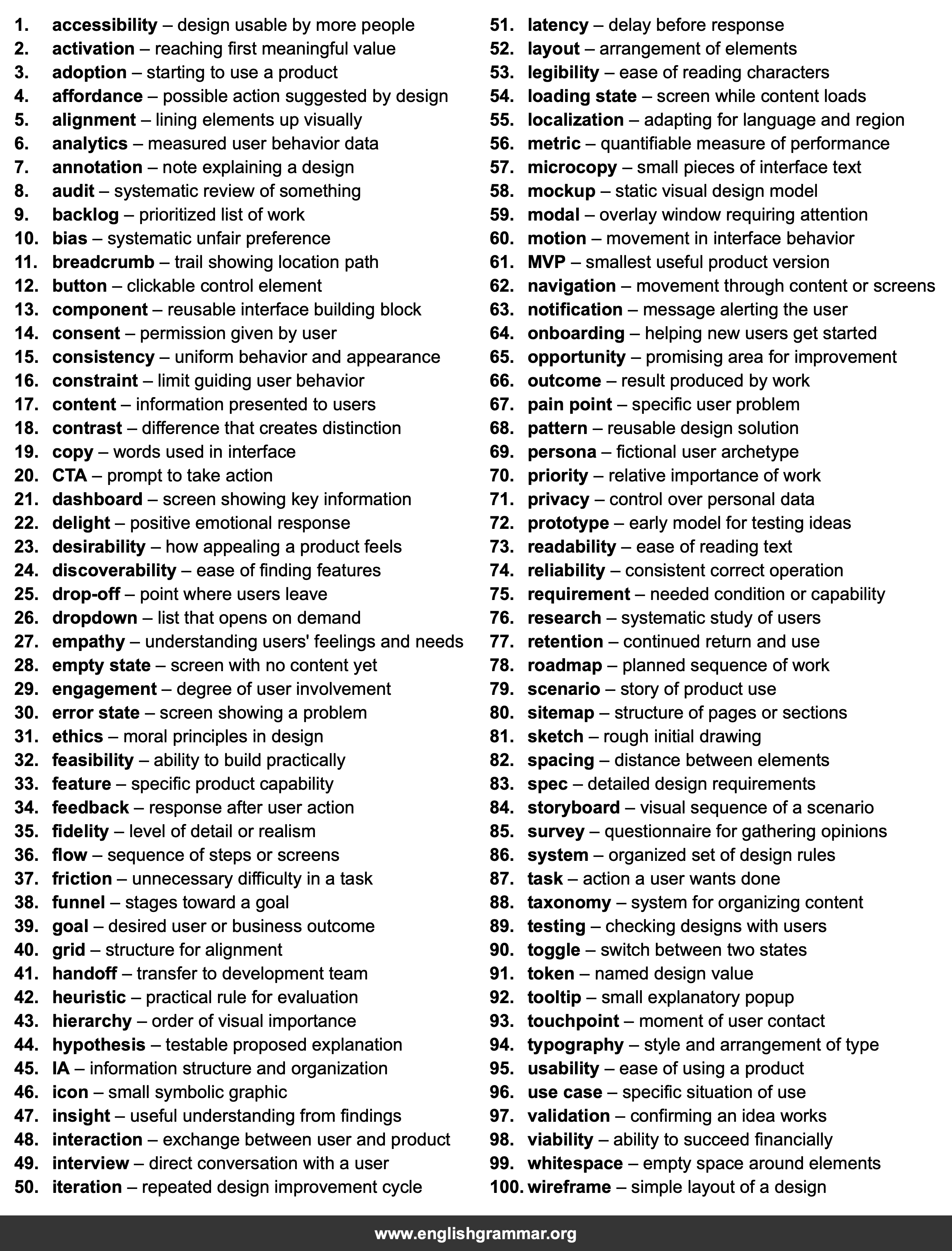
| No. | Item | Definition |
|---|---|---|
| 1. | accessibility | design usable by more people |
| 2. | activation | reaching first meaningful value |
| 3. | adoption | starting to use a product |
| 4. | affordance | possible action suggested by design |
| 5. | alignment | lining elements up visually |
| 6. | analytics | measured user behavior data |
| 7. | annotation | note explaining a design |
| 8. | audit | systematic review of something |
| 9. | backlog | prioritized list of work |
| 10. | bias | systematic unfair preference |
| 11. | breadcrumb | trail showing location path |
| 12. | button | clickable control element |
| 13. | component | reusable interface building block |
| 14. | consent | permission given by user |
| 15. | consistency | uniform behavior and appearance |
| 16. | constraint | limit guiding user behavior |
| 17. | content | information presented to users |
| 18. | contrast | difference that creates distinction |
| 19. | copy | words used in interface |
| 20. | CTA | prompt to take action |
| 21. | dashboard | screen showing key information |
| 22. | delight | positive emotional response |
| 23. | desirability | how appealing a product feels |
| 24. | discoverability | ease of finding features |
| 25. | drop-off | point where users leave |
| 26. | dropdown | list that opens on demand |
| 27. | empathy | understanding users’ feelings and needs |
| 28. | empty state | screen with no content yet |
| 29. | engagement | degree of user involvement |
| 30. | error state | screen showing a problem |
| 31. | ethics | moral principles in design |
| 32. | feasibility | ability to build practically |
| 33. | feature | specific product capability |
| 34. | feedback | response after user action |
| 35. | fidelity | level of detail or realism |
| 36. | flow | sequence of steps or screens |
| 37. | friction | unnecessary difficulty in a task |
| 38. | funnel | stages toward a goal |
| 39. | goal | desired user or business outcome |
| 40. | grid | structure for alignment |
| 41. | handoff | transfer to development team |
| 42. | heuristic | practical rule for evaluation |
| 43. | hierarchy | order of visual importance |
| 44. | hypothesis | testable proposed explanation |
| 45. | IA | information structure and organization |
| 46. | icon | small symbolic graphic |
| 47. | insight | useful understanding from findings |
| 48. | interaction | exchange between user and product |
| 49. | interview | direct conversation with a user |
| 50. | iteration | repeated design improvement cycle |
| 51. | latency | delay before response |
| 52. | layout | arrangement of elements |
| 53. | legibility | ease of reading characters |
| 54. | loading state | screen while content loads |
| 55. | localization | adapting for language and region |
| 56. | metric | quantifiable measure of performance |
| 57. | microcopy | small pieces of interface text |
| 58. | mockup | static visual design model |
| 59. | modal | overlay window requiring attention |
| 60. | motion | movement in interface behavior |
| 61. | MVP | smallest useful product version |
| 62. | navigation | movement through content or screens |
| 63. | notification | message alerting the user |
| 64. | onboarding | helping new users get started |
| 65. | opportunity | promising area for improvement |
| 66. | outcome | result produced by work |
| 67. | pain point | specific user problem |
| 68. | pattern | reusable design solution |
| 69. | persona | fictional user archetype |
| 70. | priority | relative importance of work |
| 71. | privacy | control over personal data |
| 72. | prototype | early model for testing ideas |
| 73. | readability | ease of reading text |
| 74. | reliability | consistent correct operation |
| 75. | requirement | needed condition or capability |
| 76. | research | systematic study of users |
| 77. | retention | continued return and use |
| 78. | roadmap | planned sequence of work |
| 79. | scenario | story of product use |
| 80. | sitemap | structure of pages or sections |
| 81. | sketch | rough initial drawing |
| 82. | spacing | distance between elements |
| 83. | spec | detailed design requirements |
| 84. | storyboard | visual sequence of a scenario |
| 85. | survey | questionnaire for gathering opinions |
| 86. | system | organized set of design rules |
| 87. | task | action a user wants done |
| 88. | taxonomy | system for organizing content |
| 89. | testing | checking designs with users |
| 90. | toggle | switch between two states |
| 91. | token | named design value |
| 92. | tooltip | small explanatory popup |
| 93. | touchpoint | moment of user contact |
| 94. | typography | style and arrangement of type |
| 95. | usability | ease of using a product |
| 96. | use case | specific situation of use |
| 97. | validation | confirming an idea works |
| 98. | viability | ability to succeed financially |
| 99. | whitespace | empty space around elements |
| 100. | wireframe | simple layout of a design |