
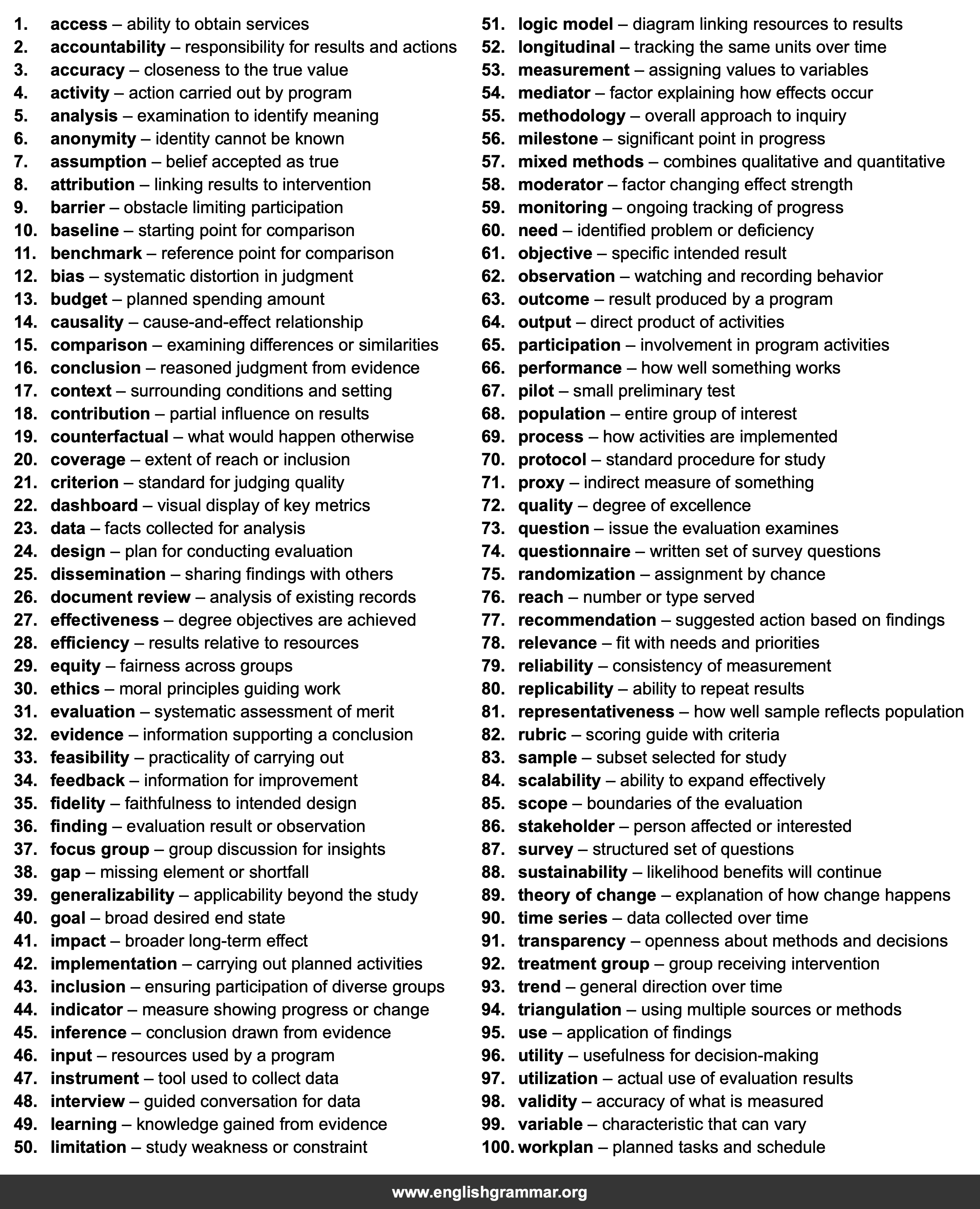
| No. | Item | Definition |
|---|---|---|
| 1. | access | ability to obtain services |
| 2. | accountability | responsibility for results and actions |
| 3. | accuracy | closeness to the true value |
| 4. | activity | action carried out by program |
| 5. | analysis | examination to identify meaning |
| 6. | anonymity | identity cannot be known |
| 7. | assumption | belief accepted as true |
| 8. | attribution | linking results to intervention |
| 9. | barrier | obstacle limiting participation |
| 10. | baseline | starting point for comparison |
| 11. | benchmark | reference point for comparison |
| 12. | bias | systematic distortion in judgment |
| 13. | budget | planned spending amount |
| 14. | causality | cause-and-effect relationship |
| 15. | comparison | examining differences or similarities |
| 16. | conclusion | reasoned judgment from evidence |
| 17. | context | surrounding conditions and setting |
| 18. | contribution | partial influence on results |
| 19. | counterfactual | what would happen otherwise |
| 20. | coverage | extent of reach or inclusion |
| 21. | criterion | standard for judging quality |
| 22. | dashboard | visual display of key metrics |
| 23. | data | facts collected for analysis |
| 24. | design | plan for conducting evaluation |
| 25. | dissemination | sharing findings with others |
| 26. | document review | analysis of existing records |
| 27. | effectiveness | degree objectives are achieved |
| 28. | efficiency | results relative to resources |
| 29. | equity | fairness across groups |
| 30. | ethics | moral principles guiding work |
| 31. | evaluation | systematic assessment of merit |
| 32. | evidence | information supporting a conclusion |
| 33. | feasibility | practicality of carrying out |
| 34. | feedback | information for improvement |
| 35. | fidelity | faithfulness to intended design |
| 36. | finding | evaluation result or observation |
| 37. | focus group | group discussion for insights |
| 38. | gap | missing element or shortfall |
| 39. | generalizability | applicability beyond the study |
| 40. | goal | broad desired end state |
| 41. | impact | broader long-term effect |
| 42. | implementation | carrying out planned activities |
| 43. | inclusion | ensuring participation of diverse groups |
| 44. | indicator | measure showing progress or change |
| 45. | inference | conclusion drawn from evidence |
| 46. | input | resources used by a program |
| 47. | instrument | tool used to collect data |
| 48. | interview | guided conversation for data |
| 49. | learning | knowledge gained from evidence |
| 50. | limitation | study weakness or constraint |
| 51. | logic model | diagram linking resources to results |
| 52. | longitudinal | tracking the same units over time |
| 53. | measurement | assigning values to variables |
| 54. | mediator | factor explaining how effects occur |
| 55. | methodology | overall approach to inquiry |
| 56. | milestone | significant point in progress |
| 57. | mixed methods | combines qualitative and quantitative |
| 58. | moderator | factor changing effect strength |
| 59. | monitoring | ongoing tracking of progress |
| 60. | need | identified problem or deficiency |
| 61. | objective | specific intended result |
| 62. | observation | watching and recording behavior |
| 63. | outcome | result produced by a program |
| 64. | output | direct product of activities |
| 65. | participation | involvement in program activities |
| 66. | performance | how well something works |
| 67. | pilot | small preliminary test |
| 68. | population | entire group of interest |
| 69. | process | how activities are implemented |
| 70. | protocol | standard procedure for study |
| 71. | proxy | indirect measure of something |
| 72. | quality | degree of excellence |
| 73. | question | issue the evaluation examines |
| 74. | questionnaire | written set of survey questions |
| 75. | randomization | assignment by chance |
| 76. | reach | number or type served |
| 77. | recommendation | suggested action based on findings |
| 78. | relevance | fit with needs and priorities |
| 79. | reliability | consistency of measurement |
| 80. | replicability | ability to repeat results |
| 81. | representativeness | how well sample reflects population |
| 82. | rubric | scoring guide with criteria |
| 83. | sample | subset selected for study |
| 84. | scalability | ability to expand effectively |
| 85. | scope | boundaries of the evaluation |
| 86. | stakeholder | person affected or interested |
| 87. | survey | structured set of questions |
| 88. | sustainability | likelihood benefits will continue |
| 89. | theory of change | explanation of how change happens |
| 90. | time series | data collected over time |
| 91. | transparency | openness about methods and decisions |
| 92. | treatment group | group receiving intervention |
| 93. | trend | general direction over time |
| 94. | triangulation | using multiple sources or methods |
| 95. | use | application of findings |
| 96. | utility | usefulness for decision-making |
| 97. | utilization | actual use of evaluation results |
| 98. | validity | accuracy of what is measured |
| 99. | variable | characteristic that can vary |
| 100. | workplan | planned tasks and schedule |