
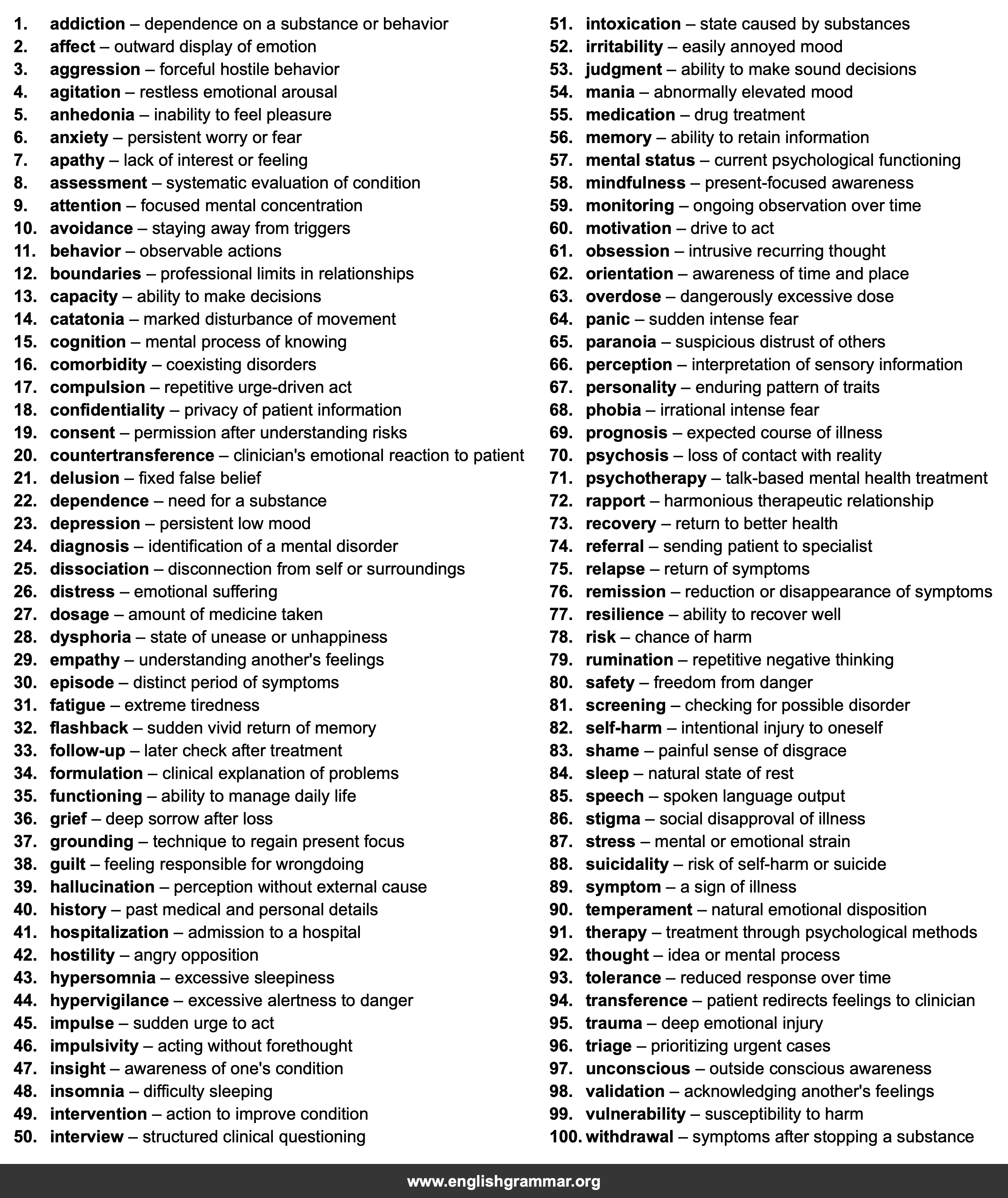
| No. | Item | Definition |
|---|---|---|
| 1. | addiction | dependence on a substance or behavior |
| 2. | affect | outward display of emotion |
| 3. | aggression | forceful hostile behavior |
| 4. | agitation | restless emotional arousal |
| 5. | anhedonia | inability to feel pleasure |
| 6. | anxiety | persistent worry or fear |
| 7. | apathy | lack of interest or feeling |
| 8. | assessment | systematic evaluation of condition |
| 9. | attention | focused mental concentration |
| 10. | avoidance | staying away from triggers |
| 11. | behavior | observable actions |
| 12. | boundaries | professional limits in relationships |
| 13. | capacity | ability to make decisions |
| 14. | catatonia | marked disturbance of movement |
| 15. | cognition | mental process of knowing |
| 16. | comorbidity | coexisting disorders |
| 17. | compulsion | repetitive urge-driven act |
| 18. | confidentiality | privacy of patient information |
| 19. | consent | permission after understanding risks |
| 20. | countertransference | clinician’s emotional reaction to patient |
| 21. | delusion | fixed false belief |
| 22. | dependence | need for a substance |
| 23. | depression | persistent low mood |
| 24. | diagnosis | identification of a mental disorder |
| 25. | dissociation | disconnection from self or surroundings |
| 26. | distress | emotional suffering |
| 27. | dosage | amount of medicine taken |
| 28. | dysphoria | state of unease or unhappiness |
| 29. | empathy | understanding another’s feelings |
| 30. | episode | distinct period of symptoms |
| 31. | fatigue | extreme tiredness |
| 32. | flashback | sudden vivid return of memory |
| 33. | follow-up | later check after treatment |
| 34. | formulation | clinical explanation of problems |
| 35. | functioning | ability to manage daily life |
| 36. | grief | deep sorrow after loss |
| 37. | grounding | technique to regain present focus |
| 38. | guilt | feeling responsible for wrongdoing |
| 39. | hallucination | perception without external cause |
| 40. | history | past medical and personal details |
| 41. | hospitalization | admission to a hospital |
| 42. | hostility | angry opposition |
| 43. | hypersomnia | excessive sleepiness |
| 44. | hypervigilance | excessive alertness to danger |
| 45. | impulse | sudden urge to act |
| 46. | impulsivity | acting without forethought |
| 47. | insight | awareness of one’s condition |
| 48. | insomnia | difficulty sleeping |
| 49. | intervention | action to improve condition |
| 50. | interview | structured clinical questioning |
| 51. | intoxication | state caused by substances |
| 52. | irritability | easily annoyed mood |
| 53. | judgment | ability to make sound decisions |
| 54. | mania | abnormally elevated mood |
| 55. | medication | drug treatment |
| 56. | memory | ability to retain information |
| 57. | mental status | current psychological functioning |
| 58. | mindfulness | present-focused awareness |
| 59. | monitoring | ongoing observation over time |
| 60. | motivation | drive to act |
| 61. | obsession | intrusive recurring thought |
| 62. | orientation | awareness of time and place |
| 63. | overdose | dangerously excessive dose |
| 64. | panic | sudden intense fear |
| 65. | paranoia | suspicious distrust of others |
| 66. | perception | interpretation of sensory information |
| 67. | personality | enduring pattern of traits |
| 68. | phobia | irrational intense fear |
| 69. | prognosis | expected course of illness |
| 70. | psychosis | loss of contact with reality |
| 71. | psychotherapy | talk-based mental health treatment |
| 72. | rapport | harmonious therapeutic relationship |
| 73. | recovery | return to better health |
| 74. | referral | sending patient to specialist |
| 75. | relapse | return of symptoms |
| 76. | remission | reduction or disappearance of symptoms |
| 77. | resilience | ability to recover well |
| 78. | risk | chance of harm |
| 79. | rumination | repetitive negative thinking |
| 80. | safety | freedom from danger |
| 81. | screening | checking for possible disorder |
| 82. | self-harm | intentional injury to oneself |
| 83. | shame | painful sense of disgrace |
| 84. | sleep | natural state of rest |
| 85. | speech | spoken language output |
| 86. | stigma | social disapproval of illness |
| 87. | stress | mental or emotional strain |
| 88. | suicidality | risk of self-harm or suicide |
| 89. | symptom | a sign of illness |
| 90. | temperament | natural emotional disposition |
| 91. | therapy | treatment through psychological methods |
| 92. | thought | idea or mental process |
| 93. | tolerance | reduced response over time |
| 94. | transference | patient redirects feelings to clinician |
| 95. | trauma | deep emotional injury |
| 96. | triage | prioritizing urgent cases |
| 97. | unconscious | outside conscious awareness |
| 98. | validation | acknowledging another’s feelings |
| 99. | vulnerability | susceptibility to harm |
| 100. | withdrawal | symptoms after stopping a substance |