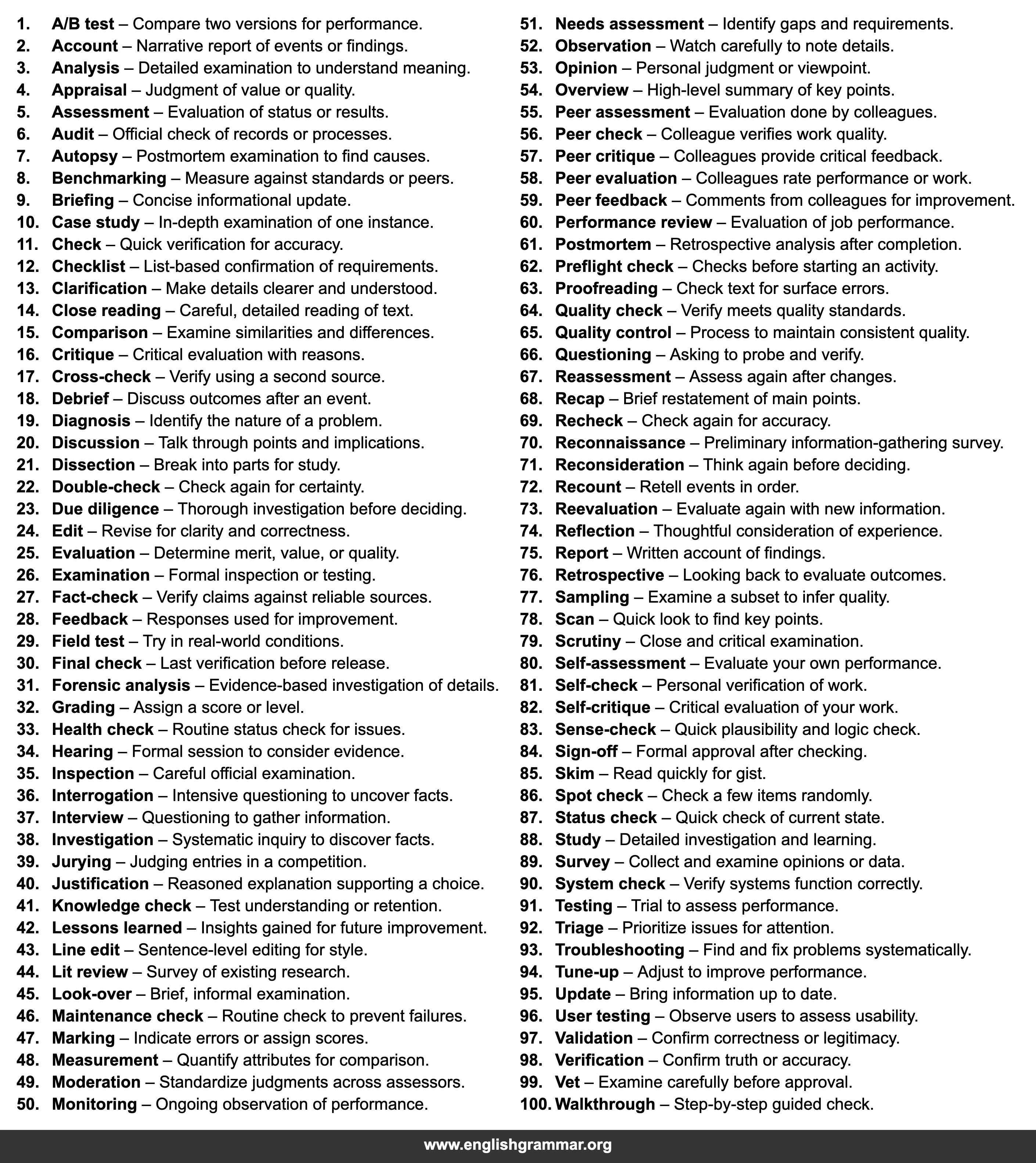
| No. | Term | Definition |
|---|---|---|
| 1. | A/B test | Compare two versions for performance. |
| 2. | Account | Narrative report of events or findings. |
| 3. | Analysis | Detailed examination to understand meaning. |
| 4. | Appraisal | Judgment of value or quality. |
| 5. | Assessment | Evaluation of status or results. |
| 6. | Audit | Official check of records or processes. |
| 7. | Autopsy | Postmortem examination to find causes. |
| 8. | Benchmarking | Measure against standards or peers. |
| 9. | Briefing | Concise informational update. |
| 10. | Case study | In-depth examination of one instance. |
| 11. | Check | Quick verification for accuracy. |
| 12. | Checklist | List-based confirmation of requirements. |
| 13. | Clarification | Make details clearer and understood. |
| 14. | Close reading | Careful, detailed reading of text. |
| 15. | Comparison | Examine similarities and differences. |
| 16. | Critique | Critical evaluation with reasons. |
| 17. | Cross-check | Verify using a second source. |
| 18. | Debrief | Discuss outcomes after an event. |
| 19. | Diagnosis | Identify the nature of a problem. |
| 20. | Discussion | Talk through points and implications. |
| 21. | Dissection | Break into parts for study. |
| 22. | Double-check | Check again for certainty. |
| 23. | Due diligence | Thorough investigation before deciding. |
| 24. | Edit | Revise for clarity and correctness. |
| 25. | Evaluation | Determine merit, value, or quality. |
| 26. | Examination | Formal inspection or testing. |
| 27. | Fact-check | Verify claims against reliable sources. |
| 28. | Feedback | Responses used for improvement. |
| 29. | Field test | Try in real-world conditions. |
| 30. | Final check | Last verification before release. |
| 31. | Forensic analysis | Evidence-based investigation of details. |
| 32. | Grading | Assign a score or level. |
| 33. | Health check | Routine status check for issues. |
| 34. | Hearing | Formal session to consider evidence. |
| 35. | Inspection | Careful official examination. |
| 36. | Interrogation | Intensive questioning to uncover facts. |
| 37. | Interview | Questioning to gather information. |
| 38. | Investigation | Systematic inquiry to discover facts. |
| 39. | Jurying | Judging entries in a competition. |
| 40. | Justification | Reasoned explanation supporting a choice. |
| 41. | Knowledge check | Test understanding or retention. |
| 42. | Lessons learned | Insights gained for future improvement. |
| 43. | Line edit | Sentence-level editing for style. |
| 44. | Lit review | Survey of existing research. |
| 45. | Look-over | Brief, informal examination. |
| 46. | Maintenance check | Routine check to prevent failures. |
| 47. | Marking | Indicate errors or assign scores. |
| 48. | Measurement | Quantify attributes for comparison. |
| 49. | Moderation | Standardize judgments across assessors. |
| 50. | Monitoring | Ongoing observation of performance. |
| 51. | Needs assessment | Identify gaps and requirements. |
| 52. | Observation | Watch carefully to note details. |
| 53. | Opinion | Personal judgment or viewpoint. |
| 54. | Overview | High-level summary of key points. |
| 55. | Peer assessment | Evaluation done by colleagues. |
| 56. | Peer check | Colleague verifies work quality. |
| 57. | Peer critique | Colleagues provide critical feedback. |
| 58. | Peer evaluation | Colleagues rate performance or work. |
| 59. | Peer feedback | Comments from colleagues for improvement. |
| 60. | Performance review | Evaluation of job performance. |
| 61. | Postmortem | Retrospective analysis after completion. |
| 62. | Preflight check | Checks before starting an activity. |
| 63. | Proofreading | Check text for surface errors. |
| 64. | Quality check | Verify meets quality standards. |
| 65. | Quality control | Process to maintain consistent quality. |
| 66. | Questioning | Asking to probe and verify. |
| 67. | Reassessment | Assess again after changes. |
| 68. | Recap | Brief restatement of main points. |
| 69. | Recheck | Check again for accuracy. |
| 70. | Reconnaissance | Preliminary information-gathering survey. |
| 71. | Reconsideration | Think again before deciding. |
| 72. | Recount | Retell events in order. |
| 73. | Reevaluation | Evaluate again with new information. |
| 74. | Reflection | Thoughtful consideration of experience. |
| 75. | Report | Written account of findings. |
| 76. | Retrospective | Looking back to evaluate outcomes. |
| 77. | Sampling | Examine a subset to infer quality. |
| 78. | Scan | Quick look to find key points. |
| 79. | Scrutiny | Close and critical examination. |
| 80. | Self-assessment | Evaluate your own performance. |
| 81. | Self-check | Personal verification of work. |
| 82. | Self-critique | Critical evaluation of your work. |
| 83. | Sense-check | Quick plausibility and logic check. |
| 84. | Sign-off | Formal approval after checking. |
| 85. | Skim | Read quickly for gist. |
| 86. | Spot check | Check a few items randomly. |
| 87. | Status check | Quick check of current state. |
| 88. | Study | Detailed investigation and learning. |
| 89. | Survey | Collect and examine opinions or data. |
| 90. | System check | Verify systems function correctly. |
| 91. | Testing | Trial to assess performance. |
| 92. | Triage | Prioritize issues for attention. |
| 93. | Troubleshooting | Find and fix problems systematically. |
| 94. | Tune-up | Adjust to improve performance. |
| 95. | Update | Bring information up to date. |
| 96. | User testing | Observe users to assess usability. |
| 97. | Validation | Confirm correctness or legitimacy. |
| 98. | Verification | Confirm truth or accuracy. |
| 99. | Vet | Examine carefully before approval. |
| 100. | Walkthrough | Step-by-step guided check. |
