
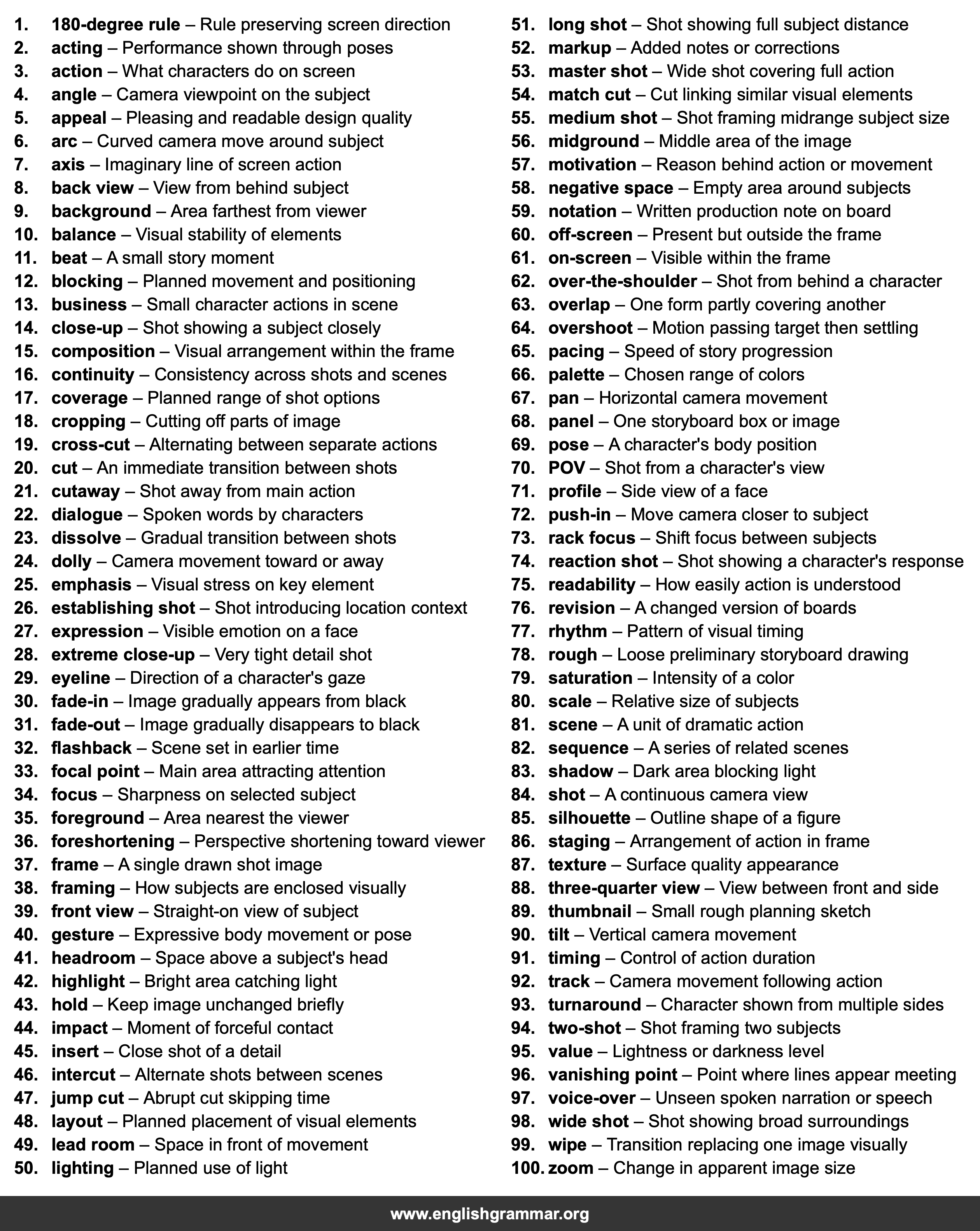
| No. | Item | Definition |
|---|---|---|
| 1. | 180-degree rule | Rule preserving screen direction |
| 2. | acting | Performance shown through poses |
| 3. | action | What characters do on screen |
| 4. | angle | Camera viewpoint on the subject |
| 5. | appeal | Pleasing and readable design quality |
| 6. | arc | Curved camera move around subject |
| 7. | axis | Imaginary line of screen action |
| 8. | back view | View from behind subject |
| 9. | background | Area farthest from viewer |
| 10. | balance | Visual stability of elements |
| 11. | beat | A small story moment |
| 12. | blocking | Planned movement and positioning |
| 13. | business | Small character actions in scene |
| 14. | close-up | Shot showing a subject closely |
| 15. | composition | Visual arrangement within the frame |
| 16. | continuity | Consistency across shots and scenes |
| 17. | coverage | Planned range of shot options |
| 18. | cropping | Cutting off parts of image |
| 19. | cross-cut | Alternating between separate actions |
| 20. | cut | An immediate transition between shots |
| 21. | cutaway | Shot away from main action |
| 22. | dialogue | Spoken words by characters |
| 23. | dissolve | Gradual transition between shots |
| 24. | dolly | Camera movement toward or away |
| 25. | emphasis | Visual stress on key element |
| 26. | establishing shot | Shot introducing location context |
| 27. | expression | Visible emotion on a face |
| 28. | extreme close-up | Very tight detail shot |
| 29. | eyeline | Direction of a character’s gaze |
| 30. | fade-in | Image gradually appears from black |
| 31. | fade-out | Image gradually disappears to black |
| 32. | flashback | Scene set in earlier time |
| 33. | focal point | Main area attracting attention |
| 34. | focus | Sharpness on selected subject |
| 35. | foreground | Area nearest the viewer |
| 36. | foreshortening | Perspective shortening toward viewer |
| 37. | frame | A single drawn shot image |
| 38. | framing | How subjects are enclosed visually |
| 39. | front view | Straight-on view of subject |
| 40. | gesture | Expressive body movement or pose |
| 41. | headroom | Space above a subject’s head |
| 42. | highlight | Bright area catching light |
| 43. | hold | Keep image unchanged briefly |
| 44. | impact | Moment of forceful contact |
| 45. | insert | Close shot of a detail |
| 46. | intercut | Alternate shots between scenes |
| 47. | jump cut | Abrupt cut skipping time |
| 48. | layout | Planned placement of visual elements |
| 49. | lead room | Space in front of movement |
| 50. | lighting | Planned use of light |
| 51. | long shot | Shot showing full subject distance |
| 52. | markup | Added notes or corrections |
| 53. | master shot | Wide shot covering full action |
| 54. | match cut | Cut linking similar visual elements |
| 55. | medium shot | Shot framing midrange subject size |
| 56. | midground | Middle area of the image |
| 57. | motivation | Reason behind action or movement |
| 58. | negative space | Empty area around subjects |
| 59. | notation | Written production note on board |
| 60. | off-screen | Present but outside the frame |
| 61. | on-screen | Visible within the frame |
| 62. | over-the-shoulder | Shot from behind a character |
| 63. | overlap | One form partly covering another |
| 64. | overshoot | Motion passing target then settling |
| 65. | pacing | Speed of story progression |
| 66. | palette | Chosen range of colors |
| 67. | pan | Horizontal camera movement |
| 68. | panel | One storyboard box or image |
| 69. | pose | A character’s body position |
| 70. | POV | Shot from a character’s view |
| 71. | profile | Side view of a face |
| 72. | push-in | Move camera closer to subject |
| 73. | rack focus | Shift focus between subjects |
| 74. | reaction shot | Shot showing a character’s response |
| 75. | readability | How easily action is understood |
| 76. | revision | A changed version of boards |
| 77. | rhythm | Pattern of visual timing |
| 78. | rough | Loose preliminary storyboard drawing |
| 79. | saturation | Intensity of a color |
| 80. | scale | Relative size of subjects |
| 81. | scene | A unit of dramatic action |
| 82. | sequence | A series of related scenes |
| 83. | shadow | Dark area blocking light |
| 84. | shot | A continuous camera view |
| 85. | silhouette | Outline shape of a figure |
| 86. | staging | Arrangement of action in frame |
| 87. | texture | Surface quality appearance |
| 88. | three-quarter view | View between front and side |
| 89. | thumbnail | Small rough planning sketch |
| 90. | tilt | Vertical camera movement |
| 91. | timing | Control of action duration |
| 92. | track | Camera movement following action |
| 93. | turnaround | Character shown from multiple sides |
| 94. | two-shot | Shot framing two subjects |
| 95. | value | Lightness or darkness level |
| 96. | vanishing point | Point where lines appear meeting |
| 97. | voice-over | Unseen spoken narration or speech |
| 98. | wide shot | Shot showing broad surroundings |
| 99. | wipe | Transition replacing one image visually |
| 100. | zoom | Change in apparent image size |