
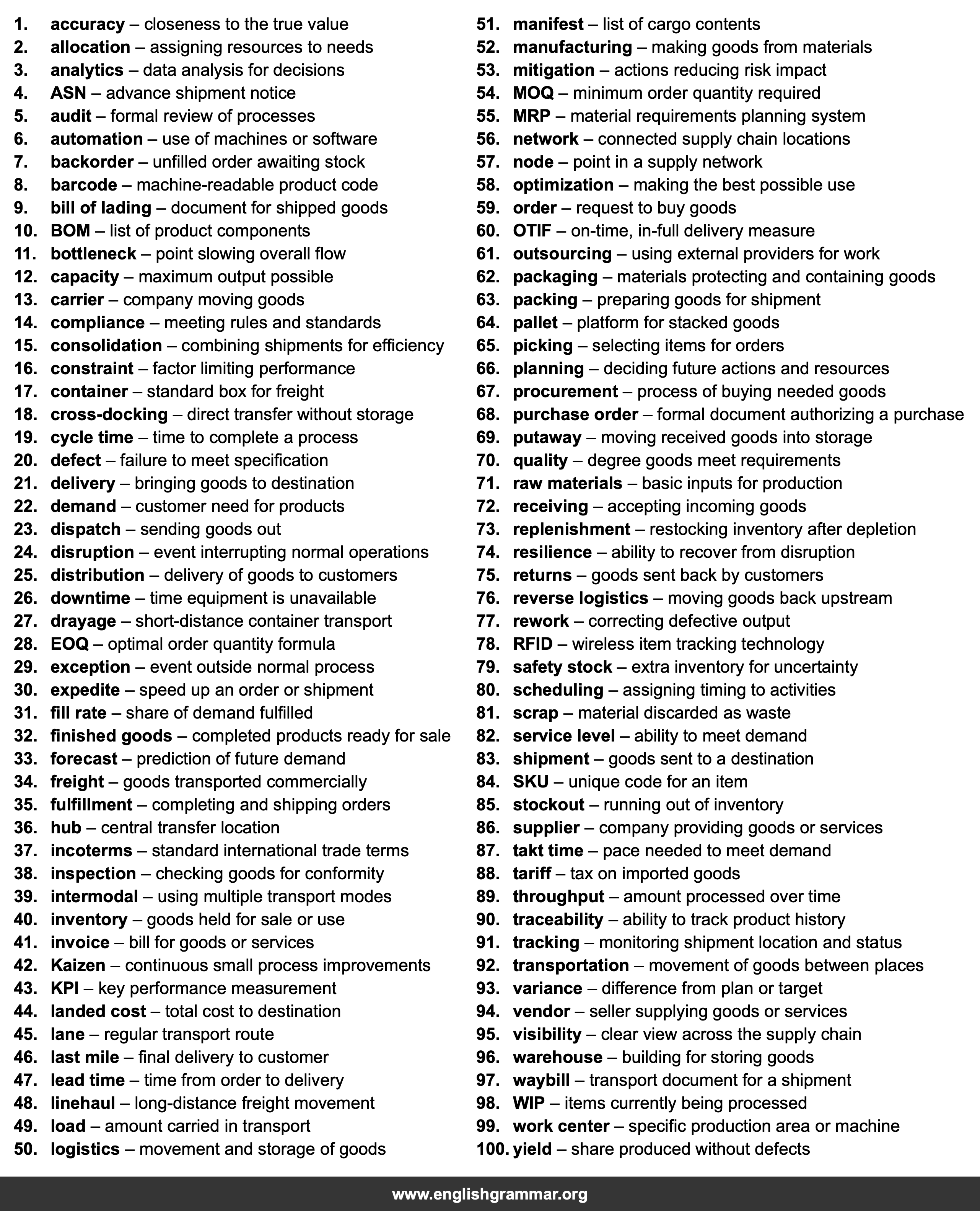
| No. | Item | Definition |
|---|---|---|
| 1. | accuracy | closeness to the true value |
| 2. | allocation | assigning resources to needs |
| 3. | analytics | data analysis for decisions |
| 4. | ASN | advance shipment notice |
| 5. | audit | formal review of processes |
| 6. | automation | use of machines or software |
| 7. | backorder | unfilled order awaiting stock |
| 8. | barcode | machine-readable product code |
| 9. | bill of lading | document for shipped goods |
| 10. | BOM | list of product components |
| 11. | bottleneck | point slowing overall flow |
| 12. | capacity | maximum output possible |
| 13. | carrier | company moving goods |
| 14. | compliance | meeting rules and standards |
| 15. | consolidation | combining shipments for efficiency |
| 16. | constraint | factor limiting performance |
| 17. | container | standard box for freight |
| 18. | cross-docking | direct transfer without storage |
| 19. | cycle time | time to complete a process |
| 20. | defect | failure to meet specification |
| 21. | delivery | bringing goods to destination |
| 22. | demand | customer need for products |
| 23. | dispatch | sending goods out |
| 24. | disruption | event interrupting normal operations |
| 25. | distribution | delivery of goods to customers |
| 26. | downtime | time equipment is unavailable |
| 27. | drayage | short-distance container transport |
| 28. | EOQ | optimal order quantity formula |
| 29. | exception | event outside normal process |
| 30. | expedite | speed up an order or shipment |
| 31. | fill rate | share of demand fulfilled |
| 32. | finished goods | completed products ready for sale |
| 33. | forecast | prediction of future demand |
| 34. | freight | goods transported commercially |
| 35. | fulfillment | completing and shipping orders |
| 36. | hub | central transfer location |
| 37. | incoterms | standard international trade terms |
| 38. | inspection | checking goods for conformity |
| 39. | intermodal | using multiple transport modes |
| 40. | inventory | goods held for sale or use |
| 41. | invoice | bill for goods or services |
| 42. | Kaizen | continuous small process improvements |
| 43. | KPI | key performance measurement |
| 44. | landed cost | total cost to destination |
| 45. | lane | regular transport route |
| 46. | last mile | final delivery to customer |
| 47. | lead time | time from order to delivery |
| 48. | linehaul | long-distance freight movement |
| 49. | load | amount carried in transport |
| 50. | logistics | movement and storage of goods |
| 51. | manifest | list of cargo contents |
| 52. | manufacturing | making goods from materials |
| 53. | mitigation | actions reducing risk impact |
| 54. | MOQ | minimum order quantity required |
| 55. | MRP | material requirements planning system |
| 56. | network | connected supply chain locations |
| 57. | node | point in a supply network |
| 58. | optimization | making the best possible use |
| 59. | order | request to buy goods |
| 60. | OTIF | on-time, in-full delivery measure |
| 61. | outsourcing | using external providers for work |
| 62. | packaging | materials protecting and containing goods |
| 63. | packing | preparing goods for shipment |
| 64. | pallet | platform for stacked goods |
| 65. | picking | selecting items for orders |
| 66. | planning | deciding future actions and resources |
| 67. | procurement | process of buying needed goods |
| 68. | purchase order | formal document authorizing a purchase |
| 69. | putaway | moving received goods into storage |
| 70. | quality | degree goods meet requirements |
| 71. | raw materials | basic inputs for production |
| 72. | receiving | accepting incoming goods |
| 73. | replenishment | restocking inventory after depletion |
| 74. | resilience | ability to recover from disruption |
| 75. | returns | goods sent back by customers |
| 76. | reverse logistics | moving goods back upstream |
| 77. | rework | correcting defective output |
| 78. | RFID | wireless item tracking technology |
| 79. | safety stock | extra inventory for uncertainty |
| 80. | scheduling | assigning timing to activities |
| 81. | scrap | material discarded as waste |
| 82. | service level | ability to meet demand |
| 83. | shipment | goods sent to a destination |
| 84. | SKU | unique code for an item |
| 85. | stockout | running out of inventory |
| 86. | supplier | company providing goods or services |
| 87. | takt time | pace needed to meet demand |
| 88. | tariff | tax on imported goods |
| 89. | throughput | amount processed over time |
| 90. | traceability | ability to track product history |
| 91. | tracking | monitoring shipment location and status |
| 92. | transportation | movement of goods between places |
| 93. | variance | difference from plan or target |
| 94. | vendor | seller supplying goods or services |
| 95. | visibility | clear view across the supply chain |
| 96. | warehouse | building for storing goods |
| 97. | waybill | transport document for a shipment |
| 98. | WIP | items currently being processed |
| 99. | work center | specific production area or machine |
| 100. | yield | share produced without defects |