
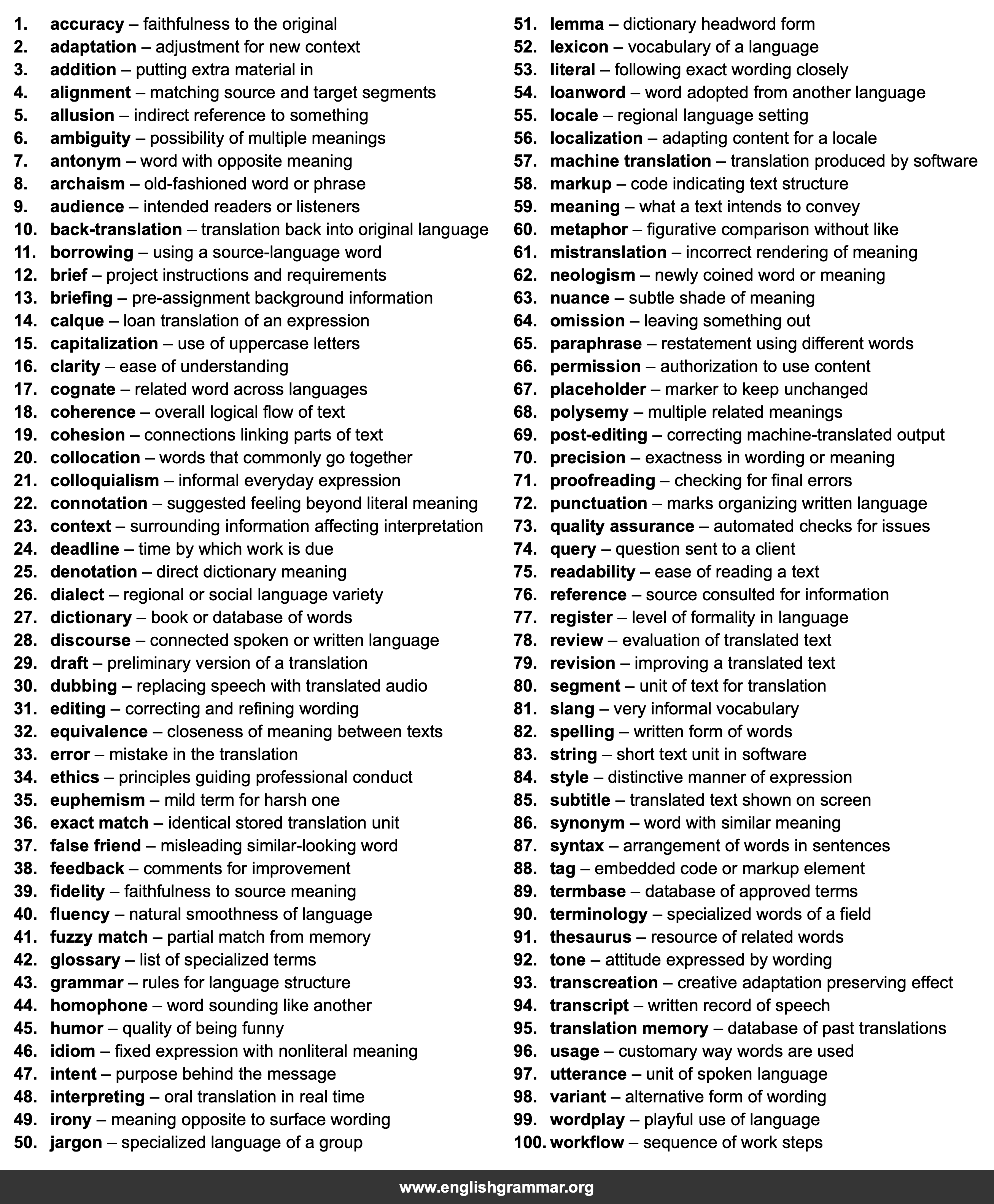
| No. | Item | Definition |
|---|---|---|
| 1. | accuracy | faithfulness to the original |
| 2. | adaptation | adjustment for new context |
| 3. | addition | putting extra material in |
| 4. | alignment | matching source and target segments |
| 5. | allusion | indirect reference to something |
| 6. | ambiguity | possibility of multiple meanings |
| 7. | antonym | word with opposite meaning |
| 8. | archaism | old-fashioned word or phrase |
| 9. | audience | intended readers or listeners |
| 10. | back-translation | translation back into original language |
| 11. | borrowing | using a source-language word |
| 12. | brief | project instructions and requirements |
| 13. | briefing | pre-assignment background information |
| 14. | calque | loan translation of an expression |
| 15. | capitalization | use of uppercase letters |
| 16. | clarity | ease of understanding |
| 17. | cognate | related word across languages |
| 18. | coherence | overall logical flow of text |
| 19. | cohesion | connections linking parts of text |
| 20. | collocation | words that commonly go together |
| 21. | colloquialism | informal everyday expression |
| 22. | connotation | suggested feeling beyond literal meaning |
| 23. | context | surrounding information affecting interpretation |
| 24. | deadline | time by which work is due |
| 25. | denotation | direct dictionary meaning |
| 26. | dialect | regional or social language variety |
| 27. | dictionary | book or database of words |
| 28. | discourse | connected spoken or written language |
| 29. | draft | preliminary version of a translation |
| 30. | dubbing | replacing speech with translated audio |
| 31. | editing | correcting and refining wording |
| 32. | equivalence | closeness of meaning between texts |
| 33. | error | mistake in the translation |
| 34. | ethics | principles guiding professional conduct |
| 35. | euphemism | mild term for harsh one |
| 36. | exact match | identical stored translation unit |
| 37. | false friend | misleading similar-looking word |
| 38. | feedback | comments for improvement |
| 39. | fidelity | faithfulness to source meaning |
| 40. | fluency | natural smoothness of language |
| 41. | fuzzy match | partial match from memory |
| 42. | glossary | list of specialized terms |
| 43. | grammar | rules for language structure |
| 44. | homophone | word sounding like another |
| 45. | humor | quality of being funny |
| 46. | idiom | fixed expression with nonliteral meaning |
| 47. | intent | purpose behind the message |
| 48. | interpreting | oral translation in real time |
| 49. | irony | meaning opposite to surface wording |
| 50. | jargon | specialized language of a group |
| 51. | lemma | dictionary headword form |
| 52. | lexicon | vocabulary of a language |
| 53. | literal | following exact wording closely |
| 54. | loanword | word adopted from another language |
| 55. | locale | regional language setting |
| 56. | localization | adapting content for a locale |
| 57. | machine translation | translation produced by software |
| 58. | markup | code indicating text structure |
| 59. | meaning | what a text intends to convey |
| 60. | metaphor | figurative comparison without like |
| 61. | mistranslation | incorrect rendering of meaning |
| 62. | neologism | newly coined word or meaning |
| 63. | nuance | subtle shade of meaning |
| 64. | omission | leaving something out |
| 65. | paraphrase | restatement using different words |
| 66. | permission | authorization to use content |
| 67. | placeholder | marker to keep unchanged |
| 68. | polysemy | multiple related meanings |
| 69. | post-editing | correcting machine-translated output |
| 70. | precision | exactness in wording or meaning |
| 71. | proofreading | checking for final errors |
| 72. | punctuation | marks organizing written language |
| 73. | quality assurance | automated checks for issues |
| 74. | query | question sent to a client |
| 75. | readability | ease of reading a text |
| 76. | reference | source consulted for information |
| 77. | register | level of formality in language |
| 78. | review | evaluation of translated text |
| 79. | revision | improving a translated text |
| 80. | segment | unit of text for translation |
| 81. | slang | very informal vocabulary |
| 82. | spelling | written form of words |
| 83. | string | short text unit in software |
| 84. | style | distinctive manner of expression |
| 85. | subtitle | translated text shown on screen |
| 86. | synonym | word with similar meaning |
| 87. | syntax | arrangement of words in sentences |
| 88. | tag | embedded code or markup element |
| 89. | termbase | database of approved terms |
| 90. | terminology | specialized words of a field |
| 91. | thesaurus | resource of related words |
| 92. | tone | attitude expressed by wording |
| 93. | transcreation | creative adaptation preserving effect |
| 94. | transcript | written record of speech |
| 95. | translation memory | database of past translations |
| 96. | usage | customary way words are used |
| 97. | utterance | unit of spoken language |
| 98. | variant | alternative form of wording |
| 99. | wordplay | playful use of language |
| 100. | workflow | sequence of work steps |