
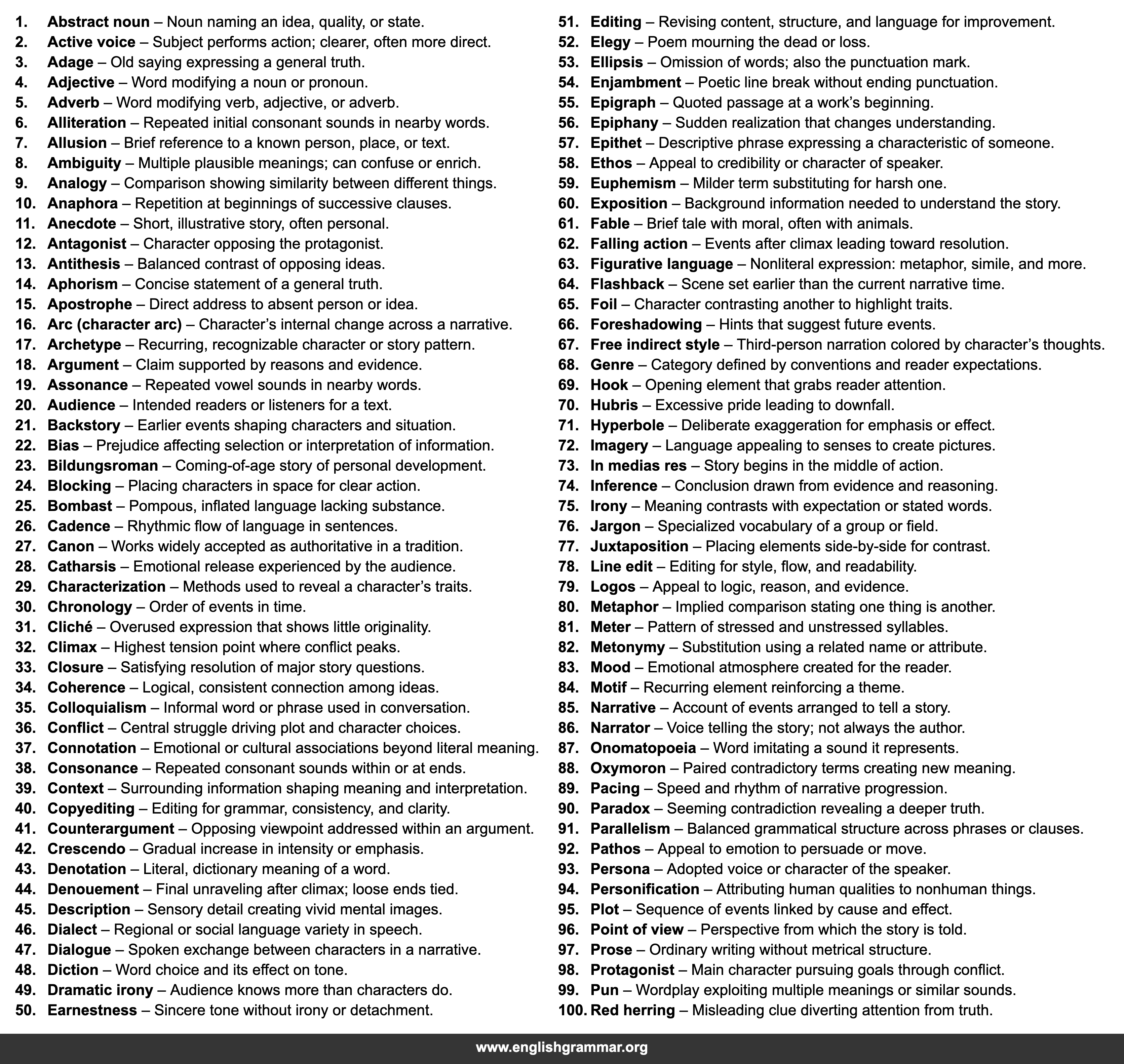
| No. | Term | Definition |
|---|---|---|
| 1. | Abstract noun | Noun naming an idea, quality, or state. |
| 2. | Active voice | Subject performs action; clearer, often more direct. |
| 3. | Adage | Old saying expressing a general truth. |
| 4. | Adjective | Word modifying a noun or pronoun. |
| 5. | Adverb | Word modifying verb, adjective, or adverb. |
| 6. | Alliteration | Repeated initial consonant sounds in nearby words. |
| 7. | Allusion | Brief reference to a known person, place, or text. |
| 8. | Ambiguity | Multiple plausible meanings; can confuse or enrich. |
| 9. | Analogy | Comparison showing similarity between different things. |
| 10. | Anaphora | Repetition at beginnings of successive clauses. |
| 11. | Anecdote | Short, illustrative story, often personal. |
| 12. | Antagonist | Character opposing the protagonist. |
| 13. | Antithesis | Balanced contrast of opposing ideas. |
| 14. | Aphorism | Concise statement of a general truth. |
| 15. | Apostrophe | Direct address to absent person or idea. |
| 16. | Arc (character arc) | Character’s internal change across a narrative. |
| 17. | Archetype | Recurring, recognizable character or story pattern. |
| 18. | Argument | Claim supported by reasons and evidence. |
| 19. | Assonance | Repeated vowel sounds in nearby words. |
| 20. | Audience | Intended readers or listeners for a text. |
| 21. | Backstory | Earlier events shaping characters and situation. |
| 22. | Bias | Prejudice affecting selection or interpretation of information. |
| 23. | Bildungsroman | Coming-of-age story of personal development. |
| 24. | Blocking | Placing characters in space for clear action. |
| 25. | Bombast | Pompous, inflated language lacking substance. |
| 26. | Cadence | Rhythmic flow of language in sentences. |
| 27. | Canon | Works widely accepted as authoritative in a tradition. |
| 28. | Catharsis | Emotional release experienced by the audience. |
| 29. | Characterization | Methods used to reveal a character’s traits. |
| 30. | Chronology | Order of events in time. |
| 31. | Cliché | Overused expression that shows little originality. |
| 32. | Climax | Highest tension point where conflict peaks. |
| 33. | Closure | Satisfying resolution of major story questions. |
| 34. | Coherence | Logical, consistent connection among ideas. |
| 35. | Colloquialism | Informal word or phrase used in conversation. |
| 36. | Conflict | Central struggle driving plot and character choices. |
| 37. | Connotation | Emotional or cultural associations beyond literal meaning. |
| 38. | Consonance | Repeated consonant sounds within or at ends. |
| 39. | Context | Surrounding information shaping meaning and interpretation. |
| 40. | Copyediting | Editing for grammar, consistency, and clarity. |
| 41. | Counterargument | Opposing viewpoint addressed within an argument. |
| 42. | Crescendo | Gradual increase in intensity or emphasis. |
| 43. | Denotation | Literal, dictionary meaning of a word. |
| 44. | Denouement | Final unraveling after climax; loose ends tied. |
| 45. | Description | Sensory detail creating vivid mental images. |
| 46. | Dialect | Regional or social language variety in speech. |
| 47. | Dialogue | Spoken exchange between characters in a narrative. |
| 48. | Diction | Word choice and its effect on tone. |
| 49. | Dramatic irony | Audience knows more than characters do. |
| 50. | Earnestness | Sincere tone without irony or detachment. |
| 51. | Editing | Revising content, structure, and language for improvement. |
| 52. | Elegy | Poem mourning the dead or loss. |
| 53. | Ellipsis | Omission of words; also the punctuation mark. |
| 54. | Enjambment | Poetic line break without ending punctuation. |
| 55. | Epigraph | Quoted passage at a work’s beginning. |
| 56. | Epiphany | Sudden realization that changes understanding. |
| 57. | Epithet | Descriptive phrase expressing a characteristic of someone. |
| 58. | Ethos | Appeal to credibility or character of speaker. |
| 59. | Euphemism | Milder term substituting for harsh one. |
| 60. | Exposition | Background information needed to understand the story. |
| 61. | Fable | Brief tale with moral, often with animals. |
| 62. | Falling action | Events after climax leading toward resolution. |
| 63. | Figurative language | Nonliteral expression: metaphor, simile, and more. |
| 64. | Flashback | Scene set earlier than the current narrative time. |
| 65. | Foil | Character contrasting another to highlight traits. |
| 66. | Foreshadowing | Hints that suggest future events. |
| 67. | Free indirect style | Third-person narration colored by character’s thoughts. |
| 68. | Genre | Category defined by conventions and reader expectations. |
| 69. | Hook | Opening element that grabs reader attention. |
| 70. | Hubris | Excessive pride leading to downfall. |
| 71. | Hyperbole | Deliberate exaggeration for emphasis or effect. |
| 72. | Imagery | Language appealing to senses to create pictures. |
| 73. | In medias res | Story begins in the middle of action. |
| 74. | Inference | Conclusion drawn from evidence and reasoning. |
| 75. | Irony | Meaning contrasts with expectation or stated words. |
| 76. | Jargon | Specialized vocabulary of a group or field. |
| 77. | Juxtaposition | Placing elements side-by-side for contrast. |
| 78. | Line edit | Editing for style, flow, and readability. |
| 79. | Logos | Appeal to logic, reason, and evidence. |
| 80. | Metaphor | Implied comparison stating one thing is another. |
| 81. | Meter | Pattern of stressed and unstressed syllables. |
| 82. | Metonymy | Substitution using a related name or attribute. |
| 83. | Mood | Emotional atmosphere created for the reader. |
| 84. | Motif | Recurring element reinforcing a theme. |
| 85. | Narrative | Account of events arranged to tell a story. |
| 86. | Narrator | Voice telling the story; not always the author. |
| 87. | Onomatopoeia | Word imitating a sound it represents. |
| 88. | Oxymoron | Paired contradictory terms creating new meaning. |
| 89. | Pacing | Speed and rhythm of narrative progression. |
| 90. | Paradox | Seeming contradiction revealing a deeper truth. |
| 91. | Parallelism | Balanced grammatical structure across phrases or clauses. |
| 92. | Pathos | Appeal to emotion to persuade or move. |
| 93. | Persona | Adopted voice or character of the speaker. |
| 94. | Personification | Attributing human qualities to nonhuman things. |
| 95. | Plot | Sequence of events linked by cause and effect. |
| 96. | Point of view | Perspective from which the story is told. |
| 97. | Prose | Ordinary writing without metrical structure. |
| 98. | Protagonist | Main character pursuing goals through conflict. |
| 99. | Pun | Wordplay exploiting multiple meanings or similar sounds. |
| 100. | Red herring | Misleading clue diverting attention from truth. |
