Home of English Grammar

Grammar Guide
  • Home
  • Exercises
  • Matches
  • Rules
  • Tools
    • Grammar Checker
    • Very Replacer
    • Word Counter
  • Top Social Media Posts
  • Various Posts
  • Vocabulary
  • Writing Guides
  • Contact

Where “all at sea” comes from, and how it changed meaning

May 14, 2026 - pdf

The origin of "all at sea"

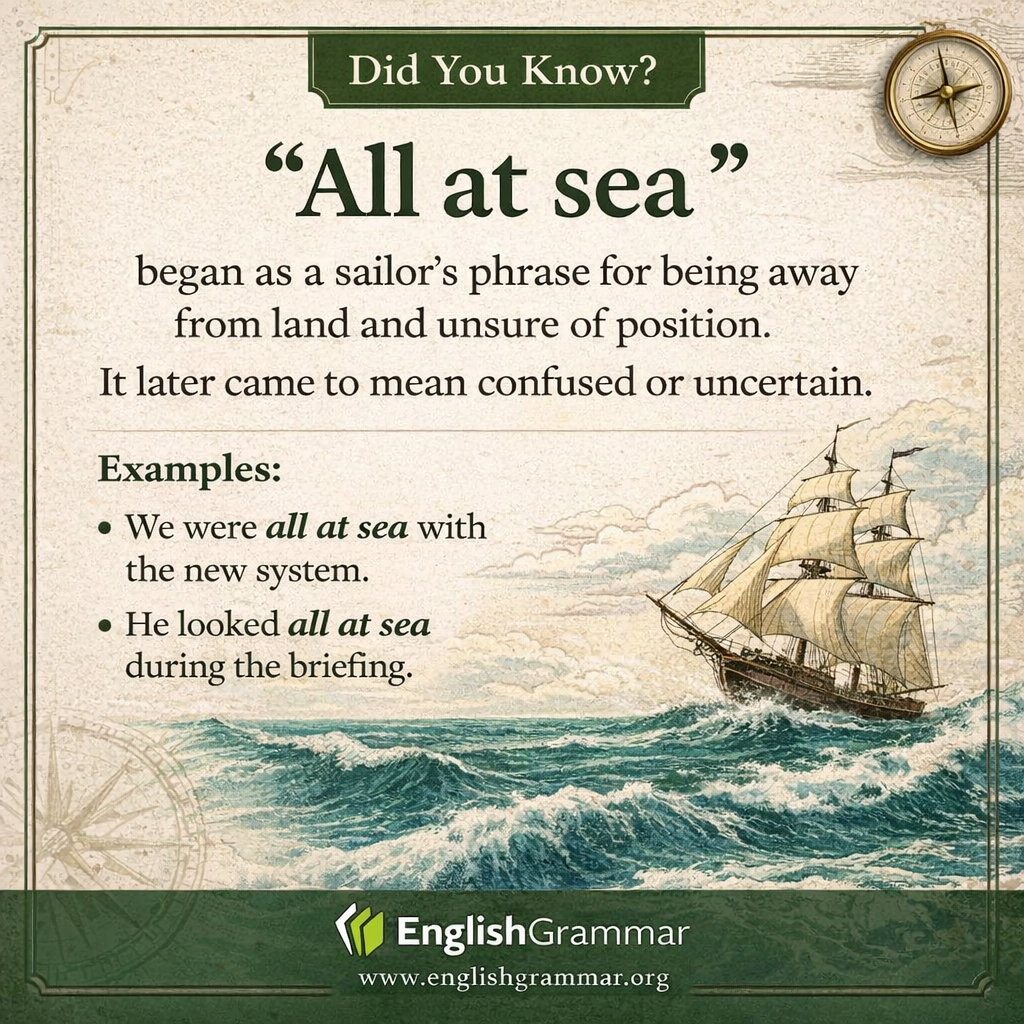
All at sea began as a literal seafaring expression. If a ship was out on open water and far from land, sailors could be uncertain of their exact position. In that setting, being all at sea suggested real disorientation.

Over time, the phrase moved into figurative English. Now it usually means confused, unsure, or not knowing what to do. The sea image still matters, because it suggests a lack of direction rather than simple ignorance.

  • Literal background: sailors far from shore could feel uncertain about where they were.
  • Modern meaning: someone feels mentally lost or unclear about a situation.
  • Example: “I was all at sea when they explained the new software.”

This helps explain why the idiom often appears in situations involving new instructions, unfamiliar systems, or sudden change. You might say a student is all at sea in the first week of a difficult class, or that a manager seemed all at sea during a fast moving meeting. In each case, the idea is not just confusion, but confusion without a clear point of reference.

  • Share
  • Post
  • Post
  • Email
NEW: Try Matches, our daily vocabulary challenge. Pick a topic and level and match words with definitions to boost your vocabulary.
2,485,429 
761,532 
Improve Your Grammar
  • Download 2026 Grammar Guide (PDF)
  • Free Weekly Exercises & Vocabulary
  • Join over 3 Million English Learners
We respect your privacy. Unsubscribe anytime.

Grammar Checker

GrammarCheck.net - Try online
Hint → Bookmark GrammarCheck for future use.

Latest Posts

  • 100 Words to Describe Awkward Moments May 14, 2026
  • Where “all at sea” comes from, and how it changed meaning May 14, 2026
  • 100 Best Synonyms for “Novel” May 14, 2026
  • 100 Best Synonyms for “Tenacious” May 14, 2026
  • 100 Words Every Pensioner Should Know May 14, 2026
  • 100 Best Synonyms for “Nostalgic” May 14, 2026
  • Ambiguous or ambivalent: what is the difference? May 14, 2026

Copyright © 2026 · EnglishGrammar.org
Disclaimer · Privacy Policy · Sitemap · Terms

Improve Your Grammar
  • Download 2026 Grammar Guide (PDF)
  • Free Weekly Exercises & Vocabulary
  • Join over 3 Million English Learners
We respect your privacy. Unsubscribe anytime.