
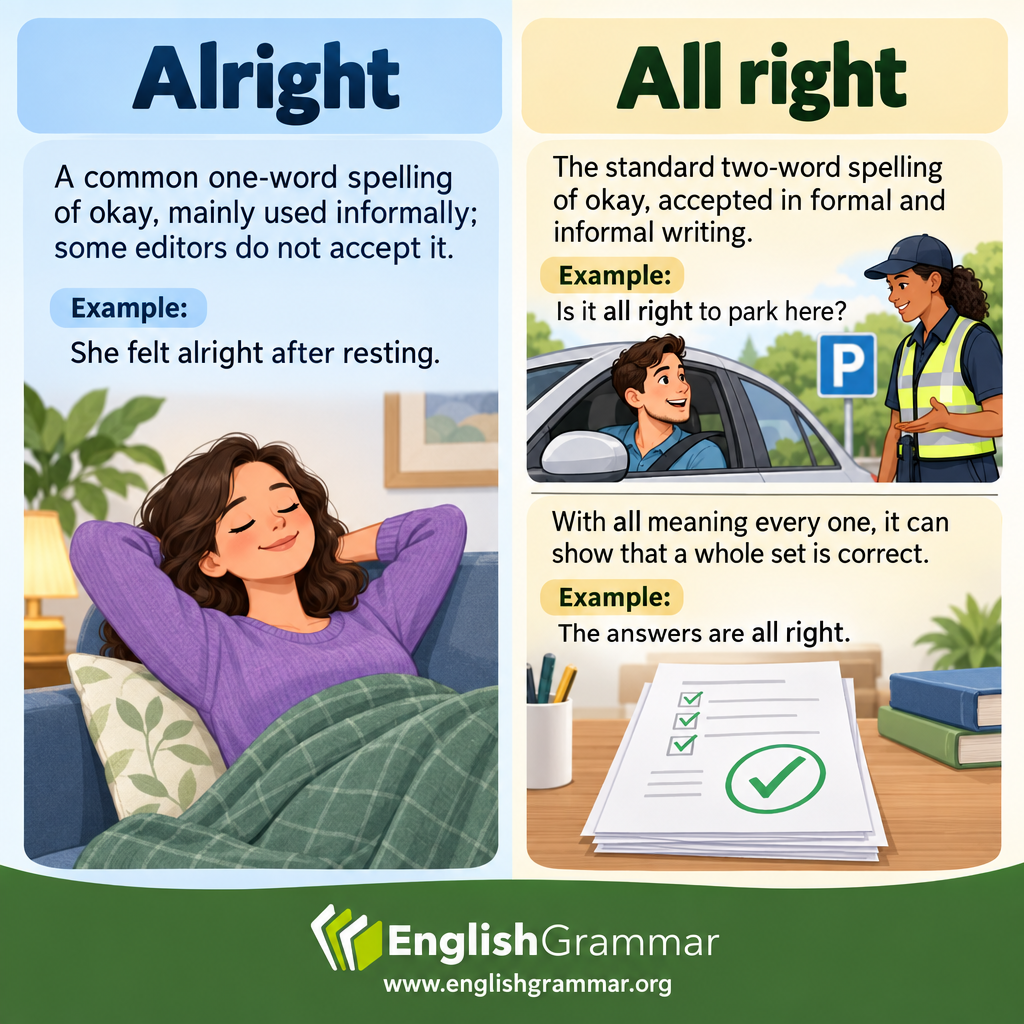
Alright and all right often have the same meaning: “okay,” “safe,” or “satisfactory.” However, the spellings differ in how widely they are accepted.
All right is the established two-word spelling. It is appropriate in both formal and informal writing. If you are completing an essay, application, report, or other edited document, this form is the safest choice.
- Is it all right to open the window?
- Everyone was all right after the minor accident.
Alright is a common one-word spelling, especially in informal messages, dialogue, lyrics, and conversational writing. Many dictionaries record it, and some publishers accept it. However, some editors and style guides still consider it unsuitable for formal prose.
- Are you alright now?
- The movie was alright, but I would not watch it again.
Spacing can also affect meaning. In “The answers are all right,” all may mean “every one,” so the sentence can mean that every answer is correct. The one-word form does not express that structure as clearly: “The answers are alright” usually means that the answers are acceptable or fairly good.
In short, both spellings may mean “okay” in informal contexts, but all right works across a wider range of writing. It also preserves the separate meaning of all when you are referring to every person or thing in a group.