
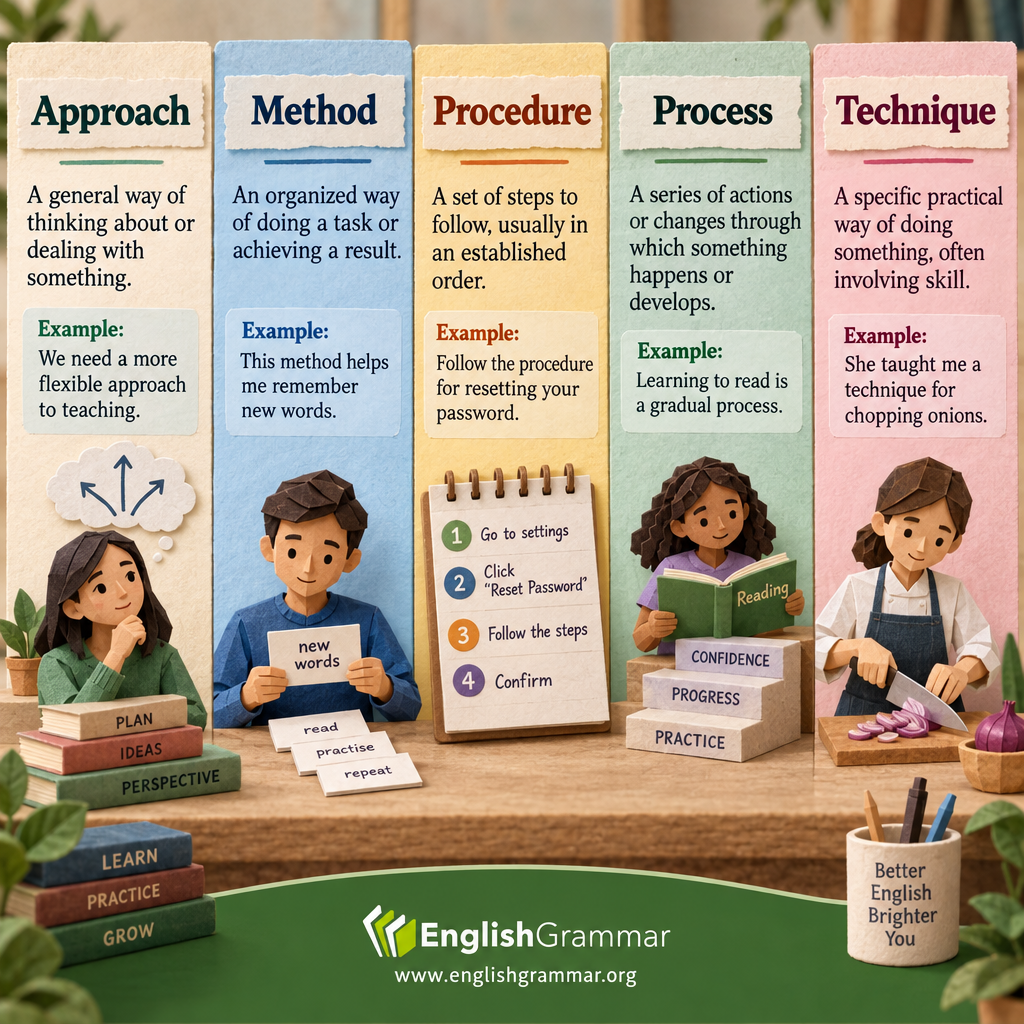
These five words all relate to how something is done, but they highlight different things. Their meanings overlap, so the best choice depends on what you want to emphasize.
- Approach emphasizes a general way of thinking about or dealing with something. It guides your choices without necessarily specifying every action. The teacher takes a playful approach to learning.
- Method emphasizes an organized way of doing a task. Choose it when discussing how you achieve a particular result. We tested two methods for removing stains.
- Procedure emphasizes a set of steps to follow, usually in an established order. It is common in workplaces, official instructions, and safety rules. The receptionist explained the procedure for reporting a lost key.
- Process emphasizes a series of actions or changes through which something happens or develops. Unlike a procedure, it need not be a set of instructions: natural changes can be processes too. Ripening is a gradual process.
- Technique emphasizes a specific practical way of doing something, often involving skill. It can be one part of a broader method. The coach showed us a technique for controlling the ball.
Imagine preparing a meal. You might favor a simple, low-waste approach, choose steaming as your cooking method, follow a kitchen safety procedure, observe the cooking process, and practice a knife technique. These distinctions are useful, not rigid boundaries: the same activity may take different names depending on the focus.
