• Skip to primary navigation
  • Skip to main content
  • Skip to primary sidebar
Home of English Grammar
  • Home
  • Exercises
  • Matches
  • Posts
  • Rules
  • Social Media Archive
  • Tools
    • Grammar Checker
    • Very Replacer
    • Word Counter
  • Vocabulary
  • Writing Guides
  • Upgrade to Pro

EnglishGrammar Team

Why “dreamt” stands out in English spelling

April 8, 2026 pdf

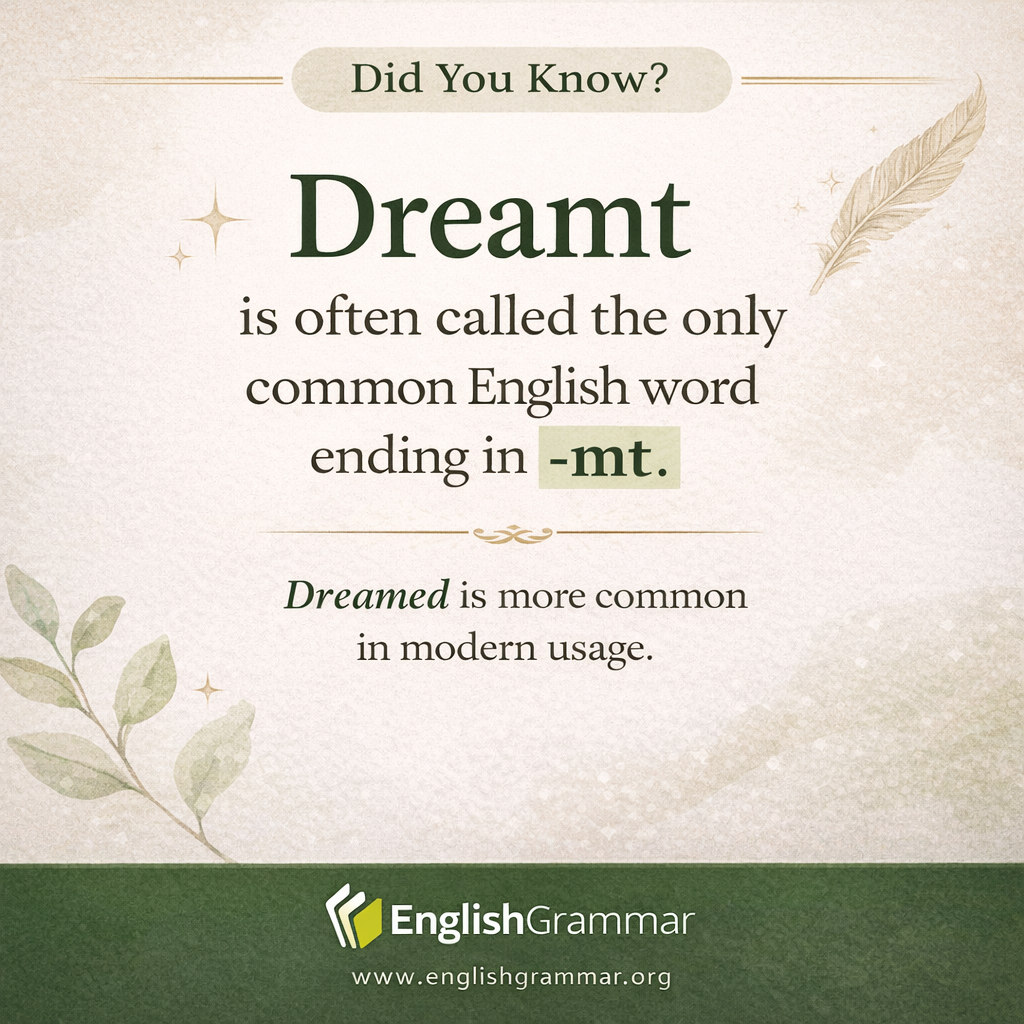
Dreamt is the only English word that ends with -mt.

Dreamt is widely cited as the only common English word that ends in -mt. That makes it memorable, because English words rarely finish with that letter pattern.

The claim usually includes the word common for a reason. English has a few very rare, technical, archaic, or proper name exceptions, but in everyday vocabulary, dreamt is the standout example people mean.

There is also an important usage note: dreamed and dreamt are both correct past tense forms of dream. Dreamed is more common, especially in American English, while dreamt appears more often in British English and in more literary styles.

  • Example: I dreamed about missing the train.
  • Example: She dreamt of living by the sea.

So the fun fact is not that dreamt is the only possible word of any kind ending in -mt, but that it is the only one most speakers are likely to know or use. That mix of rarity and familiarity is what makes it such a popular grammar fact.
Present Continuous (Affirmative Sentences) Exercise

April 8, 2026 A2pdf

Complete the 12 sentences below. Choose the best answer for each one.

Progress 0 of 12 answered
1Look. The baby ............... in the living room now.
Wrong!
Use "is sleeping" because the singular subject "the baby" needs is + verb-ing for an action happening now.
2I ............... dinner at the moment, so I can't answer the phone.
Wrong!
Use "am cooking" because the subject "I" takes am + verb-ing in the present continuous.
3My friends ............... football in the park right now.
Wrong!
Use "are playing" because the plural subject "my friends" needs are + verb-ing.
4Sara ............... to her teacher at the moment.
Wrong!
Use "is talking" because the singular subject "Sara" needs is + verb-ing.
5We ............... on the bus now.
Wrong!
Use "are sitting" because the subject "we" takes are + verb-ing in the present continuous.
6Tom ............... his teeth in the bathroom now.
Wrong!
Use "is brushing" because the singular subject "Tom" needs is + verb-ing for an action happening now.
7The children ............... a picture for their grandma now.
Wrong!
Use "are drawing" because the plural subject "the children" needs are + verb-ing.
8I ............... to music in my room right now.
Wrong!
Use "am listening" because the subject "I" takes am + verb-ing in the present continuous.
9Dad ............... the car at the moment.
Wrong!
Use "is washing" because the singular subject "Dad" needs is + verb-ing.
10You ............... very fast today.
Wrong!
Use "are walking" because the subject "you" takes are + verb-ing in the present continuous.
11My sister ............... a blue dress today.
Wrong!
Use "is wearing" because the singular subject "my sister" needs is + verb-ing for something happening around now.
12They ............... their homework at the kitchen table now.
Wrong!
Use "are doing" because the subject "they" takes are + verb-ing in the present continuous.
Exercise complete
Score 0/12
Share your score!
More Exercises →

Answers

  1. Look. The baby is sleeping in the living room now.
  2. I am cooking dinner at the moment, so I can’t answer the phone.
  3. My friends are playing football in the park right now.
  4. Sara is talking to her teacher at the moment.
  5. We are sitting on the bus now.
  6. Tom is brushing his teeth in the bathroom now.
  7. The children are drawing a picture for their grandma now.
  8. I am listening to music in my room right now.
  9. Dad is washing the car at the moment.
  10. You are walking very fast today.
  11. My sister is wearing a blue dress today.
  12. They are doing their homework at the kitchen table now.

Why Soccer Comes from Association Football

April 8, 2026 pdf

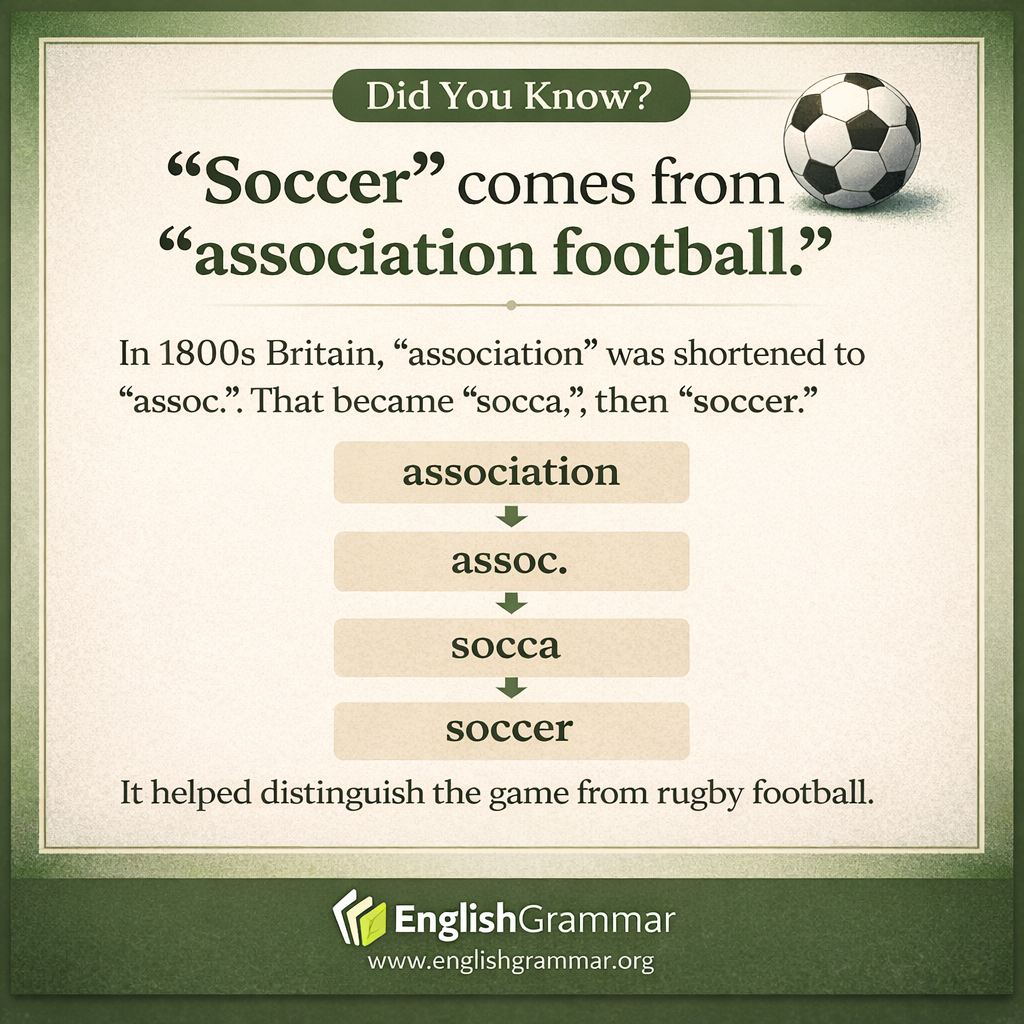
"Soccer" comes from "association football."

The word soccer comes from association football, the formal name used when the rules of the game were standardized in Britain. At the time, several kinds of football existed, so people needed a clear way to tell them apart.

One of the main contrasts was this:

  • association football, which became soccer
  • rugby football, which became rugger in older British slang

In the late 1800s, British students often made playful shortened forms of words and added an er sound. Association was shortened to assoc., which was pronounced more like soc or socca. From there, soccer developed as a casual nickname.

This means the word was originally British, even though many people now think of it as mainly American. In countries where football already clearly means the association game, people usually just say football. In places where another sport is also called football, such as the United States, soccer stayed useful because it avoids confusion.

So soccer is not a modern mistake. It is a historical nickname that grew out of association football.

Hello is a surprisingly modern greeting

April 8, 2026 pdf

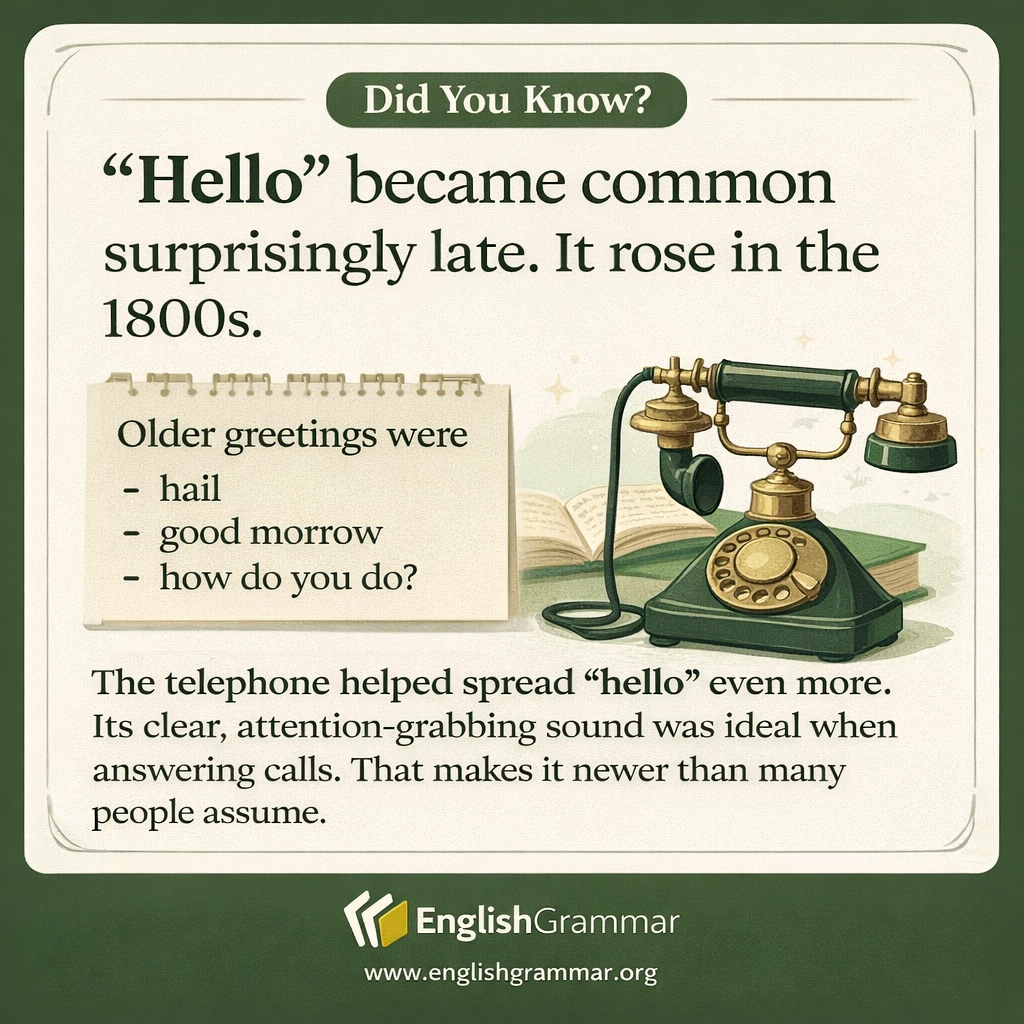
"Hello" is much newer than most people think.

Hello sounds universal and old, but as an everyday English greeting, it is relatively recent. It became common in the 1800s, which is much later than many people expect.

Earlier English greetings often used very different wording. Depending on the period and situation, people might say hail, good morrow, or how do you do? Those expressions can sound formal or old fashioned now, but they were once normal ways to greet someone.

The spread of the telephone also helped hello become even more familiar. As phone calls became part of daily life, the word gained another strong everyday use, and that helped reinforce it in spoken English.

  • Older style greeting: “Good morrow” meant something like “good morning.”
  • Polite greeting: “How do you do?” was often used when meeting someone.
  • Modern everyday greeting: “Hello” now works in person and on the phone.

So while hello feels basic and timeless, its rise as a common greeting is actually quite modern compared with many older English expressions.

100 Other Words for “Decisive”

April 8, 2026

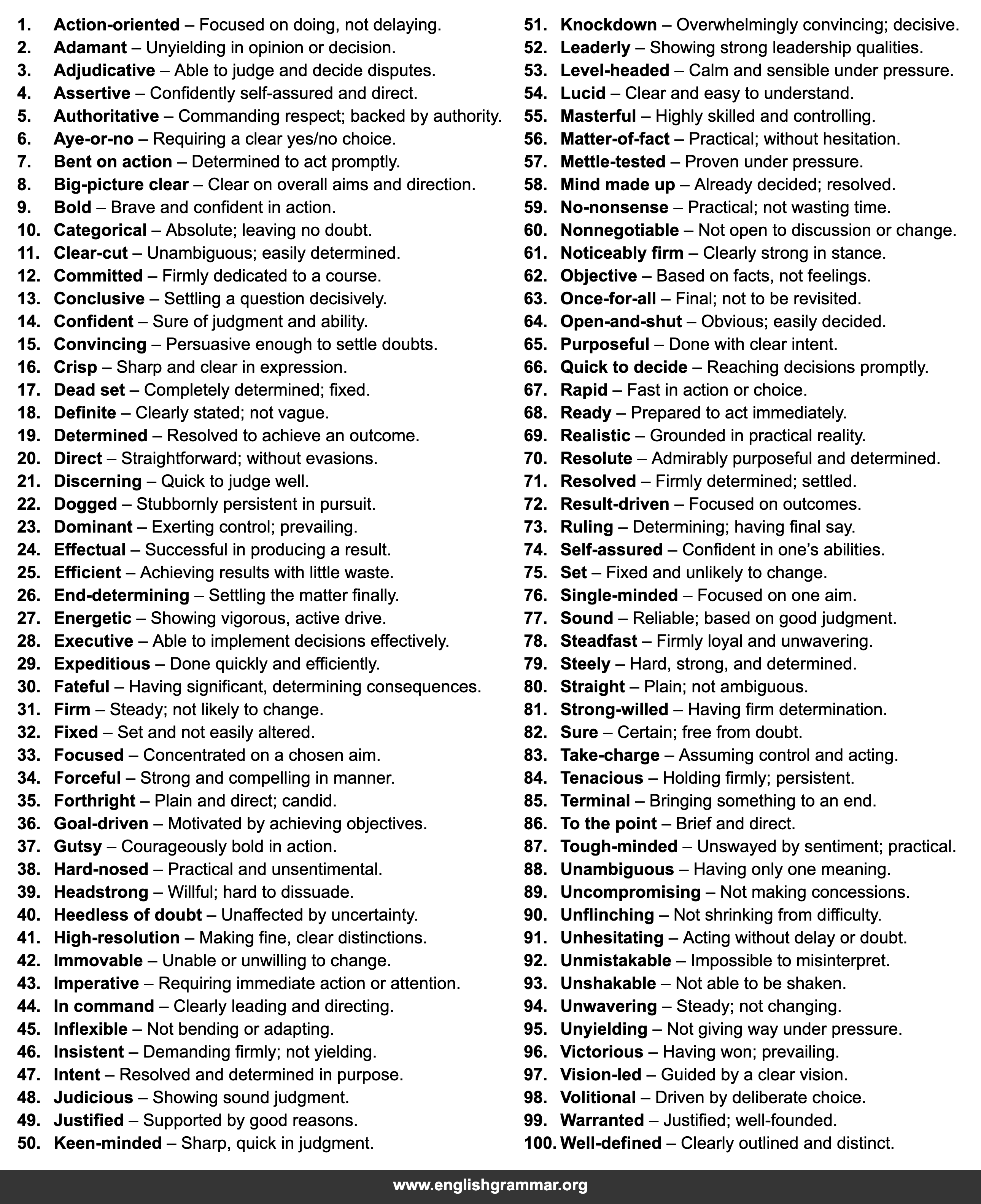
100 Other Words for

No. Term Definition
1. Action-oriented Focused on doing, not delaying.
2. Adamant Unyielding in opinion or decision.
3. Adjudicative Able to judge and decide disputes.
4. Assertive Confidently self-assured and direct.
5. Authoritative Commanding respect; backed by authority.
6. Aye-or-no Requiring a clear yes/no choice.
7. Bent on action Determined to act promptly.
8. Big-picture clear Clear on overall aims and direction.
9. Bold Brave and confident in action.
10. Categorical Absolute; leaving no doubt.
11. Clear-cut Unambiguous; easily determined.
12. Committed Firmly dedicated to a course.
13. Conclusive Settling a question decisively.
14. Confident Sure of judgment and ability.
15. Convincing Persuasive enough to settle doubts.
16. Crisp Sharp and clear in expression.
17. Dead set Completely determined; fixed.
18. Definite Clearly stated; not vague.
19. Determined Resolved to achieve an outcome.
20. Direct Straightforward; without evasions.
21. Discerning Quick to judge well.
22. Dogged Stubbornly persistent in pursuit.
23. Dominant Exerting control; prevailing.
24. Effectual Successful in producing a result.
25. Efficient Achieving results with little waste.
26. End-determining Settling the matter finally.
27. Energetic Showing vigorous, active drive.
28. Executive Able to implement decisions effectively.
29. Expeditious Done quickly and efficiently.
30. Fateful Having significant, determining consequences.
31. Firm Steady; not likely to change.
32. Fixed Set and not easily altered.
33. Focused Concentrated on a chosen aim.
34. Forceful Strong and compelling in manner.
35. Forthright Plain and direct; candid.
36. Goal-driven Motivated by achieving objectives.
37. Gutsy Courageously bold in action.
38. Hard-nosed Practical and unsentimental.
39. Headstrong Willful; hard to dissuade.
40. Heedless of doubt Unaffected by uncertainty.
41. High-resolution Making fine, clear distinctions.
42. Immovable Unable or unwilling to change.
43. Imperative Requiring immediate action or attention.
44. In command Clearly leading and directing.
45. Inflexible Not bending or adapting.
46. Insistent Demanding firmly; not yielding.
47. Intent Resolved and determined in purpose.
48. Judicious Showing sound judgment.
49. Justified Supported by good reasons.
50. Keen-minded Sharp, quick in judgment.
51. Knockdown Overwhelmingly convincing; decisive.
52. Leaderly Showing strong leadership qualities.
53. Level-headed Calm and sensible under pressure.
54. Lucid Clear and easy to understand.
55. Masterful Highly skilled and controlling.
56. Matter-of-fact Practical; without hesitation.
57. Mettle-tested Proven under pressure.
58. Mind made up Already decided; resolved.
59. No-nonsense Practical; not wasting time.
60. Nonnegotiable Not open to discussion or change.
61. Noticeably firm Clearly strong in stance.
62. Objective Based on facts, not feelings.
63. Once-for-all Final; not to be revisited.
64. Open-and-shut Obvious; easily decided.
65. Purposeful Done with clear intent.
66. Quick to decide Reaching decisions promptly.
67. Rapid Fast in action or choice.
68. Ready Prepared to act immediately.
69. Realistic Grounded in practical reality.
70. Resolute Admirably purposeful and determined.
71. Resolved Firmly determined; settled.
72. Result-driven Focused on outcomes.
73. Ruling Determining; having final say.
74. Self-assured Confident in one’s abilities.
75. Set Fixed and unlikely to change.
76. Single-minded Focused on one aim.
77. Sound Reliable; based on good judgment.
78. Steadfast Firmly loyal and unwavering.
79. Steely Hard, strong, and determined.
80. Straight Plain; not ambiguous.
81. Strong-willed Having firm determination.
82. Sure Certain; free from doubt.
83. Take-charge Assuming control and acting.
84. Tenacious Holding firmly; persistent.
85. Terminal Bringing something to an end.
86. To the point Brief and direct.
87. Tough-minded Unswayed by sentiment; practical.
88. Unambiguous Having only one meaning.
89. Uncompromising Not making concessions.
90. Unflinching Not shrinking from difficulty.
91. Unhesitating Acting without delay or doubt.
92. Unmistakable Impossible to misinterpret.
93. Unshakable Not able to be shaken.
94. Unwavering Steady; not changing.
95. Unyielding Not giving way under pressure.
96. Victorious Having won; prevailing.
97. Vision-led Guided by a clear vision.
98. Volitional Driven by deliberate choice.
99. Warranted Justified; well-founded.
100. Well-defined Clearly outlined and distinct.
  • « Go to Previous Page
  • Page 1
  • Interim pages omitted …
  • Page 1042
  • Page 1043
  • Page 1044
  • Page 1045
  • Page 1046
  • Interim pages omitted …
  • Page 2325
  • Go to Next Page »

Primary Sidebar

2,485,429 
761,532 
Improve Your English
  • Download 2026 Grammar Guide (PDF)
  • Free Weekly Exercises & Vocabulary
  • Join over 3 Million English Learners
We respect your privacy. Unsubscribe anytime.
Grammar Checker - Try Now

Latest Posts

  • Appointments Vocabulary Exercise October 12, 2026
  • 100 Best Synonyms for “Provoked” October 12, 2026
  • 100 Best Synonyms for “Stranded” October 12, 2026
  • The surprisingly old roots of “newfangled” October 12, 2026
  • 100 Best Synonyms for “Answer” October 12, 2026
  • 100 Best Synonyms for “Prove” October 12, 2026
  • 100 Best Synonyms for “Repressed” October 12, 2026
  • 100 Best Synonyms for “Ambiguity” October 12, 2026
  • 100 Best Synonyms for “Paradigmatic” October 12, 2026
  • 100 Best Synonyms for “Propaganda” October 12, 2026
Home of English Grammar

Free English grammar exercises, rules and vocabulary lists, with new exercises every week. Join the leading English grammar site with over 3 million followers.

Upgrade to Pro

Learn

  • Exercises
  • Matches
  • Grammar rules
  • Vocabulary lists
  • Writing guides
  • Online tools

More

  • Top social media posts
  • Various posts
  • Free grammar guide (PDF)
  • Contact

Pro

  • What is Pro?
  • Pro account
  • Pro exercises

Copyright © 2026 EnglishGrammar.org

  • Disclaimer
  • Privacy policy
  • Refund policy
  • Terms
  • Sitemap
Improve Your English
  • Download 2026 Grammar Guide (PDF)
  • Free Weekly Exercises & Vocabulary
  • Join over 3 Million English Learners
We respect your privacy. Unsubscribe anytime.