
• Skip to primary navigation
  • Skip to main content
  • Skip to primary sidebar
Home of English Grammar
  • Home
  • Exercises
  • Matches
  • Posts
  • Rules
  • Social Media Archive
  • Tools
    • Grammar Checker
    • Very Replacer
    • Word Counter
  • Vocabulary
  • Writing Guides
  • Pro

Why “avocado” originally meant “testicle”

April 6, 2026 pdf

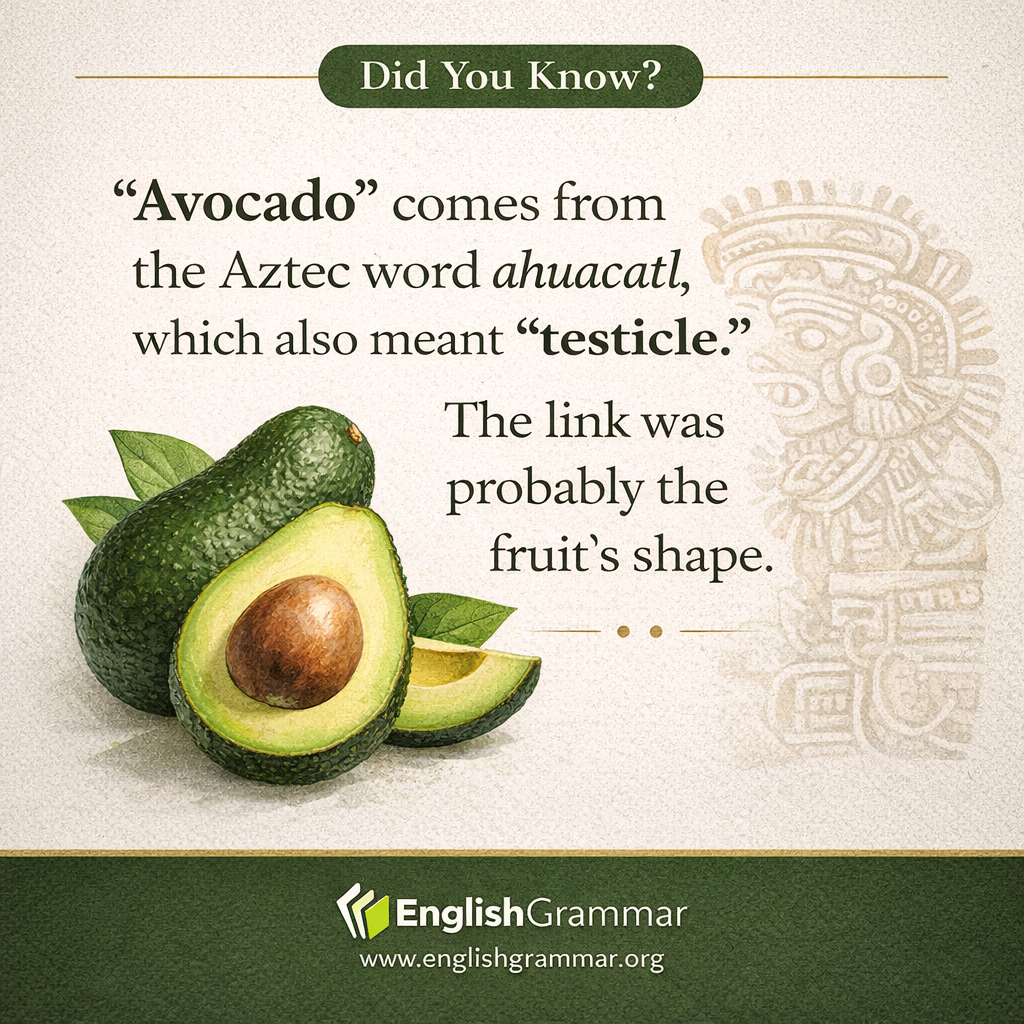
"Avocado" comes from an Aztec word meaning "testicle" (due to shape)

The English word avocado has an unusual history. It ultimately comes from ahuacatl, a word from Nahuatl, the language spoken by the Aztecs and still spoken in parts of Mexico. In Nahuatl, ahuacatl could mean both avocado and testicle.

Why the double meaning? Most historians and language sources point to the fruit’s shape. Many languages reuse existing words for new things when they look similar, so this kind of semantic overlap is not rare.

As the word moved through Spanish into English, its form changed. Spanish used aguacate, and English later developed avocado. The meaning in modern English is only the fruit, not the older anatomical sense.

Here is a simple contrast:

  • Modern English: I sliced an avocado for lunch.
  • Historical source meaning: In Nahuatl, ahuacatl could refer to the fruit or to a testicle.

So the surprising part is true, but it is really a story about how words travel, shift in form, and narrow in meaning over time.

  • Share
  • Post
  • Post
  • Reddit
  • Email
  • WhatsApp
NEW: Try Matches, our daily vocabulary challenge. Pick a topic and level and match words with definitions to boost your vocabulary.

Primary Sidebar

2,485,429 
761,532 
Improve Your English
  • Download 2026 Grammar Guide (PDF)
  • Free Weekly Exercises & Vocabulary
  • Join over 3 Million English Learners
We respect your privacy. Unsubscribe anytime.
Grammar Checker - Try Now

Latest Posts

  • 100 Best Synonyms for “Purity” October 12, 2026
  • Strategic Recommendation Language Exercise October 12, 2026
  • 100 Best Synonyms for “Attempt” October 12, 2026
  • Should have vs. should of: which is correct? October 12, 2026
  • Appointments Vocabulary Exercise October 12, 2026
  • 100 Best Synonyms for “Provoked” October 12, 2026
  • 100 Best Synonyms for “Stranded” October 12, 2026
  • The surprisingly old roots of “newfangled” October 12, 2026
  • 100 Best Synonyms for “Answer” October 12, 2026
  • 100 Best Synonyms for “Prove” October 12, 2026
Home of English Grammar

Free English grammar exercises, rules and vocabulary lists, with new exercises every week. Join the leading English grammar site with over 3 million followers.

Pro

Learn

  • Exercises
  • Matches
  • Grammar rules
  • Vocabulary lists
  • Writing guides
  • Online tools

More

  • Top social media posts
  • Various posts
  • Free grammar guide (PDF)
  • Contact

Pro

  • What is Pro?
  • Pro account
  • Pro exercises

Copyright © 2026 EnglishGrammar.org

  • Disclaimer
  • Privacy policy
  • Refund policy
  • Terms
  • Sitemap
Improve Your English
  • Download 2026 Grammar Guide (PDF)
  • Free Weekly Exercises & Vocabulary
  • Join over 3 Million English Learners
We respect your privacy. Unsubscribe anytime.