
• Skip to primary navigation
  • Skip to main content
  • Skip to primary sidebar
Home of English Grammar
  • Home
  • Course
  • Exercises
  • Grammar Rules
  • Matches
  • Posts
  • Tools
    • Grammar Checker
    • Very Replacer
    • Word Counter
  • Vocabulary Lists
  • Archives
    • Social Media Posts
    • Writing Guides
  • Sign in
  • Join free

Where “bell the cat” comes from, and what it means

May 14, 2026

The origin of "bell the cat"

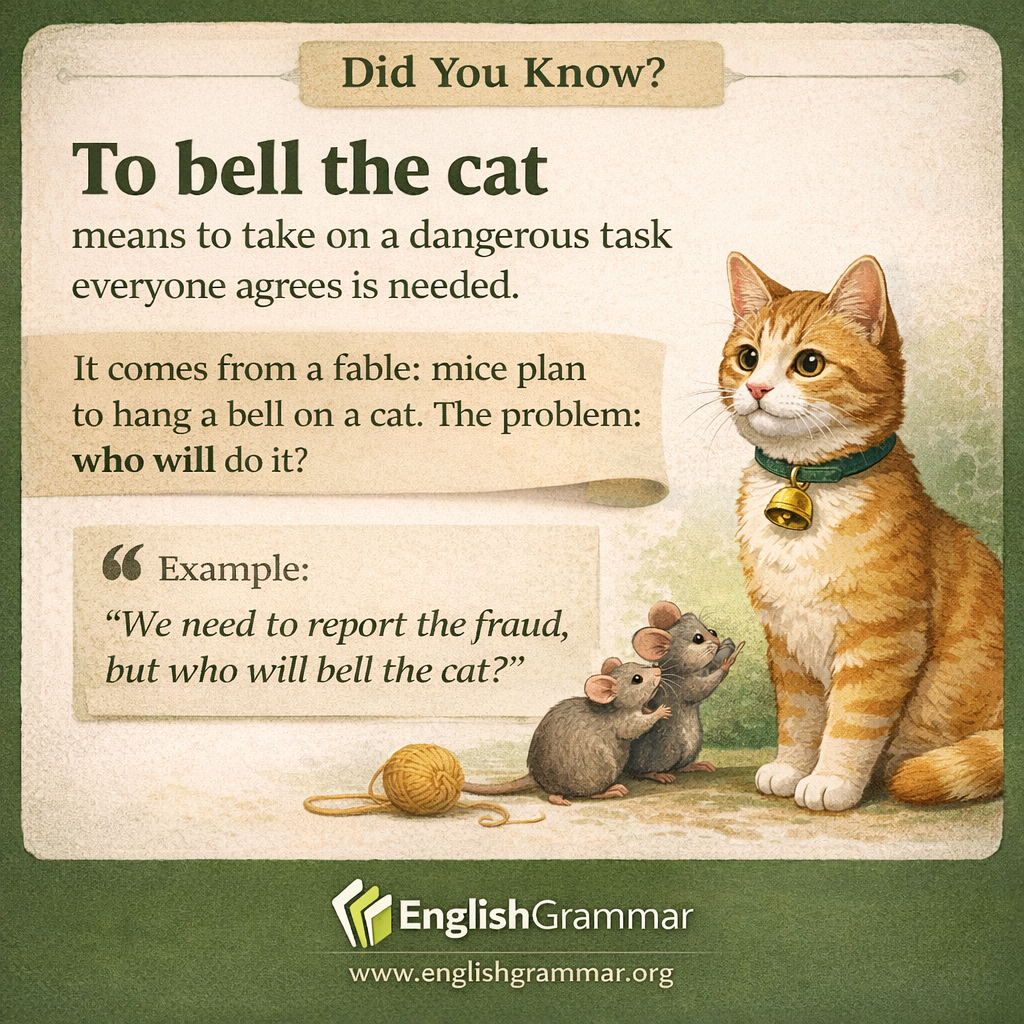
To bell the cat means to do a dangerous or difficult job that everyone agrees is necessary, but few people want to do themselves.

The phrase comes from an old fable. In the story, a group of mice want protection from a cat. One mouse suggests hanging a bell around the cat’s neck so they can hear it coming. The idea sounds excellent, and all the mice approve. Then one mouse asks the real question: Who will put the bell on the cat? That is the hard part.

So the expression is used when a plan is easy to praise but risky to carry out. It often appears when a group supports an action, but the person who actually does it may face danger, blame, or serious consequences.

  • At work: “Everyone agrees the manager should hear the truth, but who will bell the cat?”
  • In public life: People may support exposing corruption, but only a few are willing to take the risk.

The phrase is less about the plan itself and more about the courage required to act on it.

Improve your English grammar, vocabulary and writing

We take you step by step from beginner to advanced, even if you struggled with English at school or have always had trouble remembering the rules.

  • 10 modules, 112 lessons and 730 questions
  • Just log in and learn anytime and anywhere
  • Your progress is saved in your account
  • Download the 2027 Grammar Guide (PDF)
Join free

Already have an account? Sign in

See what’s in the course

Primary Sidebar

2.4M760.9K165.9K

Free 2027 Grammar Guide

  • Download Grammar Guide (PDF)
  • Online grammar course, A1 to C2
  • Weekly exercises and vocabulary
  • Join over 3 million English learners

We respect your privacy. Unsubscribe anytime.

Already have an account? Sign in

Grammar Checker - Try Now

Latest Posts

  • 100 Best Synonyms for “Vary” November 3, 2026
  • 100 Best Synonyms for “Individuals” November 3, 2026
  • Temporary vs. passing vs. fleeting vs. transient vs. ephemeral vs. evanescent November 3, 2026
  • 100 Best Synonyms for “Restless” November 3, 2026
  • Hard, firm, solid, rigid, stiff and unyielding: How to choose November 3, 2026
  • The origin of “out of the blue” November 3, 2026
  • 100 Best Synonyms for “Individualised” November 3, 2026
  • 100 Best Synonyms for “Varied” November 3, 2026
  • Fewer vs. less: counting things and measuring amounts November 3, 2026
  • 100 Phrases for Starting a Meeting Confidently November 3, 2026

Matches Rankings

    No results yet. Be the first to finish today’s Daily.

      No results yet. Be the first to finish today’s Daily.

        No results yet. Be the first to finish today’s Daily.

          No results yet. Be the first to finish today’s Daily.

          Play today’s Daily

          Home of English Grammar

          Free English grammar exercises, rules and vocabulary lists, with new exercises every week. Join the leading English grammar site with over 3 million followers.

          Join free

          Learn

          • Exercises
          • Matches
          • Grammar rules
          • Vocabulary lists
          • Writing guides
          • Online tools

          More

          • Top social media posts
          • Various posts
          • Contact

          Account

          • Join free
          • Grammar Course
          • Free grammar guide (PDF)

          Copyright © 2026 EnglishGrammar.org

          • Disclaimer
          • Privacy policy
          • Terms
          • Sitemap