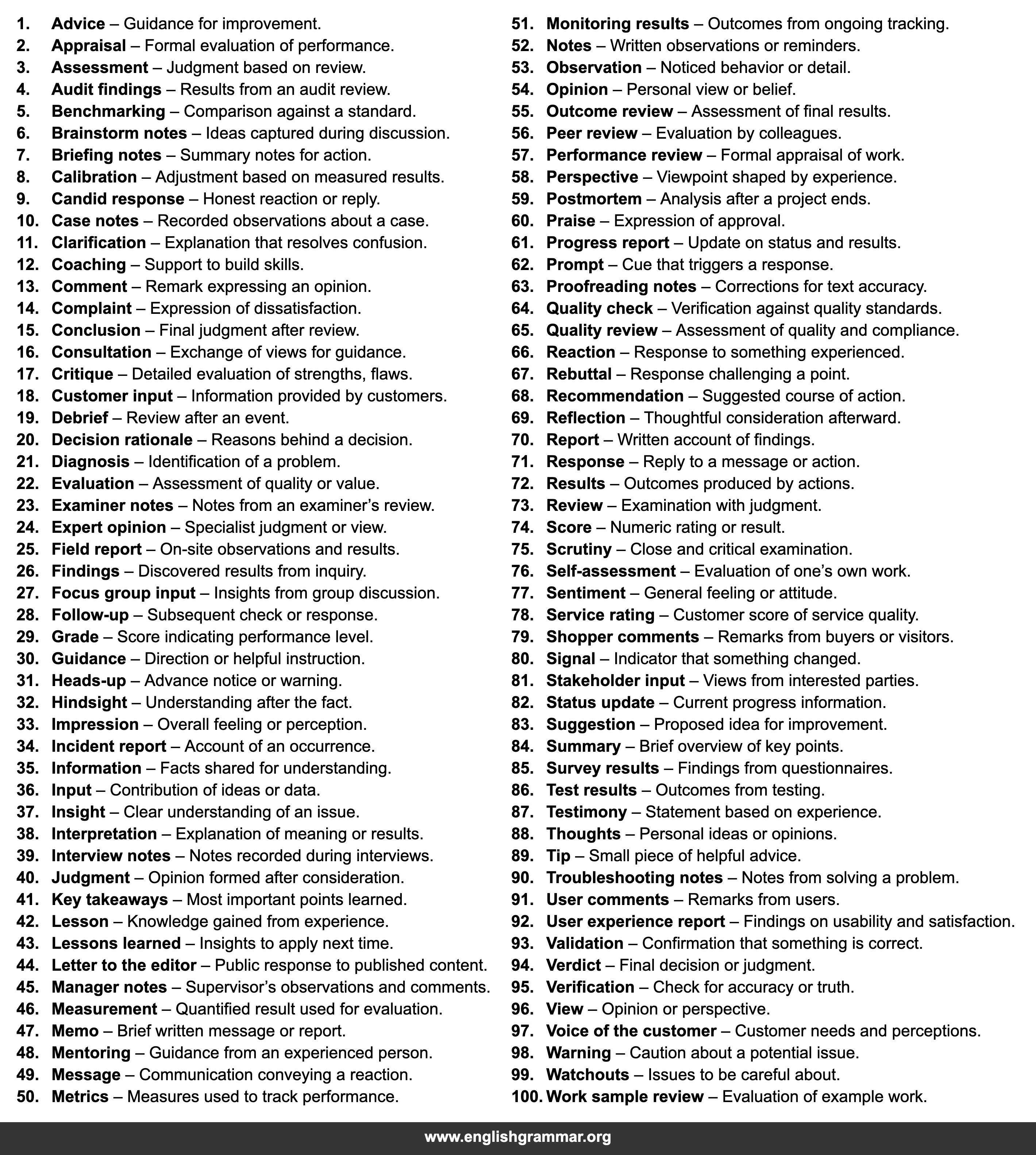
| No. | Term | Definition |
|---|---|---|
| 1. | Advice | Guidance for improvement. |
| 2. | Appraisal | Formal evaluation of performance. |
| 3. | Assessment | Judgment based on review. |
| 4. | Audit findings | Results from an audit review. |
| 5. | Benchmarking | Comparison against a standard. |
| 6. | Brainstorm notes | Ideas captured during discussion. |
| 7. | Briefing notes | Summary notes for action. |
| 8. | Calibration | Adjustment based on measured results. |
| 9. | Candid response | Honest reaction or reply. |
| 10. | Case notes | Recorded observations about a case. |
| 11. | Clarification | Explanation that resolves confusion. |
| 12. | Coaching | Support to build skills. |
| 13. | Comment | Remark expressing an opinion. |
| 14. | Complaint | Expression of dissatisfaction. |
| 15. | Conclusion | Final judgment after review. |
| 16. | Consultation | Exchange of views for guidance. |
| 17. | Critique | Detailed evaluation of strengths, flaws. |
| 18. | Customer input | Information provided by customers. |
| 19. | Debrief | Review after an event. |
| 20. | Decision rationale | Reasons behind a decision. |
| 21. | Diagnosis | Identification of a problem. |
| 22. | Evaluation | Assessment of quality or value. |
| 23. | Examiner notes | Notes from an examiner’s review. |
| 24. | Expert opinion | Specialist judgment or view. |
| 25. | Field report | On-site observations and results. |
| 26. | Findings | Discovered results from inquiry. |
| 27. | Focus group input | Insights from group discussion. |
| 28. | Follow-up | Subsequent check or response. |
| 29. | Grade | Score indicating performance level. |
| 30. | Guidance | Direction or helpful instruction. |
| 31. | Heads-up | Advance notice or warning. |
| 32. | Hindsight | Understanding after the fact. |
| 33. | Impression | Overall feeling or perception. |
| 34. | Incident report | Account of an occurrence. |
| 35. | Information | Facts shared for understanding. |
| 36. | Input | Contribution of ideas or data. |
| 37. | Insight | Clear understanding of an issue. |
| 38. | Interpretation | Explanation of meaning or results. |
| 39. | Interview notes | Notes recorded during interviews. |
| 40. | Judgment | Opinion formed after consideration. |
| 41. | Key takeaways | Most important points learned. |
| 42. | Lesson | Knowledge gained from experience. |
| 43. | Lessons learned | Insights to apply next time. |
| 44. | Letter to the editor | Public response to published content. |
| 45. | Manager notes | Supervisor’s observations and comments. |
| 46. | Measurement | Quantified result used for evaluation. |
| 47. | Memo | Brief written message or report. |
| 48. | Mentoring | Guidance from an experienced person. |
| 49. | Message | Communication conveying a reaction. |
| 50. | Metrics | Measures used to track performance. |
| 51. | Monitoring results | Outcomes from ongoing tracking. |
| 52. | Notes | Written observations or reminders. |
| 53. | Observation | Noticed behavior or detail. |
| 54. | Opinion | Personal view or belief. |
| 55. | Outcome review | Assessment of final results. |
| 56. | Peer review | Evaluation by colleagues. |
| 57. | Performance review | Formal appraisal of work. |
| 58. | Perspective | Viewpoint shaped by experience. |
| 59. | Postmortem | Analysis after a project ends. |
| 60. | Praise | Expression of approval. |
| 61. | Progress report | Update on status and results. |
| 62. | Prompt | Cue that triggers a response. |
| 63. | Proofreading notes | Corrections for text accuracy. |
| 64. | Quality check | Verification against quality standards. |
| 65. | Quality review | Assessment of quality and compliance. |
| 66. | Reaction | Response to something experienced. |
| 67. | Rebuttal | Response challenging a point. |
| 68. | Recommendation | Suggested course of action. |
| 69. | Reflection | Thoughtful consideration afterward. |
| 70. | Report | Written account of findings. |
| 71. | Response | Reply to a message or action. |
| 72. | Results | Outcomes produced by actions. |
| 73. | Review | Examination with judgment. |
| 74. | Score | Numeric rating or result. |
| 75. | Scrutiny | Close and critical examination. |
| 76. | Self-assessment | Evaluation of one’s own work. |
| 77. | Sentiment | General feeling or attitude. |
| 78. | Service rating | Customer score of service quality. |
| 79. | Shopper comments | Remarks from buyers or visitors. |
| 80. | Signal | Indicator that something changed. |
| 81. | Stakeholder input | Views from interested parties. |
| 82. | Status update | Current progress information. |
| 83. | Suggestion | Proposed idea for improvement. |
| 84. | Summary | Brief overview of key points. |
| 85. | Survey results | Findings from questionnaires. |
| 86. | Test results | Outcomes from testing. |
| 87. | Testimony | Statement based on experience. |
| 88. | Thoughts | Personal ideas or opinions. |
| 89. | Tip | Small piece of helpful advice. |
| 90. | Troubleshooting notes | Notes from solving a problem. |
| 91. | User comments | Remarks from users. |
| 92. | User experience report | Findings on usability and satisfaction. |
| 93. | Validation | Confirmation that something is correct. |
| 94. | Verdict | Final decision or judgment. |
| 95. | Verification | Check for accuracy or truth. |
| 96. | View | Opinion or perspective. |
| 97. | Voice of the customer | Customer needs and perceptions. |
| 98. | Warning | Caution about a potential issue. |
| 99. | Watchouts | Issues to be careful about. |
| 100. | Work sample review | Evaluation of example work. |
