
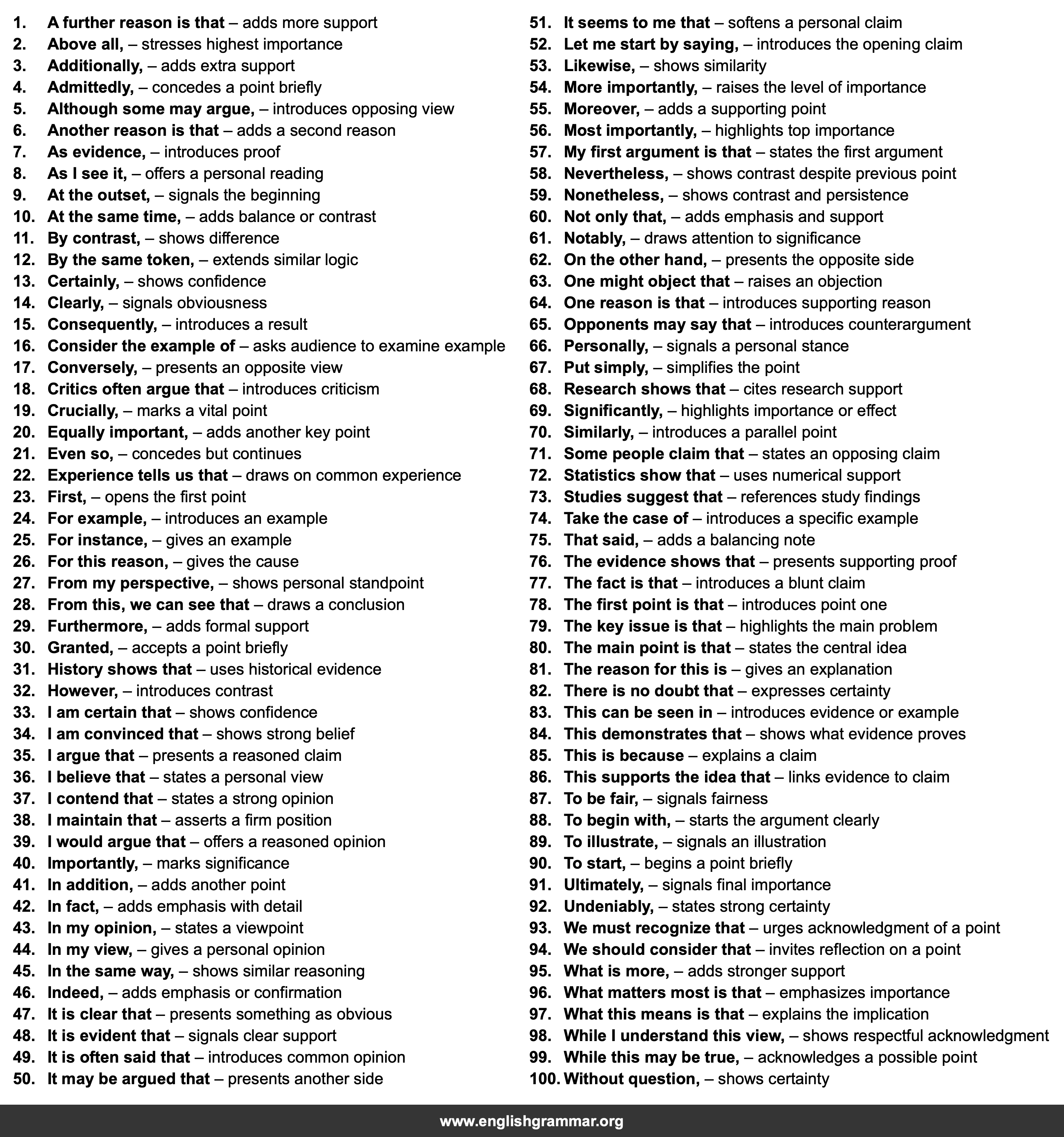
| No. | Item | Definition |
|---|---|---|
| 1. | A further reason is that | adds more support |
| 2. | Above all, | stresses highest importance |
| 3. | Additionally, | adds extra support |
| 4. | Admittedly, | concedes a point briefly |
| 5. | Although some may argue, | introduces opposing view |
| 6. | Another reason is that | adds a second reason |
| 7. | As evidence, | introduces proof |
| 8. | As I see it, | offers a personal reading |
| 9. | At the outset, | signals the beginning |
| 10. | At the same time, | adds balance or contrast |
| 11. | By contrast, | shows difference |
| 12. | By the same token, | extends similar logic |
| 13. | Certainly, | shows confidence |
| 14. | Clearly, | signals obviousness |
| 15. | Consequently, | introduces a result |
| 16. | Consider the example of | asks audience to examine example |
| 17. | Conversely, | presents an opposite view |
| 18. | Critics often argue that | introduces criticism |
| 19. | Crucially, | marks a vital point |
| 20. | Equally important, | adds another key point |
| 21. | Even so, | concedes but continues |
| 22. | Experience tells us that | draws on common experience |
| 23. | First, | opens the first point |
| 24. | For example, | introduces an example |
| 25. | For instance, | gives an example |
| 26. | For this reason, | gives the cause |
| 27. | From my perspective, | shows personal standpoint |
| 28. | From this, we can see that | draws a conclusion |
| 29. | Furthermore, | adds formal support |
| 30. | Granted, | accepts a point briefly |
| 31. | History shows that | uses historical evidence |
| 32. | However, | introduces contrast |
| 33. | I am certain that | shows confidence |
| 34. | I am convinced that | shows strong belief |
| 35. | I argue that | presents a reasoned claim |
| 36. | I believe that | states a personal view |
| 37. | I contend that | states a strong opinion |
| 38. | I maintain that | asserts a firm position |
| 39. | I would argue that | offers a reasoned opinion |
| 40. | Importantly, | marks significance |
| 41. | In addition, | adds another point |
| 42. | In fact, | adds emphasis with detail |
| 43. | In my opinion, | states a viewpoint |
| 44. | In my view, | gives a personal opinion |
| 45. | In the same way, | shows similar reasoning |
| 46. | Indeed, | adds emphasis or confirmation |
| 47. | It is clear that | presents something as obvious |
| 48. | It is evident that | signals clear support |
| 49. | It is often said that | introduces common opinion |
| 50. | It may be argued that | presents another side |
| 51. | It seems to me that | softens a personal claim |
| 52. | Let me start by saying, | introduces the opening claim |
| 53. | Likewise, | shows similarity |
| 54. | More importantly, | raises the level of importance |
| 55. | Moreover, | adds a supporting point |
| 56. | Most importantly, | highlights top importance |
| 57. | My first argument is that | states the first argument |
| 58. | Nevertheless, | shows contrast despite previous point |
| 59. | Nonetheless, | shows contrast and persistence |
| 60. | Not only that, | adds emphasis and support |
| 61. | Notably, | draws attention to significance |
| 62. | On the other hand, | presents the opposite side |
| 63. | One might object that | raises an objection |
| 64. | One reason is that | introduces supporting reason |
| 65. | Opponents may say that | introduces counterargument |
| 66. | Personally, | signals a personal stance |
| 67. | Put simply, | simplifies the point |
| 68. | Research shows that | cites research support |
| 69. | Significantly, | highlights importance or effect |
| 70. | Similarly, | introduces a parallel point |
| 71. | Some people claim that | states an opposing claim |
| 72. | Statistics show that | uses numerical support |
| 73. | Studies suggest that | references study findings |
| 74. | Take the case of | introduces a specific example |
| 75. | That said, | adds a balancing note |
| 76. | The evidence shows that | presents supporting proof |
| 77. | The fact is that | introduces a blunt claim |
| 78. | The first point is that | introduces point one |
| 79. | The key issue is that | highlights the main problem |
| 80. | The main point is that | states the central idea |
| 81. | The reason for this is | gives an explanation |
| 82. | There is no doubt that | expresses certainty |
| 83. | This can be seen in | introduces evidence or example |
| 84. | This demonstrates that | shows what evidence proves |
| 85. | This is because | explains a claim |
| 86. | This supports the idea that | links evidence to claim |
| 87. | To be fair, | signals fairness |
| 88. | To begin with, | starts the argument clearly |
| 89. | To illustrate, | signals an illustration |
| 90. | To start, | begins a point briefly |
| 91. | Ultimately, | signals final importance |
| 92. | Undeniably, | states strong certainty |
| 93. | We must recognize that | urges acknowledgment of a point |
| 94. | We should consider that | invites reflection on a point |
| 95. | What is more, | adds stronger support |
| 96. | What matters most is that | emphasizes importance |
| 97. | What this means is that | explains the implication |
| 98. | While I understand this view, | shows respectful acknowledgment |
| 99. | While this may be true, | acknowledges a possible point |
| 100. | Without question, | shows certainty |