
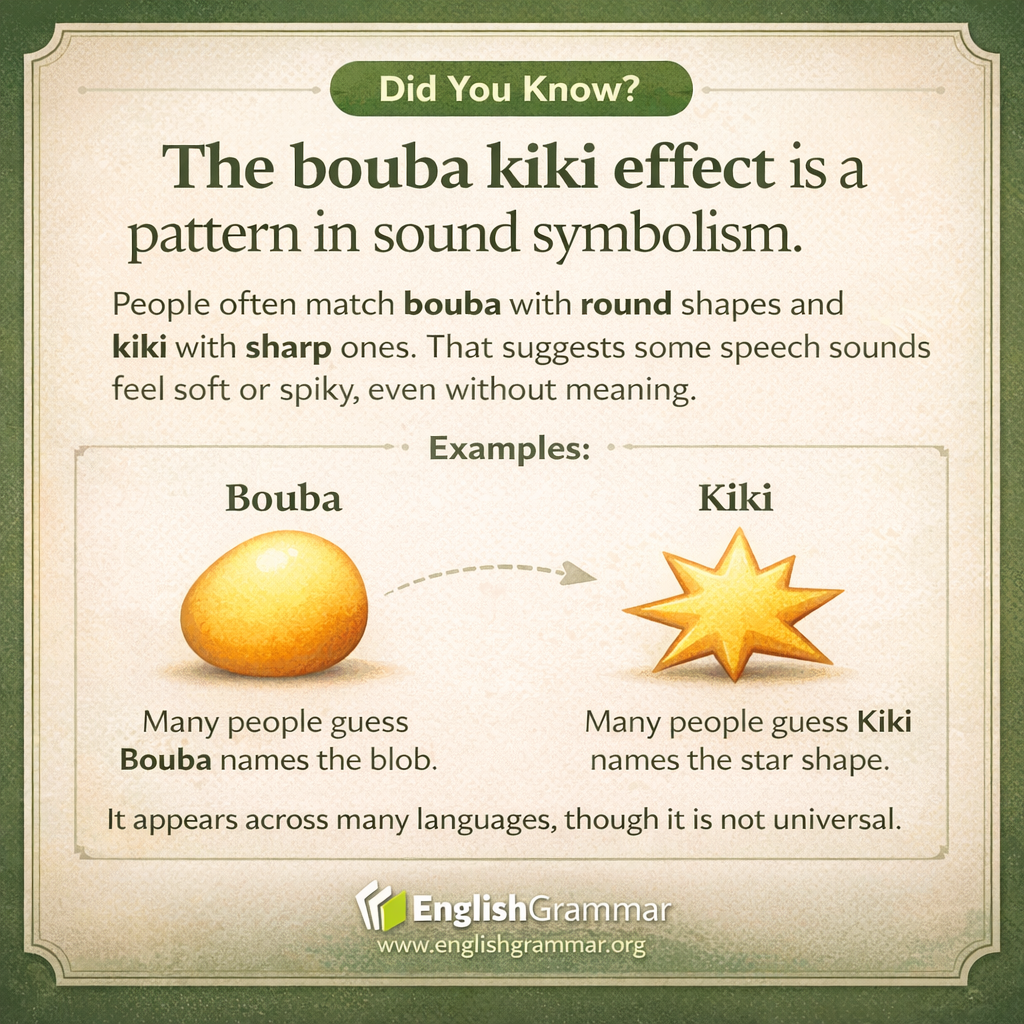
The bouba kiki effect is a well known finding in psychology and linguistics. When people see a rounded shape and a jagged shape, they often match bouba with the rounded one and kiki with the jagged one. The words themselves are made up, but the pattern appears again and again.
This suggests that sounds can carry a kind of shape feeling. Soft, flowing sounds like b and ou often seem smoother or rounder. Tighter, sharper sounds like k and i often seem more pointed. In other words, sound is not always experienced as completely separate from meaning.
For example, if a teacher draws a blob and a spiky star shape, many students will guess that the blob is called Bouba and the star is called Kiki. They are not translating anything. They are responding to a pattern that many people seem to feel intuitively.
- It is an example of sound symbolism, where sound and meaning are linked.
- It appears in many languages and age groups.
- It is common, but not universal, so not every person or culture responds the same way.
The effect matters because it hints that human language may connect sound, perception, and meaning more closely than we sometimes assume.
