
• Skip to primary navigation
  • Skip to main content
  • Skip to primary sidebar
Home of English Grammar
  • Home
  • Course
  • Exercises
  • Grammar Rules
  • Matches
  • Posts
  • Tools
    • Grammar Checker
    • Very Replacer
    • Word Counter
  • Vocabulary Lists
  • Archives
    • Social Media Posts
    • Writing Guides
  • Join free

How Boycott Became a Common Word

June 22, 2026

"Boycott" is named after a real person.

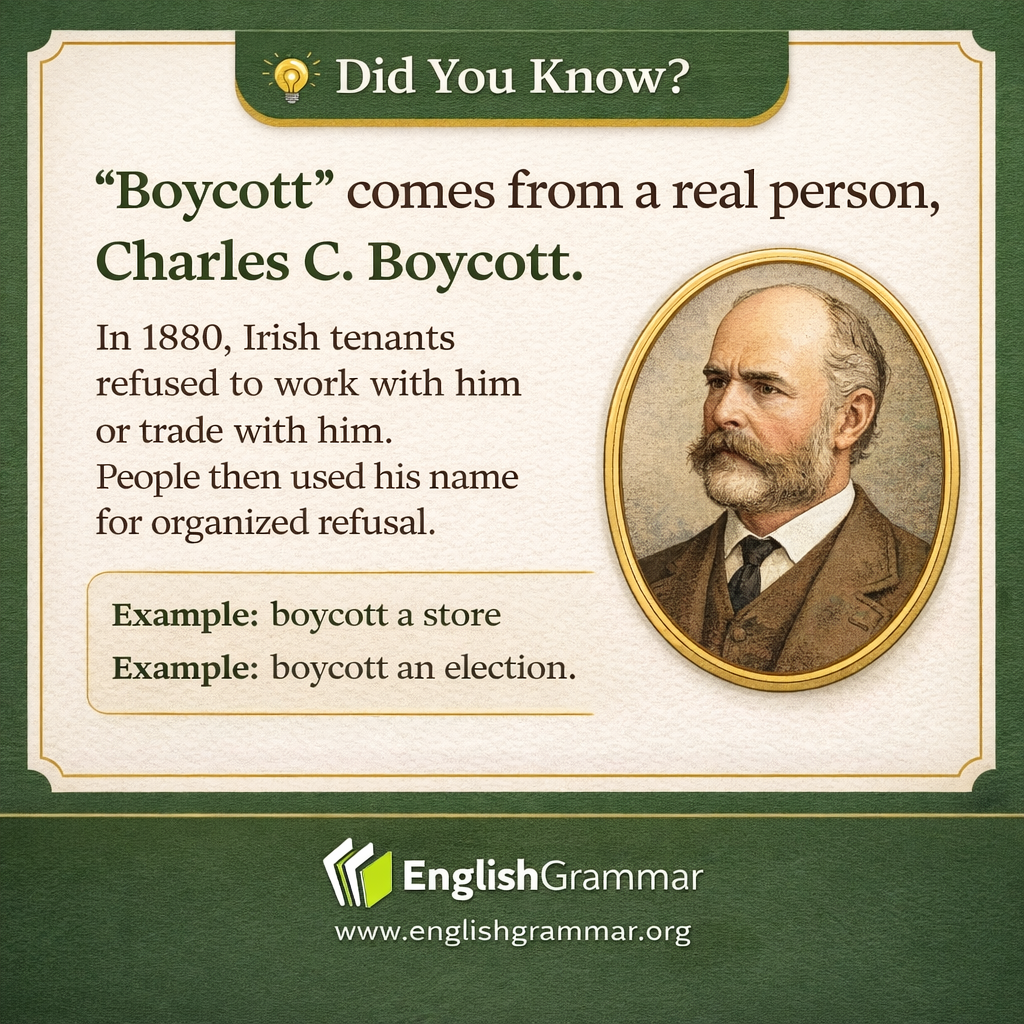
Boycott is one of those words that began as a person’s name. It comes from Charles C. Boycott, a land agent in Ireland in 1880.

During a dispute over rents and evictions, local tenants and workers chose a strategy of organized social and economic refusal. They would not work for Boycott, trade with him, or assist him. Instead of attacking him physically, they isolated him by refusing normal cooperation.

News reports spread the story widely, and Boycott’s surname quickly became a general word. Soon, people were using boycott as both a noun and a verb.

  • Noun: “There was a boycott of the company’s products.”
  • Verb: “Consumers decided to boycott the store.”

Today, the word usually means a coordinated refusal to buy from, deal with, or participate in something as a form of protest. For example, people might boycott a brand, a business, or even an election.

It is a good example of how English sometimes turns proper names into everyday vocabulary.

Improve your English grammar, vocabulary and writing

We take you step by step from beginner to advanced, even if you struggled with English at school or have always had trouble remembering the rules.

  • 10 modules, 112 lessons and 730 questions
  • Just log in and learn anytime and anywhere
  • Your progress is saved in your account
  • Download the 2027 Grammar Guide (PDF)
Join free

Already have an account? Sign in

See what’s in the course

Primary Sidebar

2.4M761.4K165.8K

Free 2027 Grammar Guide

  • Download Grammar Guide (PDF)
  • Online grammar course, A1 to C2
  • Weekly exercises and vocabulary
  • Join over 3 million English learners

We respect your privacy. Unsubscribe anytime.

Already have an account? Sign in

Grammar Checker - Try Now

Latest Posts

  • 100 Best Synonyms for “Communicative” October 23, 2026
  • Icky vs. gross vs. nasty vs. disgusting vs. revolting vs. vile October 23, 2026
  • Comparatives Exercise October 23, 2026
  • 100 Best Synonyms for “Proposition” October 23, 2026
  • 100 Best Synonyms for “Stagnation” October 23, 2026
  • 100 Best Synonyms for “Dumb” October 23, 2026
  • The origin and meaning of “off the cuff” October 23, 2026
  • 100 Phrases for Declining Requests at Work Politely October 23, 2026
  • 100 Best Synonyms for “Plausible” October 23, 2026
  • Maybe, perhaps, possibly, conceivably, probably and definitely: How to choose October 23, 2026
Home of English Grammar

Free English grammar exercises, rules and vocabulary lists, with new exercises every week. Join the leading English grammar site with over 3 million followers.

Join free

Learn

  • Exercises
  • Matches
  • Grammar rules
  • Vocabulary lists
  • Writing guides
  • Online tools

More

  • Top social media posts
  • Various posts
  • Contact

Account

  • Join free
  • Grammar Course
  • Free grammar guide (PDF)

Copyright © 2026 EnglishGrammar.org

  • Disclaimer
  • Privacy policy
  • Terms
  • Sitemap