
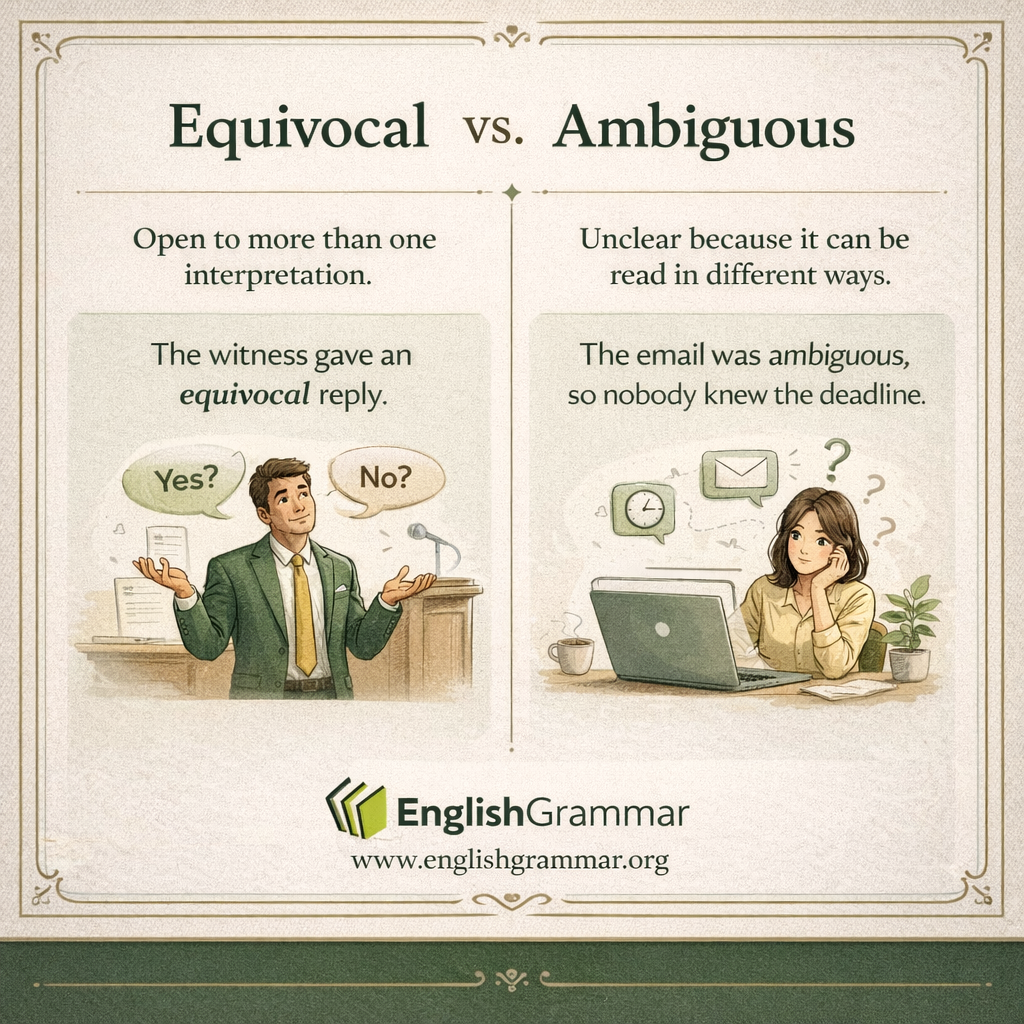
Equivocal and ambiguous are close, but they are not the same.
Equivocal usually describes language that is intentionally unclear, hesitant, or noncommittal. It often suggests that a speaker is avoiding a direct answer. If someone responds carefully so they cannot be pinned down, their reply may be equivocal.
Example: The witness gave an equivocal reply when asked whether he had seen the report.
Ambiguous describes something that can be understood in more than one way. The uncertainty comes from the wording or structure itself, not necessarily from a speaker trying to evade.
Example: The email was ambiguous, so nobody knew whether the deadline was Friday or Monday.
- Use equivocal for an answer, statement, or attitude that seems evasive or deliberately noncommittal.
- Use ambiguous for wording, signs, instructions, or messages that allow multiple interpretations.
A simple memory tip is this: equivocal often points to the speaker’s intention, while ambiguous points to the meaning of the words.