
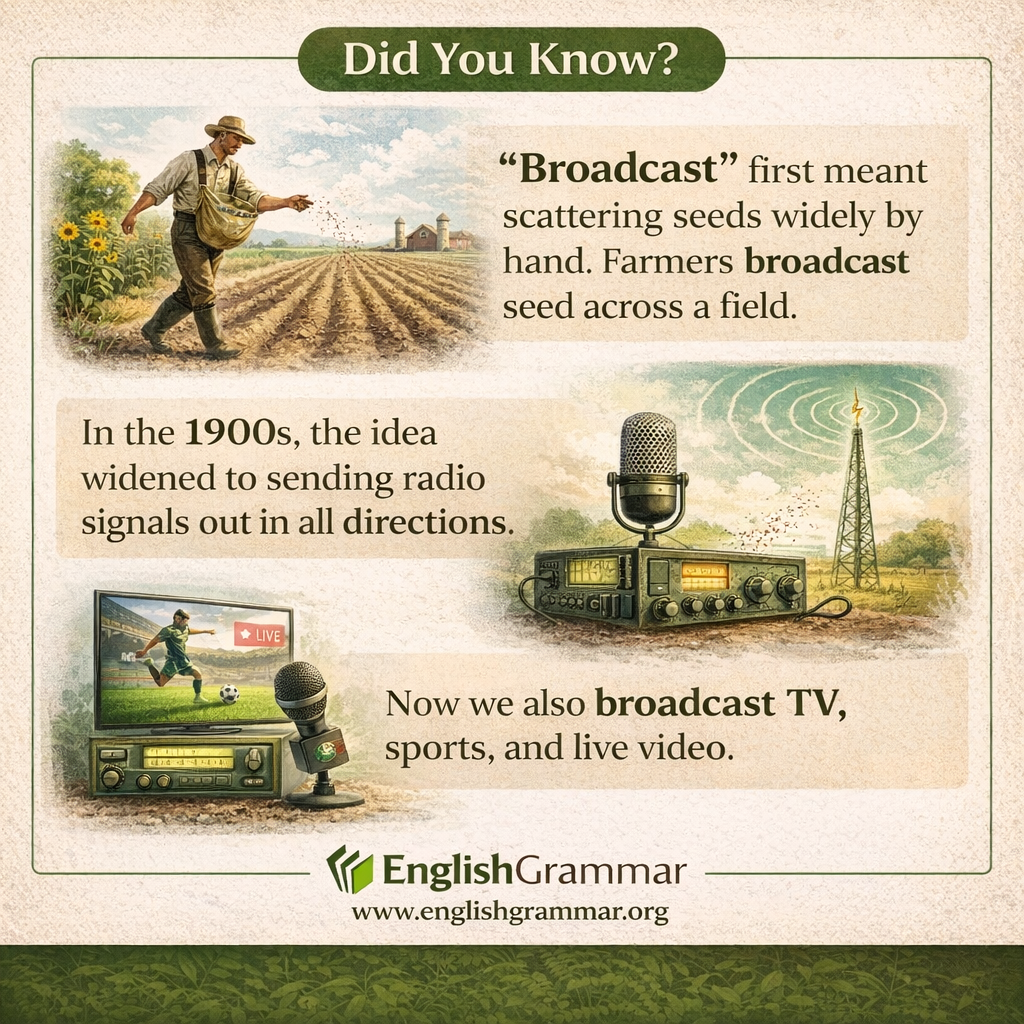
Broadcast did not begin as a media word. It originally came from agriculture, where it meant to scatter seed widely over the ground by hand. A farmer could broadcast seed across a field instead of placing it in neat rows.
In the early 1900s, that same image helped English speakers describe a new kind of communication. Radio signals were sent out widely, reaching many listeners at once, so the verb broadcast fit well. The idea was not about seeds anymore, but about spreading sound over a wide area.
Later, the word expanded again. It came to be used for television and then for other kinds of mass communication.
- Farming: broadcast seed over a field
- Radio: broadcast a news program
- Television: broadcast a football game
- Internet: broadcast a live video stream
The core idea stays the same in every use: something is sent out broadly rather than delivered to just one person.
