
• Skip to primary navigation
  • Skip to main content
  • Skip to primary sidebar
Home of English Grammar
  • Home
  • Course
  • Exercises
  • Grammar Rules
  • Vocabulary Matches
  • Posts
  • Tools
    • Grammar Checker
    • Very Replacer
    • Word Counter
  • Vocabulary Lists
  • Archives
    • Social Media Posts
    • Writing Guides
  • Sign in
  • Join free

Why “bungalow” comes from Bengal

May 11, 2026

Bungalow comes from Bengal

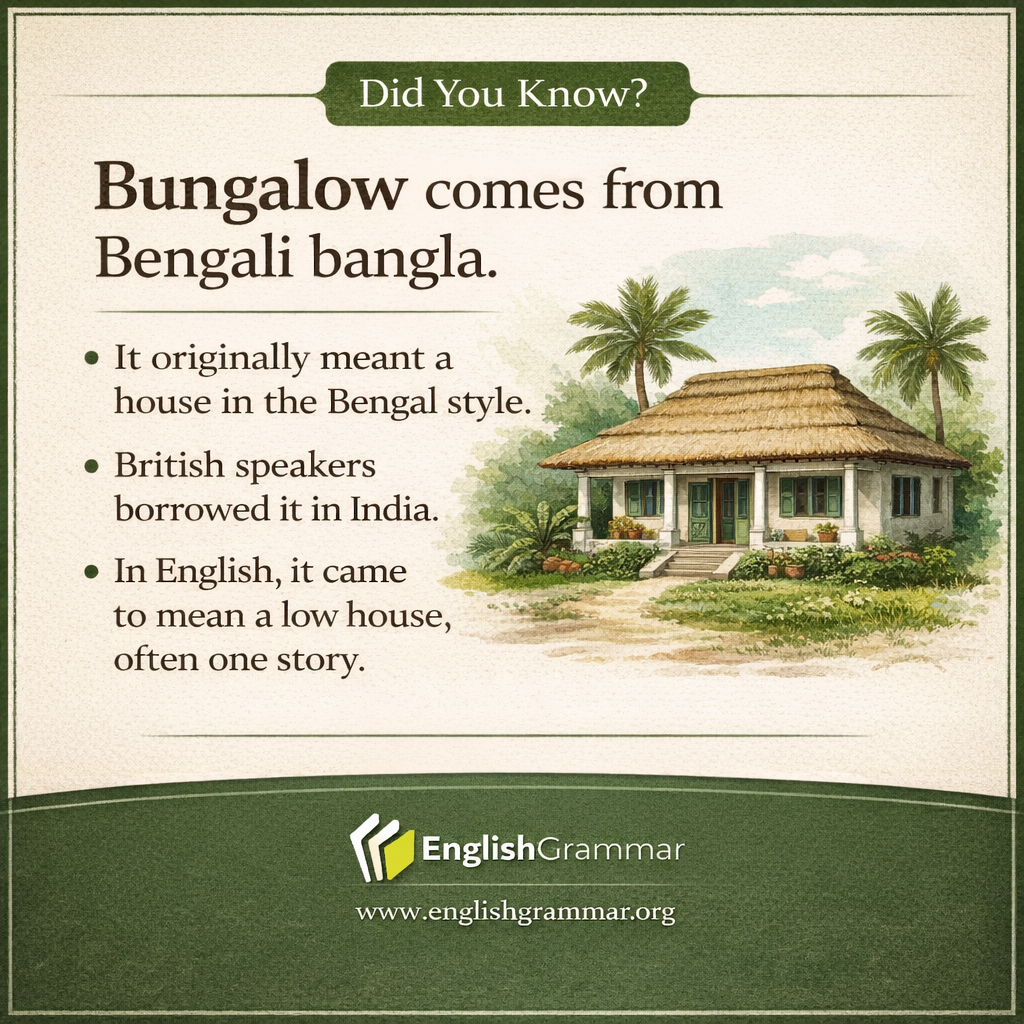
Bungalow looks like a classic English housing word, but it actually comes from Bengali bangla. That word meant a house built in the style associated with Bengal.

During the period of British rule in India, English speakers borrowed many local words. Bungalow was one of them. At first, it referred to a home modeled on the Bengal style, typically simple, airy, and suited to a hot climate.

Over time, the meaning shifted in English. Instead of pointing mainly to its regional origin, bungalow came to mean a certain kind of house, usually low and often only one story.

That is why the modern English meaning is related to, but not exactly the same as, the original one.

  • Original sense: a house in the Bengal style
  • Later English sense: a low house, often one story
  • Example: “They bought a small bungalow near the beach.”

This is a good reminder that borrowed words often change slightly after entering a new language. Their form may stay familiar while their meaning becomes narrower, broader, or simply different over time.

Improve your English grammar, vocabulary and writing

We take you step by step from beginner to advanced, even if you struggled with English at school or have always had trouble remembering the rules.

  • 10 modules, 112 lessons and 730 questions
  • Just log in and learn anytime and anywhere
  • Your progress is saved in your account
  • Download the 2027 Grammar Guide (PDF)
Join free

Already have an account? Sign in

See what’s in the course

Primary Sidebar

2.4M760.9K165.9K

Free 2027 Grammar Guide

  • Download Grammar Guide (PDF)
  • Online grammar course, A1 to C2
  • Weekly exercises and vocabulary
  • Join over 3 million English learners

We respect your privacy. Unsubscribe anytime.

Already have an account? Sign in

Grammar Checker - Try Now

Latest Posts

  • The origin of “out of the frying pan into the fire” November 4, 2026
  • Hairdresser Vocabulary Exercise November 4, 2026
  • Must and Have To for Obligation Exercise November 4, 2026
  • 100 Best Synonyms for “Chic” November 4, 2026
  • 100 Best Synonyms for “Vision” November 4, 2026
  • 100 Best Synonyms for “Inevitable” November 4, 2026
  • 100 Best Synonyms for “Retributive” November 3, 2026
  • 100 Best Synonyms for “Vary” November 3, 2026
  • 100 Best Synonyms for “Individuals” November 3, 2026
  • Temporary vs. passing vs. fleeting vs. transient vs. ephemeral vs. evanescent November 3, 2026
Home of English Grammar

Free English grammar exercises, rules and vocabulary lists, with new exercises every week. Join the leading English grammar site with over 3 million followers.

Join free

Learn

  • Exercises
  • Matches
  • Grammar rules
  • Vocabulary lists
  • Writing guides
  • Online tools

More

  • Top social media posts
  • Various posts
  • Contact

Account

  • Join free
  • Grammar Course
  • Free grammar guide (PDF)

Copyright © 2026 EnglishGrammar.org

  • Disclaimer
  • Privacy policy
  • Terms
  • Sitemap