Home of English Grammar

Grammar Guide
  • Home
  • Exercises
  • Matches
  • Rules
  • Tools
    • Grammar Checker
    • Very Replacer
    • Word Counter
  • Top Social Media Posts
  • Various Posts
  • Vocabulary
  • Writing Guides
  • Contact

What “chew the cud” means, and where it comes from

May 15, 2026 - pdf

The origin of "chew the cud"

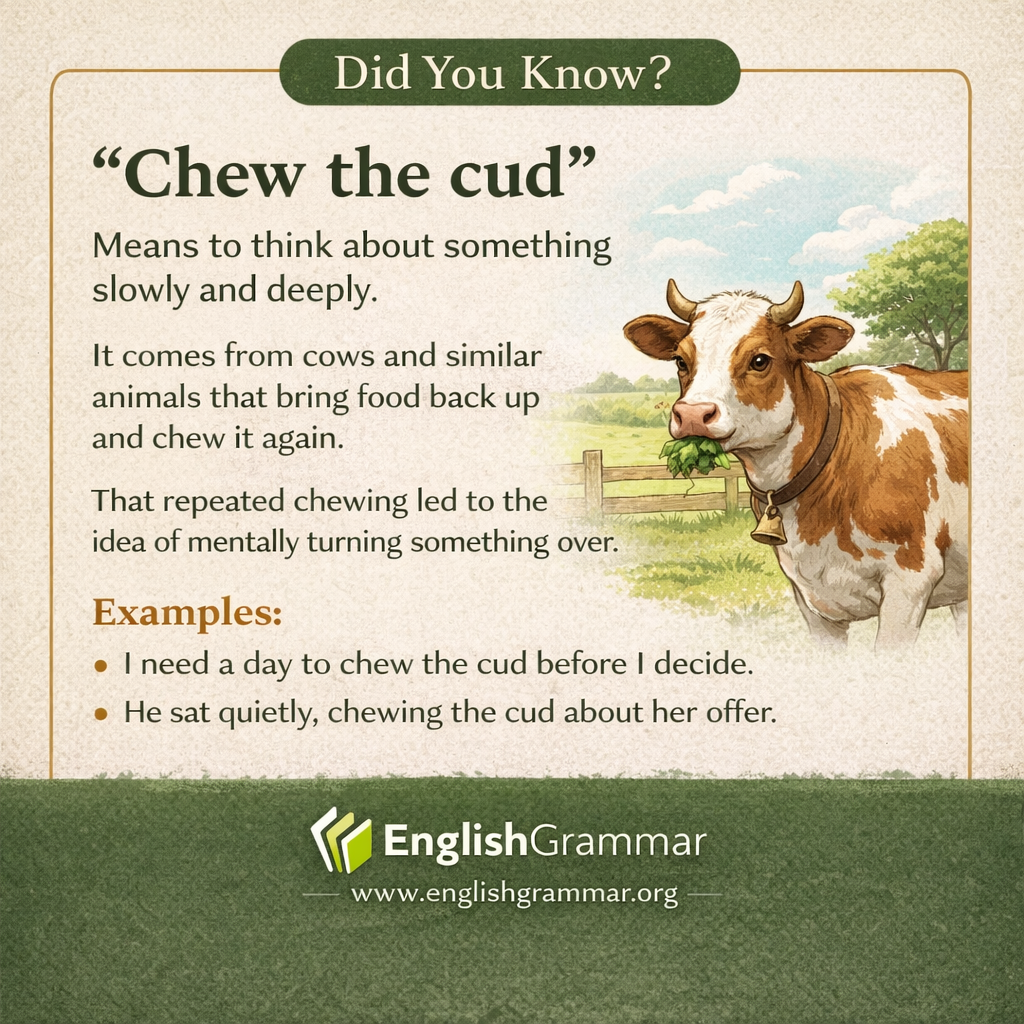
“Chew the cud” means to think deeply, slowly, and often quietly about something. In modern English, it usually suggests calm reflection rather than quick decision making.

The expression comes from animals such as cows, sheep, and goats. These animals first swallow partly digested food, then bring it back into the mouth and chew it again. That repeated process created a clear image for people: going back over something more than once.

Because of that link, the phrase came to mean mentally revisiting an idea, memory, or decision. When you chew the cud, you are not just thinking once. You are turning the matter over in your mind.

  • I need some time to chew the cud before I accept the job.
  • After the meeting, she went for a walk and chewed the cud about what had been said.

This idiom is fairly traditional in tone, so it often appears in thoughtful or literary contexts. It can also be used in everyday speech when you want to suggest slow, careful consideration rather than rushed thinking.

  • Share
  • Post
  • Post
  • Email
NEW: Try Matches, our daily vocabulary challenge. Pick a topic and level and match words with definitions to boost your vocabulary.
2,485,429 
761,532 
Improve Your Grammar
  • Download 2026 Grammar Guide (PDF)
  • Free Weekly Exercises & Vocabulary
  • Join over 3 Million English Learners
We respect your privacy. Unsubscribe anytime.

Grammar Checker

GrammarCheck.net - Try online
Hint → Bookmark GrammarCheck for future use.

Latest Posts

  • Cursory vs. perfunctory: what is the difference? June 5, 2026
  • 100 Best Synonyms for “Magnanimous” June 5, 2026
  • The origin of “go the extra mile” June 5, 2026
  • 100 Words Every Operations Analyst Should Know June 5, 2026
  • 100 Words to Describe Neighbors June 5, 2026
  • 100 Questions to Ask During a Coffee Chat June 5, 2026
  • 100 Words to Describe Silence June 5, 2026

Copyright © 2026 · EnglishGrammar.org
Disclaimer · Privacy Policy · Sitemap · Terms

Improve Your Grammar
  • Download 2026 Grammar Guide (PDF)
  • Free Weekly Exercises & Vocabulary
  • Join over 3 Million English Learners
We respect your privacy. Unsubscribe anytime.