
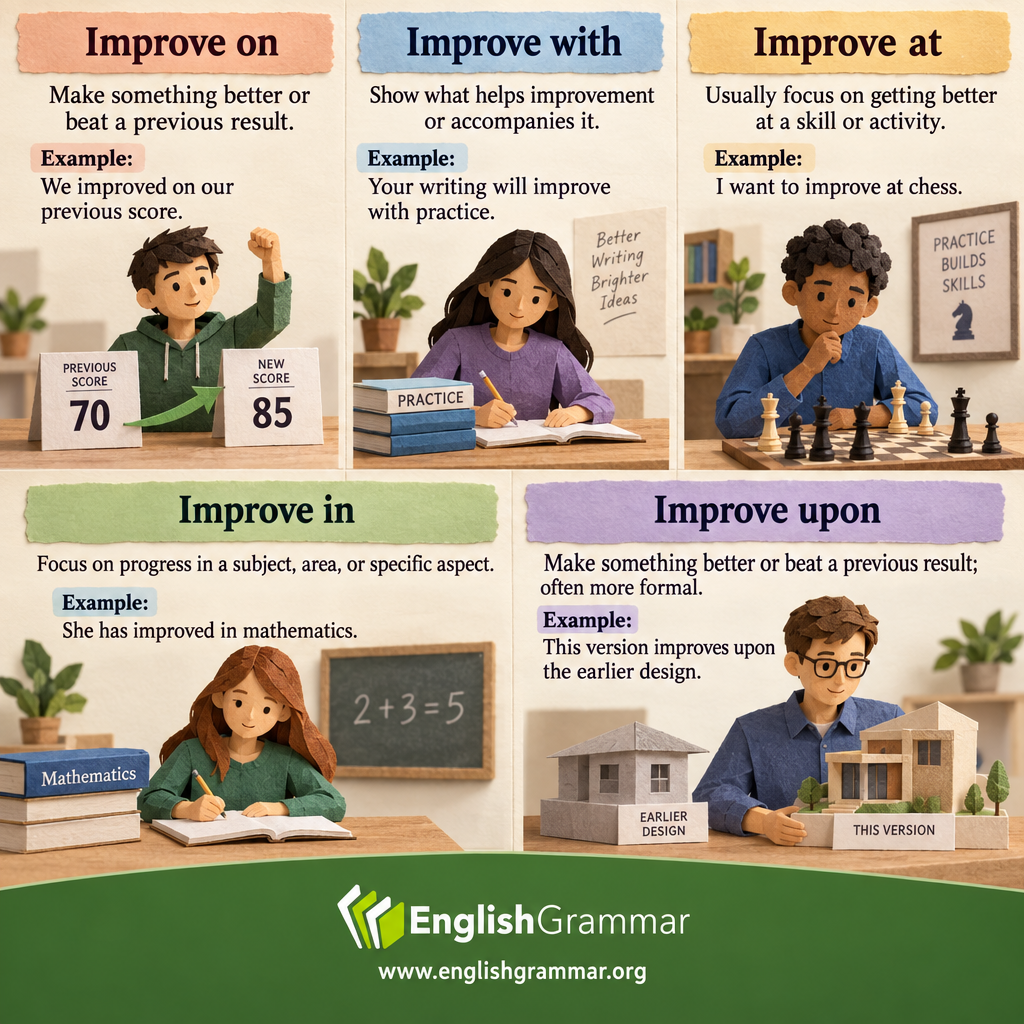
The preposition after improve helps show what is getting better, what helps it, or what earlier result you are comparing it with. These phrases overlap, so context matters.
- Improve on means to make something better or achieve a better result than before. We hope to improve on last year’s sales figures. The earlier figures are the starting point for comparison. Can you improve on this design? asks whether you can produce a better version.
- Improve with introduces something that helps improvement or a condition that accompanies it. Her confidence improved with regular practice. It can also introduce a tool: We improved the presentation with clearer charts.
- Improve at usually points to a skill or activity. He is improving at swimming. You can also use it before an activity expressed with an -ing form: She improved at solving puzzles.
- Improve in points to a subject, area, or particular aspect. The team has improved in accuracy. It identifies where progress has happened.
- Improve upon has the same basic uses as improve on, but often sounds more formal. The new proposal improves upon the original plan.
The distinction between at and in is not absolute. Compare She improved at speaking French, which focuses on an activity, with She improved in French, which treats French as a subject or area. Choose the wording that best matches your focus rather than treating these prepositions as completely separate meanings.
