
• Skip to primary navigation
  • Skip to main content
  • Skip to primary sidebar
Home of English Grammar
  • Home
  • Exercises
  • Matches
  • Posts
  • Rules
  • Social Media Archive
  • Tools
    • Grammar Checker
    • Very Replacer
    • Word Counter
  • Vocabulary
  • Writing Guides
  • Pro

What a cliché is, and why writers avoid it

April 4, 2026 pdf

Clichés

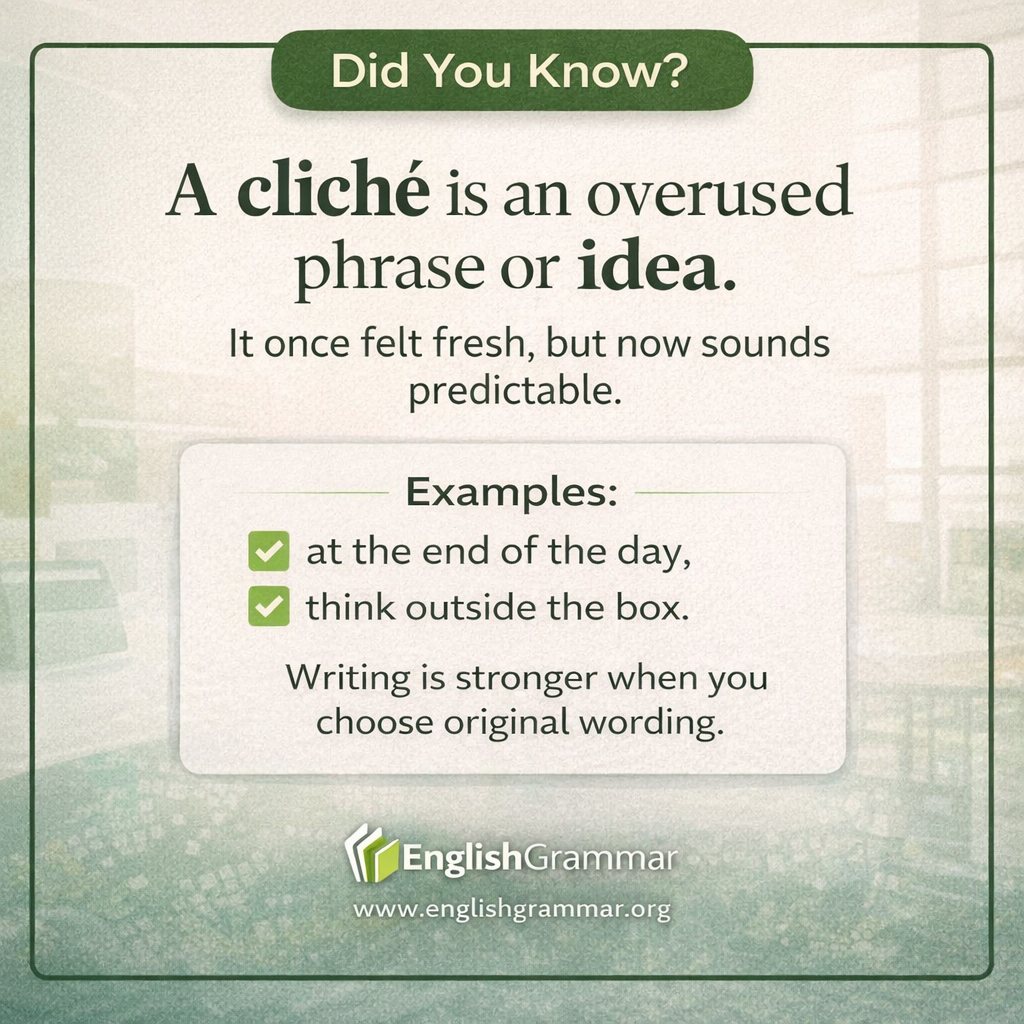
A cliché is a phrase, image, or idea that has been used so often that it no longer feels fresh. It may still be understood easily, but it can make writing sound predictable or lazy.

Common examples include at the end of the day, think outside the box, and every cloud has a silver lining. These expressions are familiar, but because readers have seen them many times, they usually add little impact.

Writers often avoid clichés when they want their language to feel specific and original. Instead of using a ready made phrase, it is usually stronger to describe the exact point.

  • Cliché: She was as busy as a bee.
  • Clearer version: She answered emails, took calls, and finished the report before noon.

Not every cliché is a mistake. In casual speech, clichés can be useful because they are quick and widely understood. But in careful writing, especially stories, essays, and ads, replacing them with precise wording usually creates a stronger effect.

  • Share
  • Post
  • Post
  • Reddit
  • Email
  • WhatsApp
NEW: Try Matches, our daily vocabulary challenge. Pick a topic and level and match words with definitions to boost your vocabulary.

Primary Sidebar

2,485,429 
761,532 
Improve Your English
  • Download 2026 Grammar Guide (PDF)
  • Free Weekly Exercises & Vocabulary
  • Join over 3 Million English Learners
We respect your privacy. Unsubscribe anytime.
Grammar Checker - Try Now

Latest Posts

  • 100 Best Synonyms for “Parasite” October 13, 2026
  • 100 Best Synonyms for “Tempted” October 13, 2026
  • 100 Best Synonyms for “Purity” October 12, 2026
  • Strategic Recommendation Language Exercise October 12, 2026
  • 100 Best Synonyms for “Attempt” October 12, 2026
  • Should have vs. should of: which is correct? October 12, 2026
  • Appointments Vocabulary Exercise October 12, 2026
  • 100 Best Synonyms for “Provoked” October 12, 2026
  • 100 Best Synonyms for “Stranded” October 12, 2026
  • The surprisingly old roots of “newfangled” October 12, 2026
Home of English Grammar

Free English grammar exercises, rules and vocabulary lists, with new exercises every week. Join the leading English grammar site with over 3 million followers.

Pro

Learn

  • Exercises
  • Matches
  • Grammar rules
  • Vocabulary lists
  • Writing guides
  • Online tools

More

  • Top social media posts
  • Various posts
  • Free grammar guide (PDF)
  • Contact

Pro

  • What is Pro?
  • Pro account
  • Pro exercises

Copyright © 2026 EnglishGrammar.org

  • Disclaimer
  • Privacy policy
  • Refund policy
  • Terms
  • Sitemap
Improve Your English
  • Download 2026 Grammar Guide (PDF)
  • Free Weekly Exercises & Vocabulary
  • Join over 3 Million English Learners
We respect your privacy. Unsubscribe anytime.