
• Skip to primary navigation
  • Skip to main content
  • Skip to primary sidebar
Home of English Grammar
  • Home
  • Course
  • Exercises
  • Grammar Rules
  • Matches
  • Posts
  • Tools
    • Grammar Checker
    • Very Replacer
    • Word Counter
  • Vocabulary Lists
  • Archives
    • Social Media Posts
    • Writing Guides
  • Join free

Doubtful vs. dubious: what is the difference?

September 20, 2026

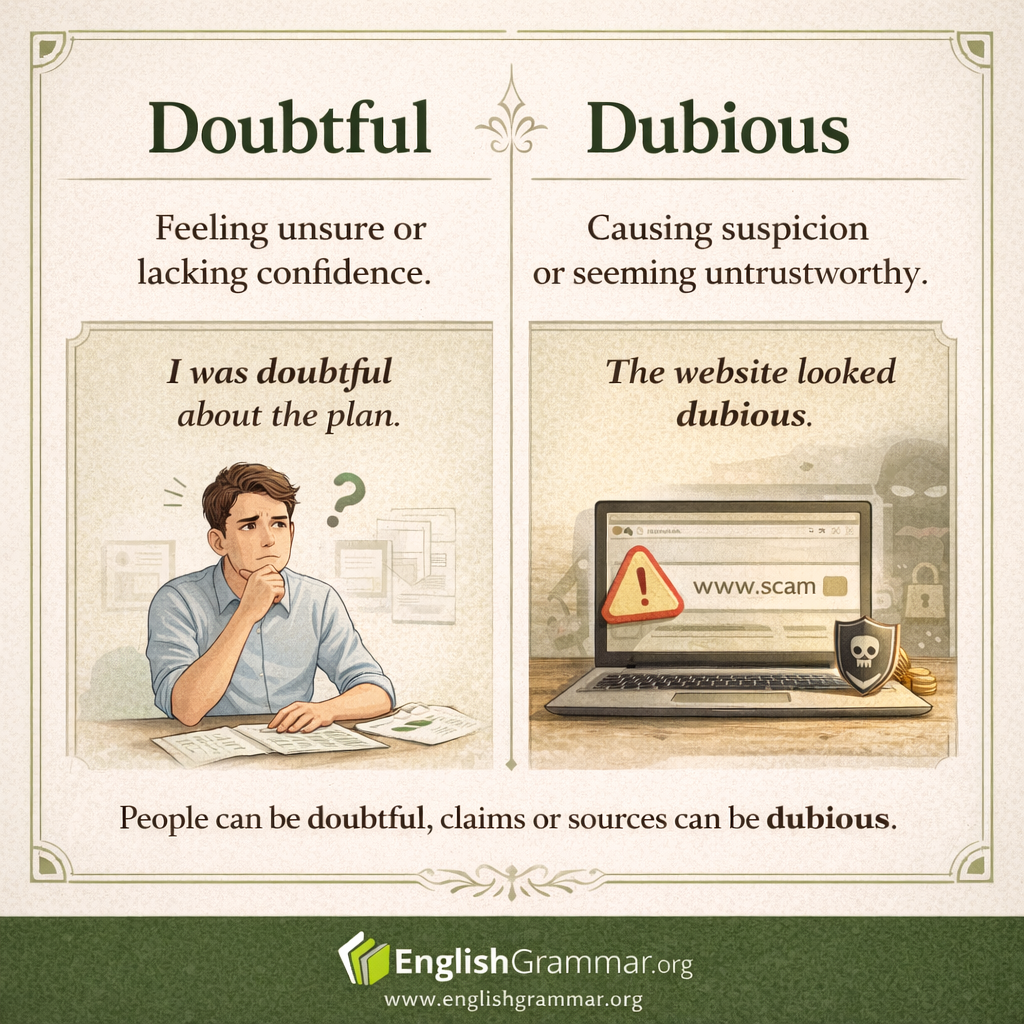
Doubtful vs. Dubious

Doubtful usually describes a person’s state of mind. It means unsure, uncertain, or lacking confidence about something. If you hesitate to believe a claim or feel unconvinced about a plan, doubtful is often the better choice.

Dubious usually describes the thing being judged. It means suspicious, questionable, or not likely to be honest or reliable. A source, excuse, deal, or website can seem dubious.

The simplest contrast is this: people are often doubtful, while claims, stories, and sources are often dubious.

  • I was doubtful about the numbers in the report.
  • Her explanation sounded dubious from the start.
  • He seemed doubtful that the policy would work.
  • They rejected the email because it looked dubious.

There is some overlap in real usage, especially when doubtful means unlikely, but this core distinction removes most confusion. If you mean uncertain, choose doubtful. If you mean suspicious or unreliable, choose dubious.

Improve your English grammar, vocabulary and writing

We take you step by step from beginner to advanced, even if you struggled with English at school or have always had trouble remembering the rules.

  • 10 modules, 105 lessons and 688 questions
  • Just log in and learn anytime and anywhere
  • Your progress is saved in your account
  • Download the 2026 Grammar Guide (PDF)
Join free

Already have an account? Sign in

See what’s in the course

Primary Sidebar

2.4M761.4K165.8K

Free 2026 Grammar Guide

  • Download Grammar Guide (PDF)
  • Online grammar course, A1 to C2
  • Weekly exercises and vocabulary
  • Join over 3 million English learners

We respect your privacy. Unsubscribe anytime.

Already have an account? Sign in

Grammar Checker - Try Now

Latest Posts

  • 100 Best Synonyms for “Changing” October 16, 2026
  • 100 Best Synonyms for “Platitude” October 15, 2026
  • 100 Best Synonyms for “Reluctant” October 15, 2026
  • “&c.”: an older abbreviation for “et cetera” October 15, 2026
  • 100 Best Synonyms for “Causing” October 15, 2026
  • 100 Best Synonyms for “Relief” October 15, 2026
  • Reported Speech and Reporting Verbs Exercise October 15, 2026
  • 100 Best Synonyms for “Plague” October 15, 2026
  • 100 Best Synonyms for “Unimpressed” October 15, 2026
  • Ease vs. alleviate vs. mitigate vs. abate vs. palliate October 15, 2026
Home of English Grammar

Free English grammar exercises, rules and vocabulary lists, with new exercises every week. Join the leading English grammar site with over 3 million followers.

Join free

Learn

  • Exercises
  • Matches
  • Grammar rules
  • Vocabulary lists
  • Writing guides
  • Online tools

More

  • Top social media posts
  • Various posts
  • Contact

Account

  • Join free
  • Grammar Course
  • Free grammar guide (PDF)

Copyright © 2026 EnglishGrammar.org

  • Disclaimer
  • Privacy policy
  • Terms
  • Sitemap