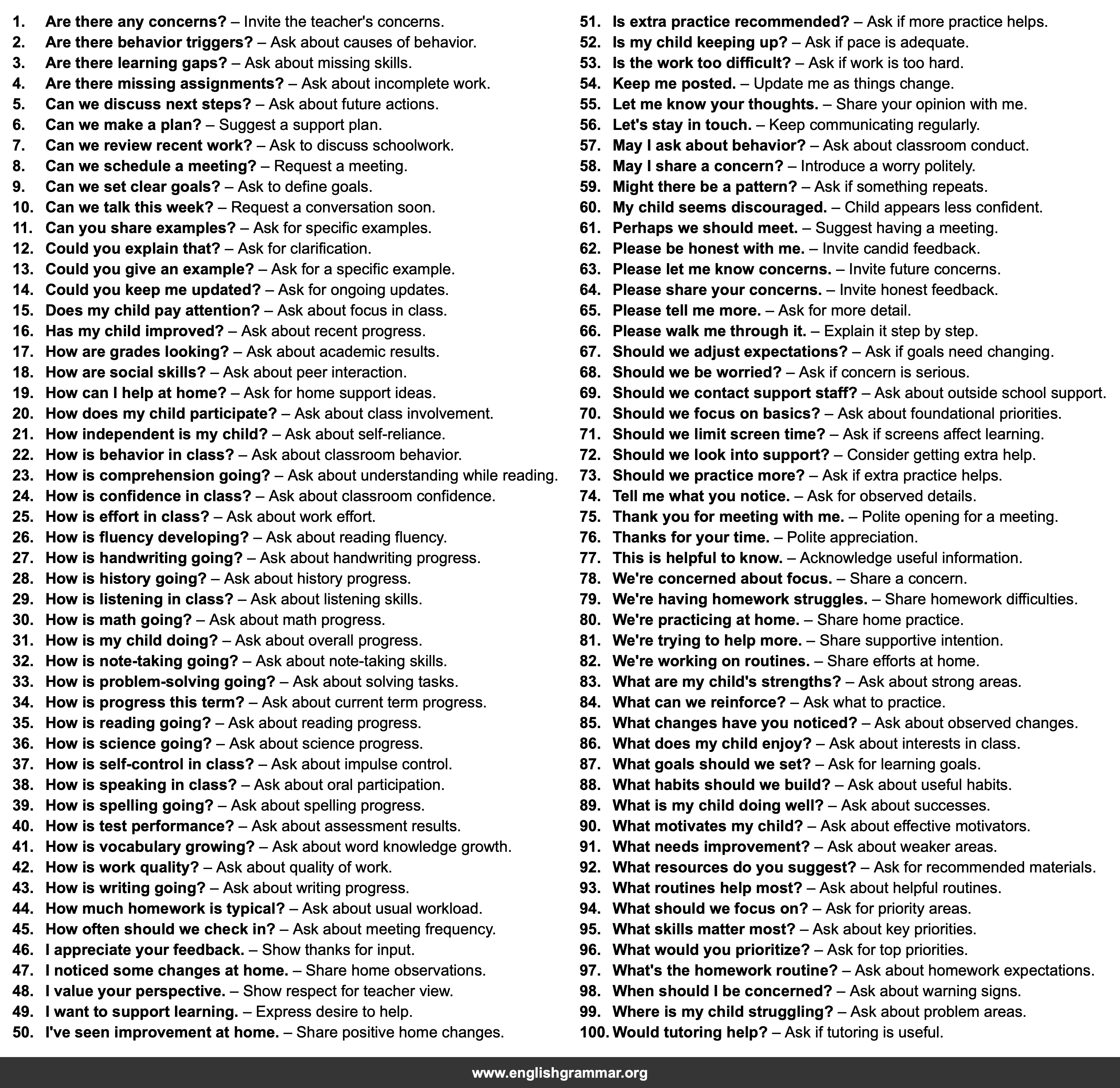
| No. | Item | Definition |
|---|---|---|
| 1. | Are there any concerns? | Invite the teacher’s concerns. |
| 2. | Are there behavior triggers? | Ask about causes of behavior. |
| 3. | Are there learning gaps? | Ask about missing skills. |
| 4. | Are there missing assignments? | Ask about incomplete work. |
| 5. | Can we discuss next steps? | Ask about future actions. |
| 6. | Can we make a plan? | Suggest a support plan. |
| 7. | Can we review recent work? | Ask to discuss schoolwork. |
| 8. | Can we schedule a meeting? | Request a meeting. |
| 9. | Can we set clear goals? | Ask to define goals. |
| 10. | Can we talk this week? | Request a conversation soon. |
| 11. | Can you share examples? | Ask for specific examples. |
| 12. | Could you explain that? | Ask for clarification. |
| 13. | Could you give an example? | Ask for a specific example. |
| 14. | Could you keep me updated? | Ask for ongoing updates. |
| 15. | Does my child pay attention? | Ask about focus in class. |
| 16. | Has my child improved? | Ask about recent progress. |
| 17. | How are grades looking? | Ask about academic results. |
| 18. | How are social skills? | Ask about peer interaction. |
| 19. | How can I help at home? | Ask for home support ideas. |
| 20. | How does my child participate? | Ask about class involvement. |
| 21. | How independent is my child? | Ask about self-reliance. |
| 22. | How is behavior in class? | Ask about classroom behavior. |
| 23. | How is comprehension going? | Ask about understanding while reading. |
| 24. | How is confidence in class? | Ask about classroom confidence. |
| 25. | How is effort in class? | Ask about work effort. |
| 26. | How is fluency developing? | Ask about reading fluency. |
| 27. | How is handwriting going? | Ask about handwriting progress. |
| 28. | How is history going? | Ask about history progress. |
| 29. | How is listening in class? | Ask about listening skills. |
| 30. | How is math going? | Ask about math progress. |
| 31. | How is my child doing? | Ask about overall progress. |
| 32. | How is note-taking going? | Ask about note-taking skills. |
| 33. | How is problem-solving going? | Ask about solving tasks. |
| 34. | How is progress this term? | Ask about current term progress. |
| 35. | How is reading going? | Ask about reading progress. |
| 36. | How is science going? | Ask about science progress. |
| 37. | How is self-control in class? | Ask about impulse control. |
| 38. | How is speaking in class? | Ask about oral participation. |
| 39. | How is spelling going? | Ask about spelling progress. |
| 40. | How is test performance? | Ask about assessment results. |
| 41. | How is vocabulary growing? | Ask about word knowledge growth. |
| 42. | How is work quality? | Ask about quality of work. |
| 43. | How is writing going? | Ask about writing progress. |
| 44. | How much homework is typical? | Ask about usual workload. |
| 45. | How often should we check in? | Ask about meeting frequency. |
| 46. | I appreciate your feedback. | Show thanks for input. |
| 47. | I noticed some changes at home. | Share home observations. |
| 48. | I value your perspective. | Show respect for teacher view. |
| 49. | I want to support learning. | Express desire to help. |
| 50. | I’ve seen improvement at home. | Share positive home changes. |
| 51. | Is extra practice recommended? | Ask if more practice helps. |
| 52. | Is my child keeping up? | Ask if pace is adequate. |
| 53. | Is the work too difficult? | Ask if work is too hard. |
| 54. | Keep me posted. | Update me as things change. |
| 55. | Let me know your thoughts. | Share your opinion with me. |
| 56. | Let’s stay in touch. | Keep communicating regularly. |
| 57. | May I ask about behavior? | Ask about classroom conduct. |
| 58. | May I share a concern? | Introduce a worry politely. |
| 59. | Might there be a pattern? | Ask if something repeats. |
| 60. | My child seems discouraged. | Child appears less confident. |
| 61. | Perhaps we should meet. | Suggest having a meeting. |
| 62. | Please be honest with me. | Invite candid feedback. |
| 63. | Please let me know concerns. | Invite future concerns. |
| 64. | Please share your concerns. | Invite honest feedback. |
| 65. | Please tell me more. | Ask for more detail. |
| 66. | Please walk me through it. | Explain it step by step. |
| 67. | Should we adjust expectations? | Ask if goals need changing. |
| 68. | Should we be worried? | Ask if concern is serious. |
| 69. | Should we contact support staff? | Ask about outside school support. |
| 70. | Should we focus on basics? | Ask about foundational priorities. |
| 71. | Should we limit screen time? | Ask if screens affect learning. |
| 72. | Should we look into support? | Consider getting extra help. |
| 73. | Should we practice more? | Ask if extra practice helps. |
| 74. | Tell me what you notice. | Ask for observed details. |
| 75. | Thank you for meeting with me. | Polite opening for a meeting. |
| 76. | Thanks for your time. | Polite appreciation. |
| 77. | This is helpful to know. | Acknowledge useful information. |
| 78. | We’re concerned about focus. | Share a concern. |
| 79. | We’re having homework struggles. | Share homework difficulties. |
| 80. | We’re practicing at home. | Share home practice. |
| 81. | We’re trying to help more. | Share supportive intention. |
| 82. | We’re working on routines. | Share efforts at home. |
| 83. | What are my child’s strengths? | Ask about strong areas. |
| 84. | What can we reinforce? | Ask what to practice. |
| 85. | What changes have you noticed? | Ask about observed changes. |
| 86. | What does my child enjoy? | Ask about interests in class. |
| 87. | What goals should we set? | Ask for learning goals. |
| 88. | What habits should we build? | Ask about useful habits. |
| 89. | What is my child doing well? | Ask about successes. |
| 90. | What motivates my child? | Ask about effective motivators. |
| 91. | What needs improvement? | Ask about weaker areas. |
| 92. | What resources do you suggest? | Ask for recommended materials. |
| 93. | What routines help most? | Ask about helpful routines. |
| 94. | What should we focus on? | Ask for priority areas. |
| 95. | What skills matter most? | Ask about key priorities. |
| 96. | What would you prioritize? | Ask for top priorities. |
| 97. | What’s the homework routine? | Ask about homework expectations. |
| 98. | When should I be concerned? | Ask about warning signs. |
| 99. | Where is my child struggling? | Ask about problem areas. |
| 100. | Would tutoring help? | Ask if tutoring is useful. |
