
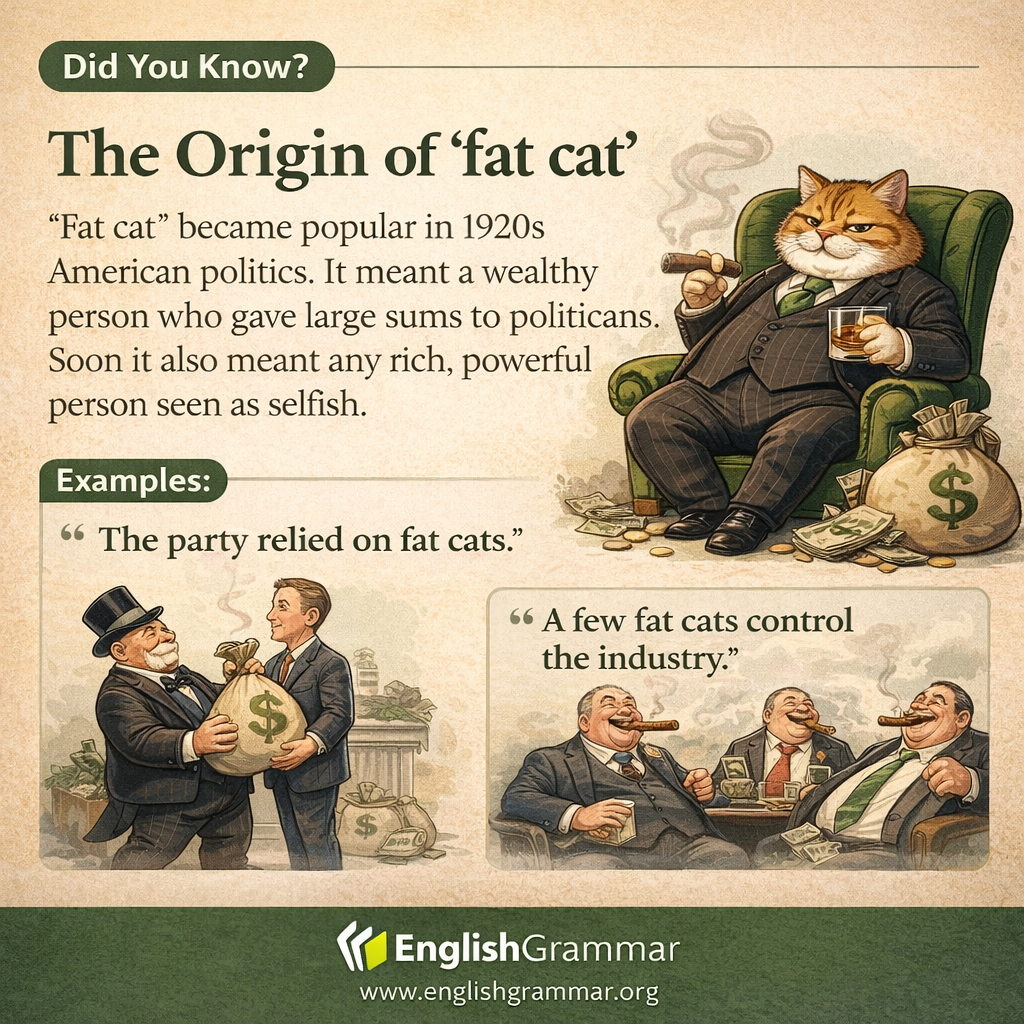
The phrase “fat cat” became well known in the United States in the 1920s. It was first used in politics for a wealthy person who gave large amounts of money to a political party or candidate. In that earlier sense, the focus was not just wealth, but political influence.
For example, a newspaper might describe major donors as fat cats if a party depended on them for funding. A sentence like “The party relied on fat cats” reflects that original use.
Over time, the meaning broadened. Today, “fat cat” usually refers to a rich and powerful person who is viewed as greedy, privileged, or out of touch. It is often critical, not neutral.
- Earlier meaning: a wealthy political donor.
- Later broader meaning: a rich, influential person seen negatively.
- Typical tone: informal and disapproving.
So if someone says, “A few fat cats control the industry,” they usually mean that a small group of wealthy elites has too much power. The phrase is colorful, but it carries a clear criticism.
