
• Skip to primary navigation
  • Skip to main content
  • Skip to primary sidebar
Home of English Grammar
  • Home
  • Course
  • Exercises
  • Grammar Rules
  • Matches
  • Posts
  • Tools
    • Grammar Checker
    • Very Replacer
    • Word Counter
  • Vocabulary Lists
  • Archives
    • Social Media Posts
    • Writing Guides
  • Sign in
  • Join free

Why we say “dead as a doornail”

May 20, 2026

The origin of "dead as a doornail"

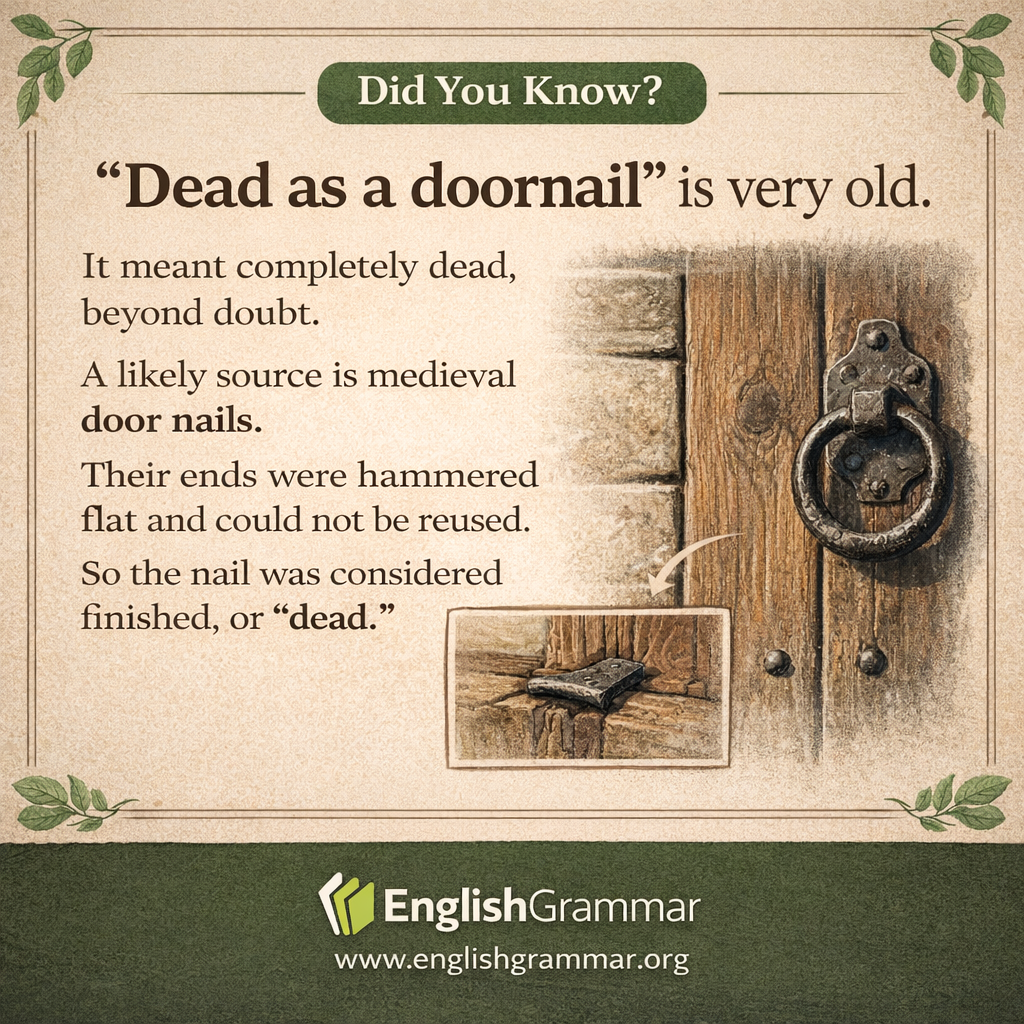
“Dead as a doornail” is an old English expression meaning completely dead or beyond any doubt. Writers have used it for centuries, including William Shakespeare and Charles Dickens, so the phrase was already well established long ago.

The exact origin is not certain, but the most widely repeated explanation involves old wooden doors. Large nails were driven through the door, and the point sticking out on the other side was hammered flat, a process sometimes called clinching. Once flattened, the nail was fixed in place and could not easily be used again. In that practical sense, it was considered dead, meaning finished or inactive.

That helps explain why the phrase sounds so strong. It does not just mean dead. It means unquestionably, unmistakably dead.

  • Literal style: “The battery is dead as a doornail.”
  • Figurative style: “By midnight, the conversation was dead as a doornail.”

Today, people often use the expression humorously or for emphasis, especially for machines, phones, batteries, or plans that have clearly stopped working. Even if the precise history cannot be proved with certainty, the door nail explanation remains the most common and sensible one.

Improve your English grammar, vocabulary and writing

We take you step by step from beginner to advanced, even if you struggled with English at school or have always had trouble remembering the rules.

  • 10 modules, 112 lessons and 730 questions
  • Just log in and learn anytime and anywhere
  • Your progress is saved in your account
  • Download the 2027 Grammar Guide (PDF)
Join free

Already have an account? Sign in

See what’s in the course

Primary Sidebar

2.4M760.9K165.9K

Free 2027 Grammar Guide

  • Download Grammar Guide (PDF)
  • Online grammar course, A1 to C2
  • Weekly exercises and vocabulary
  • Join over 3 million English learners

We respect your privacy. Unsubscribe anytime.

Already have an account? Sign in

Grammar Checker - Try Now

Latest Posts

  • 100 Best Synonyms for “Unreal” November 2, 2026
  • 100 Best Synonyms for “Regard” November 2, 2026
  • 100 Best Synonyms for “Respite” November 2, 2026
  • 100 Proverbs from Around the World Every Adult Should Know November 2, 2026
  • 100 Best Synonyms for “Inappropriate” November 2, 2026
  • 100 Best Synonyms for “Unprecedented” November 2, 2026
  • Ample vs. plentiful vs. abundant vs. bountiful vs. copious vs. profuse November 2, 2026
  • 100 Best Synonyms for “Respectfully” November 2, 2026
  • Creepy, spooky, eerie, sinister, macabre, and bloodcurdling: What’s the difference? November 2, 2026
  • 100 Best Synonyms for “Improvement” November 2, 2026
Home of English Grammar

Free English grammar exercises, rules and vocabulary lists, with new exercises every week. Join the leading English grammar site with over 3 million followers.

Join free

Learn

  • Exercises
  • Matches
  • Grammar rules
  • Vocabulary lists
  • Writing guides
  • Online tools

More

  • Top social media posts
  • Various posts
  • Contact

Account

  • Join free
  • Grammar Course
  • Free grammar guide (PDF)

Copyright © 2026 EnglishGrammar.org

  • Disclaimer
  • Privacy policy
  • Terms
  • Sitemap