
• Skip to primary navigation
  • Skip to main content
  • Skip to primary sidebar
Home of English Grammar
  • Home
  • Course
  • Exercises
  • Grammar Rules
  • Matches
  • Posts
  • Tools
    • Grammar Checker
    • Very Replacer
    • Word Counter
  • Vocabulary Lists
  • Archives
    • Social Media Posts
    • Writing Guides
  • Join free

Forward vs. foreword: what is the difference?

September 12, 2026

Forward vs. Foreword

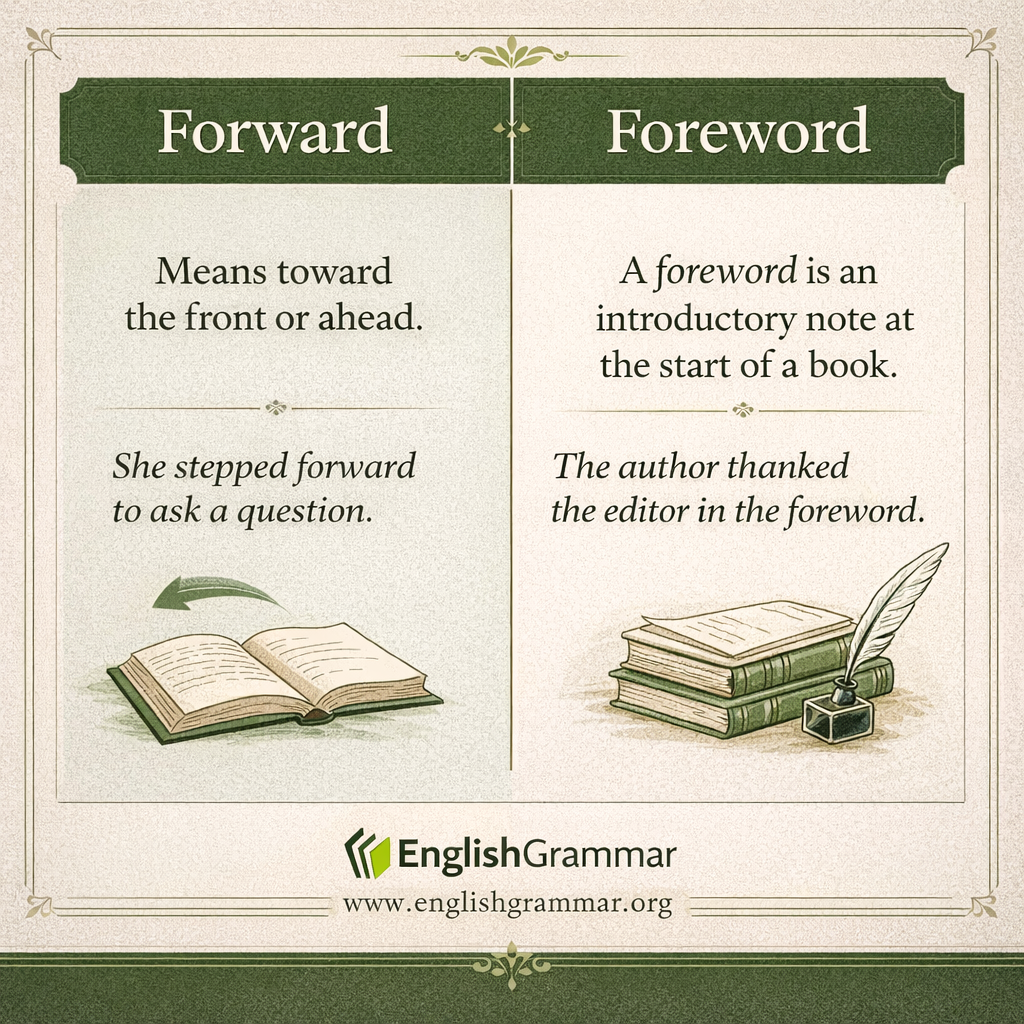
Forward and foreword sound alike, but they mean very different things.

Forward usually relates to movement, direction, or progress. It can mean toward the front, ahead, or onward. You might move forward in a line, look forward to an event, or push a plan forward. Example: She stepped forward when her name was called.

Foreword is a noun used in publishing. It is the short introductory section at the beginning of a book. A foreword is often written by someone other than the main author, such as an expert, editor, or well known figure. Example: The professor wrote the foreword to the new edition.

A simple way to remember the difference is this: forward is about position or progress, while foreword is a word found before the main text of a book.

  • Use forward for movement, direction, or progress.
  • Use foreword for a book’s opening note.
  • They sound the same, but they are not interchangeable.

Improve your English grammar, vocabulary and writing

We take you step by step from beginner to advanced, even if you struggled with English at school or have always had trouble remembering the rules.

  • 10 modules, 105 lessons and 688 questions
  • Just log in and learn anytime and anywhere
  • Your progress is saved in your account
  • Download the 2026 Grammar Guide (PDF)
Join free

Already have an account? Sign in

See what’s in the course

Primary Sidebar

2.4M761.4K165.8K

Free 2026 Grammar Guide

  • Download Grammar Guide (PDF)
  • Online grammar course, A1 to C2
  • Weekly exercises and vocabulary
  • Join over 3 million English learners

We respect your privacy. Unsubscribe anytime.

Already have an account? Sign in

Grammar Checker - Try Now

Latest Posts

  • 100 Best Synonyms for “Revealed” October 17, 2026
  • Conditional Consequence Clauses Exercise October 17, 2026
  • “Twingle-twangle” is a real example of reduplication October 17, 2026
  • Comparing Places Exercise October 17, 2026
  • 100 Best Synonyms for “Pompous” October 17, 2026
  • 100 Best Synonyms for “Unprotected” October 17, 2026
  • 100 Best Synonyms for “Compliance” October 16, 2026
  • 100 Best Synonyms for “Responsiveness” October 16, 2026
  • 100 Best Synonyms for “Polarizing” October 16, 2026
  • The origin of “no spring chicken” October 16, 2026
Home of English Grammar

Free English grammar exercises, rules and vocabulary lists, with new exercises every week. Join the leading English grammar site with over 3 million followers.

Join free

Learn

  • Exercises
  • Matches
  • Grammar rules
  • Vocabulary lists
  • Writing guides
  • Online tools

More

  • Top social media posts
  • Various posts
  • Contact

Account

  • Join free
  • Grammar Course
  • Free grammar guide (PDF)

Copyright © 2026 EnglishGrammar.org

  • Disclaimer
  • Privacy policy
  • Terms
  • Sitemap