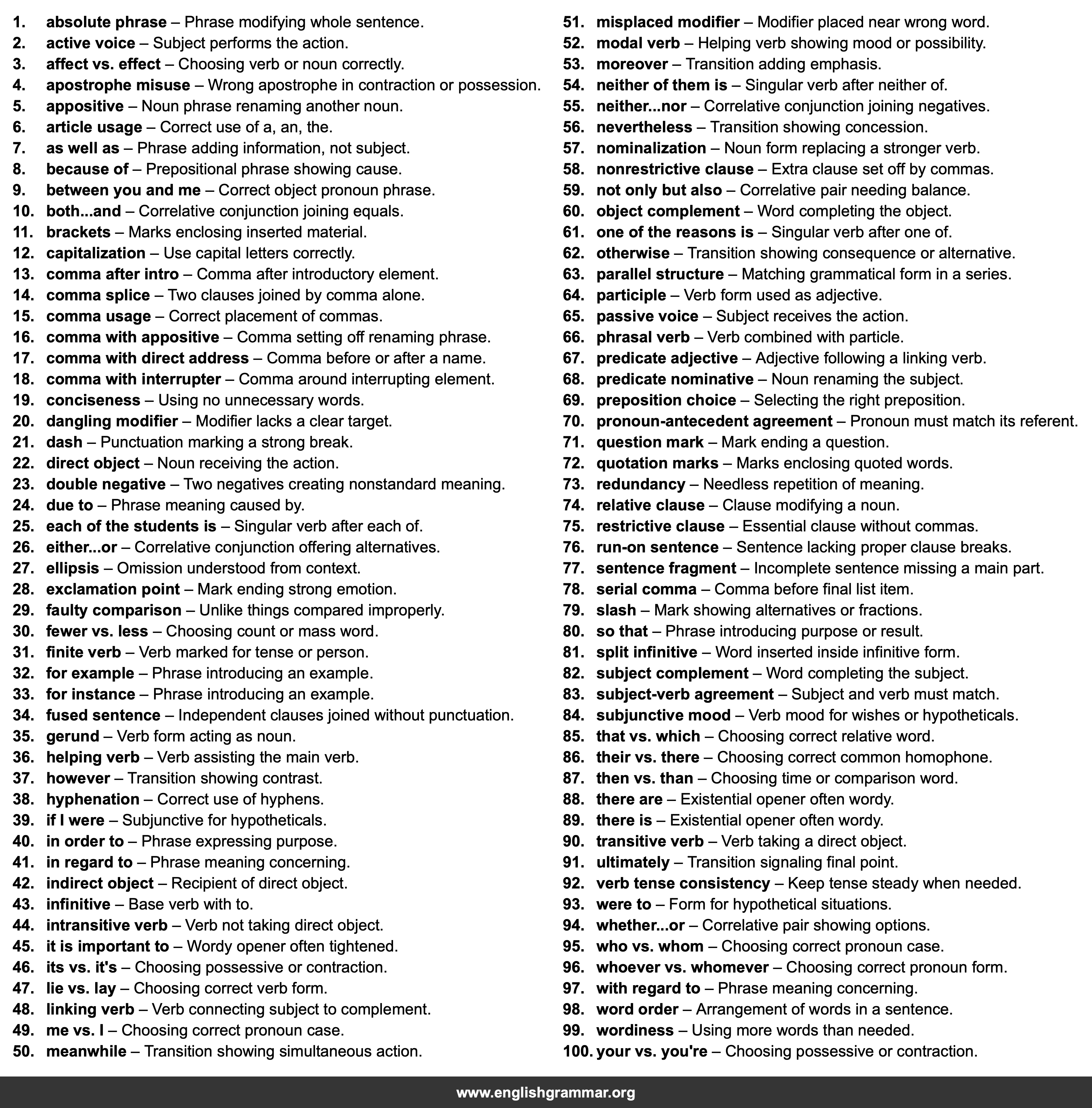
| No. | Item | Definition |
|---|---|---|
| 1. | absolute phrase | Phrase modifying whole sentence. |
| 2. | active voice | Subject performs the action. |
| 3. | affect vs. effect | Choosing verb or noun correctly. |
| 4. | apostrophe misuse | Wrong apostrophe in contraction or possession. |
| 5. | appositive | Noun phrase renaming another noun. |
| 6. | article usage | Correct use of a, an, the. |
| 7. | as well as | Phrase adding information, not subject. |
| 8. | because of | Prepositional phrase showing cause. |
| 9. | between you and me | Correct object pronoun phrase. |
| 10. | both…and | Correlative conjunction joining equals. |
| 11. | brackets | Marks enclosing inserted material. |
| 12. | capitalization | Use capital letters correctly. |
| 13. | comma after intro | Comma after introductory element. |
| 14. | comma splice | Two clauses joined by comma alone. |
| 15. | comma usage | Correct placement of commas. |
| 16. | comma with appositive | Comma setting off renaming phrase. |
| 17. | comma with direct address | Comma before or after a name. |
| 18. | comma with interrupter | Comma around interrupting element. |
| 19. | conciseness | Using no unnecessary words. |
| 20. | dangling modifier | Modifier lacks a clear target. |
| 21. | dash | Punctuation marking a strong break. |
| 22. | direct object | Noun receiving the action. |
| 23. | double negative | Two negatives creating nonstandard meaning. |
| 24. | due to | Phrase meaning caused by. |
| 25. | each of the students is | Singular verb after each of. |
| 26. | either…or | Correlative conjunction offering alternatives. |
| 27. | ellipsis | Omission understood from context. |
| 28. | exclamation point | Mark ending strong emotion. |
| 29. | faulty comparison | Unlike things compared improperly. |
| 30. | fewer vs. less | Choosing count or mass word. |
| 31. | finite verb | Verb marked for tense or person. |
| 32. | for example | Phrase introducing an example. |
| 33. | for instance | Phrase introducing an example. |
| 34. | fused sentence | Independent clauses joined without punctuation. |
| 35. | gerund | Verb form acting as noun. |
| 36. | helping verb | Verb assisting the main verb. |
| 37. | however | Transition showing contrast. |
| 38. | hyphenation | Correct use of hyphens. |
| 39. | if I were | Subjunctive for hypotheticals. |
| 40. | in order to | Phrase expressing purpose. |
| 41. | in regard to | Phrase meaning concerning. |
| 42. | indirect object | Recipient of direct object. |
| 43. | infinitive | Base verb with to. |
| 44. | intransitive verb | Verb not taking direct object. |
| 45. | it is important to | Wordy opener often tightened. |
| 46. | its vs. it’s | Choosing possessive or contraction. |
| 47. | lie vs. lay | Choosing correct verb form. |
| 48. | linking verb | Verb connecting subject to complement. |
| 49. | me vs. I | Choosing correct pronoun case. |
| 50. | meanwhile | Transition showing simultaneous action. |
| 51. | misplaced modifier | Modifier placed near wrong word. |
| 52. | modal verb | Helping verb showing mood or possibility. |
| 53. | moreover | Transition adding emphasis. |
| 54. | neither of them is | Singular verb after neither of. |
| 55. | neither…nor | Correlative conjunction joining negatives. |
| 56. | nevertheless | Transition showing concession. |
| 57. | nominalization | Noun form replacing a stronger verb. |
| 58. | nonrestrictive clause | Extra clause set off by commas. |
| 59. | not only but also | Correlative pair needing balance. |
| 60. | object complement | Word completing the object. |
| 61. | one of the reasons is | Singular verb after one of. |
| 62. | otherwise | Transition showing consequence or alternative. |
| 63. | parallel structure | Matching grammatical form in a series. |
| 64. | participle | Verb form used as adjective. |
| 65. | passive voice | Subject receives the action. |
| 66. | phrasal verb | Verb combined with particle. |
| 67. | predicate adjective | Adjective following a linking verb. |
| 68. | predicate nominative | Noun renaming the subject. |
| 69. | preposition choice | Selecting the right preposition. |
| 70. | pronoun-antecedent agreement | Pronoun must match its referent. |
| 71. | question mark | Mark ending a question. |
| 72. | quotation marks | Marks enclosing quoted words. |
| 73. | redundancy | Needless repetition of meaning. |
| 74. | relative clause | Clause modifying a noun. |
| 75. | restrictive clause | Essential clause without commas. |
| 76. | run-on sentence | Sentence lacking proper clause breaks. |
| 77. | sentence fragment | Incomplete sentence missing a main part. |
| 78. | serial comma | Comma before final list item. |
| 79. | slash | Mark showing alternatives or fractions. |
| 80. | so that | Phrase introducing purpose or result. |
| 81. | split infinitive | Word inserted inside infinitive form. |
| 82. | subject complement | Word completing the subject. |
| 83. | subject-verb agreement | Subject and verb must match. |
| 84. | subjunctive mood | Verb mood for wishes or hypotheticals. |
| 85. | that vs. which | Choosing correct relative word. |
| 86. | their vs. there | Choosing correct common homophone. |
| 87. | then vs. than | Choosing time or comparison word. |
| 88. | there are | Existential opener often wordy. |
| 89. | there is | Existential opener often wordy. |
| 90. | transitive verb | Verb taking a direct object. |
| 91. | ultimately | Transition signaling final point. |
| 92. | verb tense consistency | Keep tense steady when needed. |
| 93. | were to | Form for hypothetical situations. |
| 94. | whether…or | Correlative pair showing options. |
| 95. | who vs. whom | Choosing correct pronoun case. |
| 96. | whoever vs. whomever | Choosing correct pronoun form. |
| 97. | with regard to | Phrase meaning concerning. |
| 98. | word order | Arrangement of words in a sentence. |
| 99. | wordiness | Using more words than needed. |
| 100. | your vs. you’re | Choosing possessive or contraction. |
