
• Skip to primary navigation
  • Skip to main content
  • Skip to primary sidebar
Home of English Grammar
  • Home
  • Course
  • Exercises
  • Grammar Rules
  • Matches
  • Posts
  • Tools
    • Grammar Checker
    • Very Replacer
    • Word Counter
  • Vocabulary Lists
  • Archives
    • Social Media Posts
    • Writing Guides
  • Join free

Why “guy” comes from Guy Fawkes

April 20, 2026

Why "guy" comes from Guy Fawkes

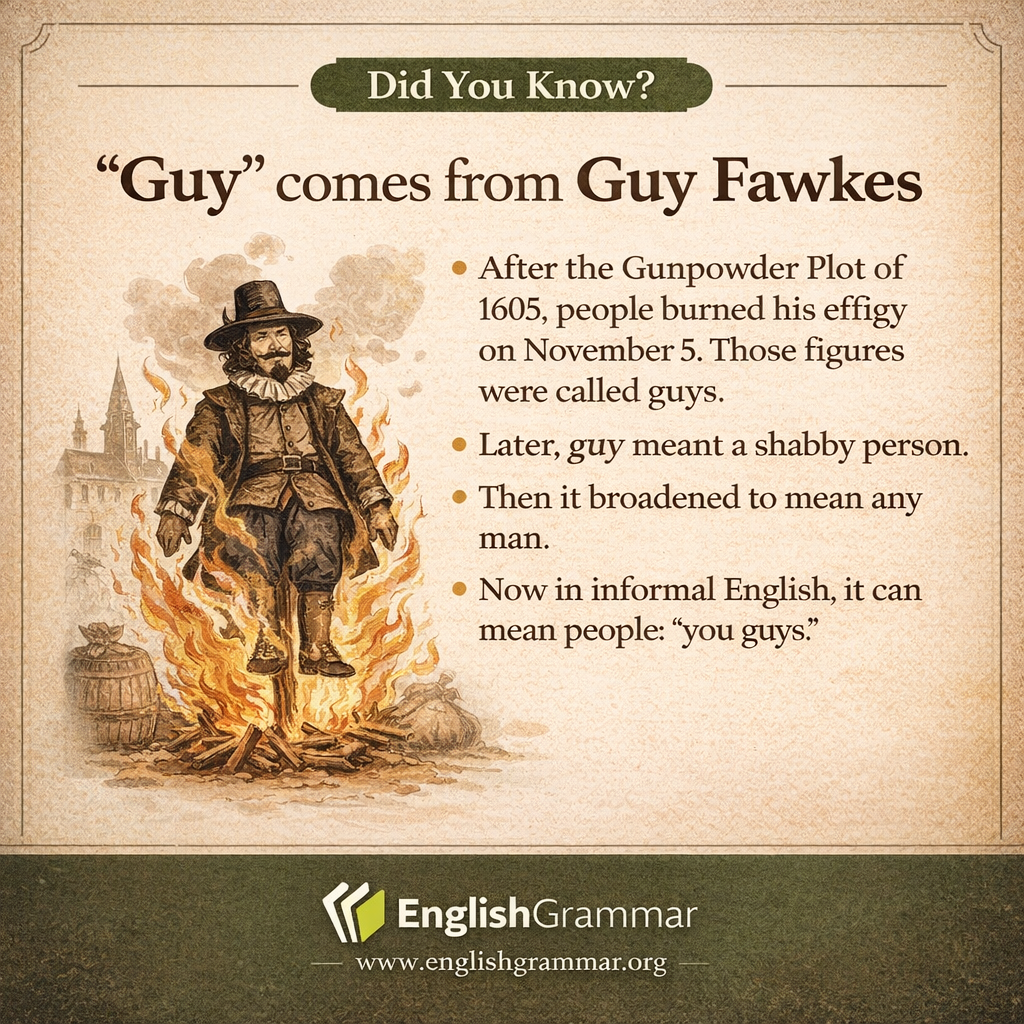
The word guy comes from Guy Fawkes, one of the men involved in the Gunpowder Plot of 1605 in England. After the plot failed, people marked November 5 by burning effigies of Fawkes. Those figures were called guys.

From there, the meaning widened. By the 18th and 19th centuries, guy could mean a person dressed oddly or a shabby looking man, probably because the effigies looked ragged. Later, especially in American English, it became a general informal word for man.

Today, the word is even broader in casual speech. Many speakers use guy for one man, guys for several men, and you guys for a mixed group.

  • Original sense: They carried a guy through the streets on November 5.
  • Later sense: He looked like a guy in old torn clothes.
  • Modern sense: That guy is my neighbor.
  • Group use: Are you guys ready?

So a personal name became a holiday figure, then a description, and finally one of the most common informal words in English.

Improve your English grammar, vocabulary and writing

We take you step by step from beginner to advanced, even if you struggled with English at school or have always had trouble remembering the rules.

  • 10 modules, 105 lessons and 688 questions
  • Just log in and learn anytime and anywhere
  • Your progress is saved in your account
  • Download the 2027 Grammar Guide (PDF)
Join free

Already have an account? Sign in

See what’s in the course

Primary Sidebar

2.4M761.4K165.8K

Free 2027 Grammar Guide

  • Download Grammar Guide (PDF)
  • Online grammar course, A1 to C2
  • Weekly exercises and vocabulary
  • Join over 3 million English learners

We respect your privacy. Unsubscribe anytime.

Already have an account? Sign in

Grammar Checker - Try Now

Latest Posts

  • “Disinterested” and “uninterested” have overlapped for centuries October 22, 2026
  • 100 Best Synonyms for “Spontaneous” October 22, 2026
  • Critical Discussion Error Correction Exercise October 22, 2026
  • 100 Best Synonyms for “Cheerless” October 22, 2026
  • 100 Best Synonyms for “Prophecy” October 22, 2026
  • 100 Best Synonyms for “Spirit” October 22, 2026
  • 100 Best Synonyms for “Distinct” October 22, 2026
  • Comprise, consist of, include, compose, constitute, and make up: How to choose October 22, 2026
  • Describing People Vocabulary Exercise October 22, 2026
  • 100 Best Synonyms for “Properties” October 22, 2026
Home of English Grammar

Free English grammar exercises, rules and vocabulary lists, with new exercises every week. Join the leading English grammar site with over 3 million followers.

Join free

Learn

  • Exercises
  • Matches
  • Grammar rules
  • Vocabulary lists
  • Writing guides
  • Online tools

More

  • Top social media posts
  • Various posts
  • Contact

Account

  • Join free
  • Grammar Course
  • Free grammar guide (PDF)

Copyright © 2026 EnglishGrammar.org

  • Disclaimer
  • Privacy policy
  • Terms
  • Sitemap