
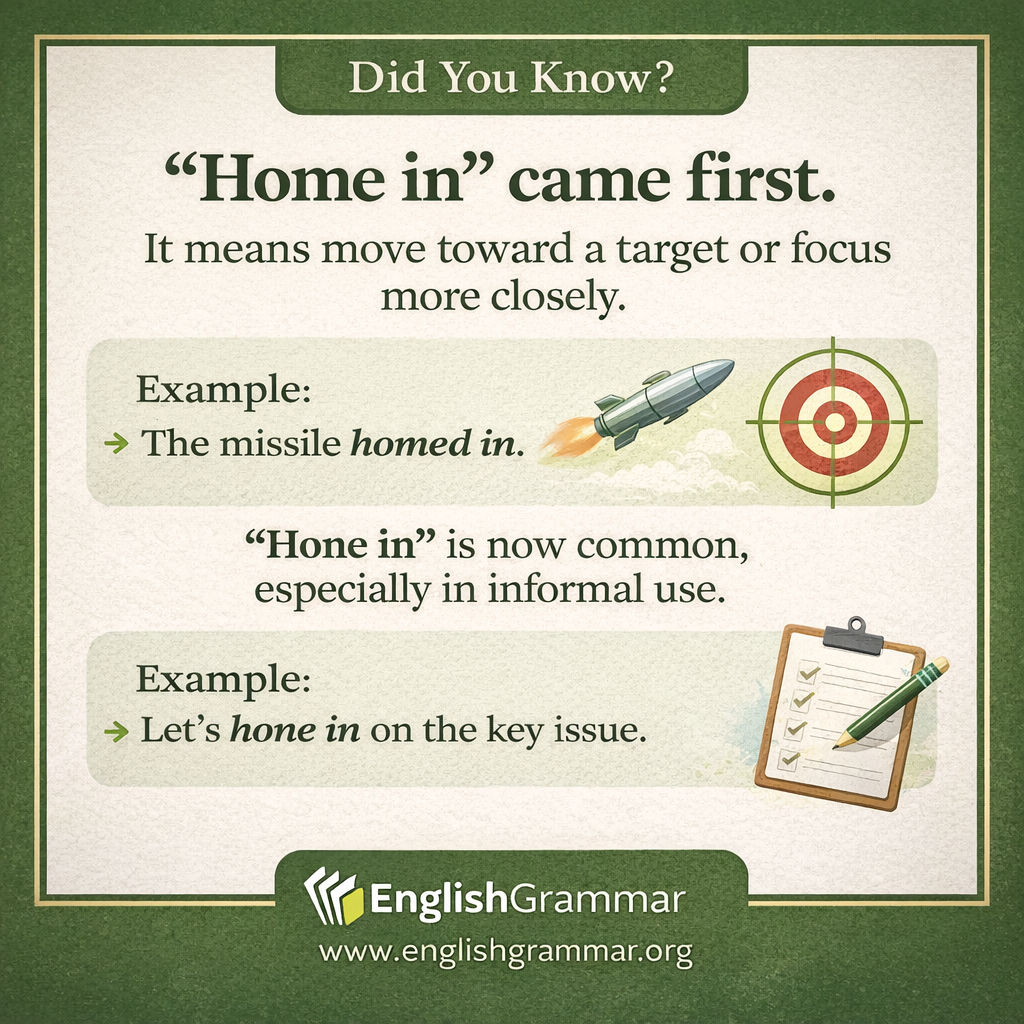
“Home in” is the older and more traditional phrase. It comes from the idea of something returning to its home or moving directly toward a target. At first, it was used literally, as with animals or guided weapons. Later, it also came to mean focusing more closely on something.
Examples:
- The missile homed in on its target.
- We need to home in on the main cause of the problem.
“Hone in” appeared later. It is influenced by the verb hone, which means sharpen or refine. Because people often think of sharpening focus, “hone in” became common, especially in informal writing and speech.
Many editors still prefer “home in” in careful or formal writing because it is the older and historically standard form. But “hone in” is now so common that many dictionaries list it as an accepted variant.
A simple guide is this: if you want the traditional choice, use “home in.” If you use “hone in,” know that many readers will accept it, but some will still see it as less formal.
