
Home of English Grammar

Grammar Guide
  • Home
  • Exercises
  • Matches
  • Rules
  • Tools
    • Grammar Checker
    • Very Replacer
    • Word Counter
  • Top Social Media Posts
  • Various Posts
  • Vocabulary
  • Writing Guides
  • Contact

How “by and large” sailed into everyday English

March 24, 2026 - pdf

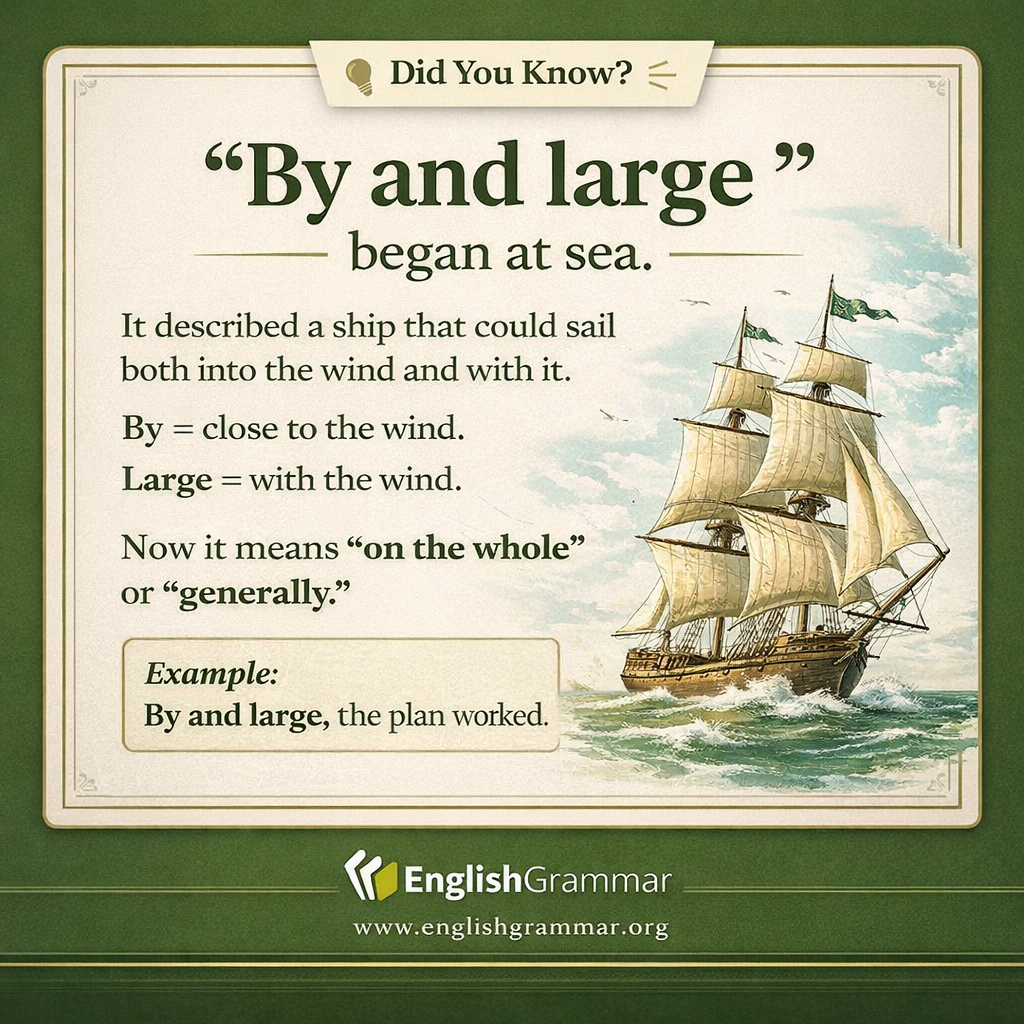
"By and large" started as a sailing term.

By and large began as a nautical expression. It referred to a ship that could sail by, meaning close to the wind, and large, meaning with the wind behind it. A vessel that could manage both conditions was versatile.

Over time, the phrase moved into general English. Now by and large usually means on the whole, generally, or taking everything together.

For example: By and large, the meeting went well. In that sentence, the speaker is giving an overall judgment, not describing sailing.

  • Original sense: a ship could sail close to the wind and also with it.
  • Modern sense: an overall summary or general conclusion.

This kind of history is common in English. A technical phrase starts in a specific field, then becomes everyday language after speakers keep the useful general idea.

  • Share
  • Post
  • Post
  • Email
NEW: Try Matches, our daily vocabulary challenge. Pick a topic and level and match words with definitions to boost your vocabulary.
2,485,429 
761,532 
Improve Your Grammar
  • Download 2026 Grammar Guide (PDF)
  • Free Weekly Exercises & Vocabulary
  • Join over 3 Million English Learners
We respect your privacy. Unsubscribe anytime.

Grammar Checker

GrammarCheck.net - Try online
Hint → Bookmark GrammarCheck for future use.

Latest Posts

  • Why the word assassin has such a tangled medieval history May 7, 2026
  • 100 Best Synonyms for “Let Go” May 7, 2026
  • Egoist vs. egotist: what is the difference? May 7, 2026
  • 100 Best Synonyms for “Focused” May 7, 2026
  • 100 Email Phrases for Saying a Request Needs More Review May 7, 2026
  • 100 Best Synonyms for “Take Responsibility” May 7, 2026
  • What “smoke and mirrors” means, and where it comes from May 7, 2026

Copyright © 2026 · EnglishGrammar.org
Disclaimer · Privacy Policy · Sitemap · Terms

Improve Your Grammar
  • Download 2026 Grammar Guide (PDF)
  • Free Weekly Exercises & Vocabulary
  • Join over 3 Million English Learners
We respect your privacy. Unsubscribe anytime.