
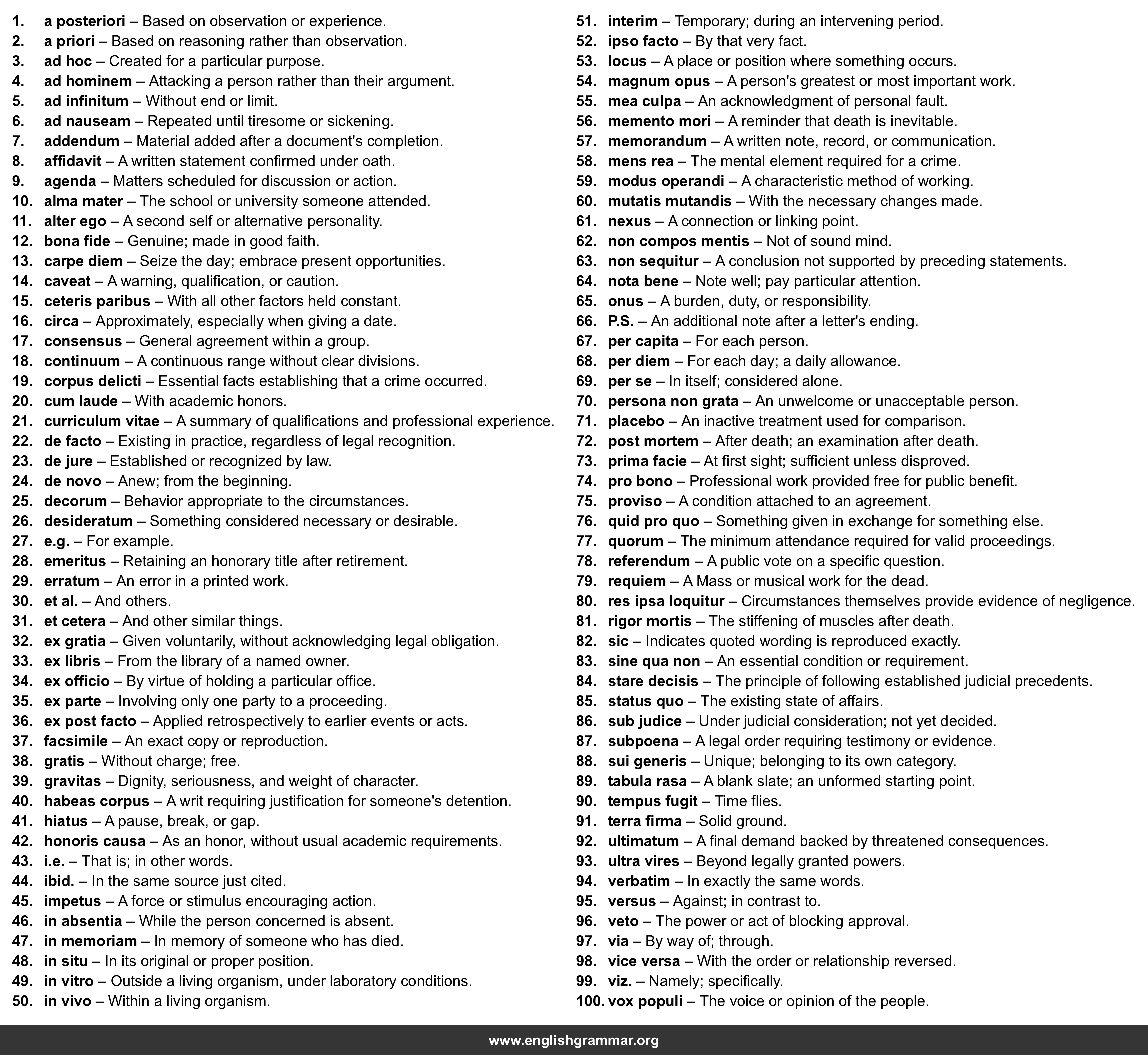
| No. | Item | Definition |
|---|---|---|
| 1. | a posteriori | Based on observation or experience. |
| 2. | a priori | Based on reasoning rather than observation. |
| 3. | ad hoc | Created for a particular purpose. |
| 4. | ad hominem | Attacking a person rather than their argument. |
| 5. | ad infinitum | Without end or limit. |
| 6. | ad nauseam | Repeated until tiresome or sickening. |
| 7. | addendum | Material added after a document’s completion. |
| 8. | affidavit | A written statement confirmed under oath. |
| 9. | agenda | Matters scheduled for discussion or action. |
| 10. | alma mater | The school or university someone attended. |
| 11. | alter ego | A second self or alternative personality. |
| 12. | bona fide | Genuine; made in good faith. |
| 13. | carpe diem | Seize the day; embrace present opportunities. |
| 14. | caveat | A warning, qualification, or caution. |
| 15. | ceteris paribus | With all other factors held constant. |
| 16. | circa | Approximately, especially when giving a date. |
| 17. | consensus | General agreement within a group. |
| 18. | continuum | A continuous range without clear divisions. |
| 19. | corpus delicti | Essential facts establishing that a crime occurred. |
| 20. | cum laude | With academic honors. |
| 21. | curriculum vitae | A summary of qualifications and professional experience. |
| 22. | de facto | Existing in practice, regardless of legal recognition. |
| 23. | de jure | Established or recognized by law. |
| 24. | de novo | Anew; from the beginning. |
| 25. | decorum | Behavior appropriate to the circumstances. |
| 26. | desideratum | Something considered necessary or desirable. |
| 27. | e.g. | For example. |
| 28. | emeritus | Retaining an honorary title after retirement. |
| 29. | erratum | An error in a printed work. |
| 30. | et al. | And others. |
| 31. | et cetera | And other similar things. |
| 32. | ex gratia | Given voluntarily, without acknowledging legal obligation. |
| 33. | ex libris | From the library of a named owner. |
| 34. | ex officio | By virtue of holding a particular office. |
| 35. | ex parte | Involving only one party to a proceeding. |
| 36. | ex post facto | Applied retrospectively to earlier events or acts. |
| 37. | facsimile | An exact copy or reproduction. |
| 38. | gratis | Without charge; free. |
| 39. | gravitas | Dignity, seriousness, and weight of character. |
| 40. | habeas corpus | A writ requiring justification for someone’s detention. |
| 41. | hiatus | A pause, break, or gap. |
| 42. | honoris causa | As an honor, without usual academic requirements. |
| 43. | i.e. | That is; in other words. |
| 44. | ibid. | In the same source just cited. |
| 45. | impetus | A force or stimulus encouraging action. |
| 46. | in absentia | While the person concerned is absent. |
| 47. | in memoriam | In memory of someone who has died. |
| 48. | in situ | In its original or proper position. |
| 49. | in vitro | Outside a living organism, under laboratory conditions. |
| 50. | in vivo | Within a living organism. |
| 51. | interim | Temporary; during an intervening period. |
| 52. | ipso facto | By that very fact. |
| 53. | locus | A place or position where something occurs. |
| 54. | magnum opus | A person’s greatest or most important work. |
| 55. | mea culpa | An acknowledgment of personal fault. |
| 56. | memento mori | A reminder that death is inevitable. |
| 57. | memorandum | A written note, record, or communication. |
| 58. | mens rea | The mental element required for a crime. |
| 59. | modus operandi | A characteristic method of working. |
| 60. | mutatis mutandis | With the necessary changes made. |
| 61. | nexus | A connection or linking point. |
| 62. | non compos mentis | Not of sound mind. |
| 63. | non sequitur | A conclusion not supported by preceding statements. |
| 64. | nota bene | Note well; pay particular attention. |
| 65. | onus | A burden, duty, or responsibility. |
| 66. | P.S. | An additional note after a letter’s ending. |
| 67. | per capita | For each person. |
| 68. | per diem | For each day; a daily allowance. |
| 69. | per se | In itself; considered alone. |
| 70. | persona non grata | An unwelcome or unacceptable person. |
| 71. | placebo | An inactive treatment used for comparison. |
| 72. | post mortem | After death; an examination after death. |
| 73. | prima facie | At first sight; sufficient unless disproved. |
| 74. | pro bono | Professional work provided free for public benefit. |
| 75. | proviso | A condition attached to an agreement. |
| 76. | quid pro quo | Something given in exchange for something else. |
| 77. | quorum | The minimum attendance required for valid proceedings. |
| 78. | referendum | A public vote on a specific question. |
| 79. | requiem | A Mass or musical work for the dead. |
| 80. | res ipsa loquitur | Circumstances themselves provide evidence of negligence. |
| 81. | rigor mortis | The stiffening of muscles after death. |
| 82. | sic | Indicates quoted wording is reproduced exactly. |
| 83. | sine qua non | An essential condition or requirement. |
| 84. | stare decisis | The principle of following established judicial precedents. |
| 85. | status quo | The existing state of affairs. |
| 86. | sub judice | Under judicial consideration; not yet decided. |
| 87. | subpoena | A legal order requiring testimony or evidence. |
| 88. | sui generis | Unique; belonging to its own category. |
| 89. | tabula rasa | A blank slate; an unformed starting point. |
| 90. | tempus fugit | Time flies. |
| 91. | terra firma | Solid ground. |
| 92. | ultimatum | A final demand backed by threatened consequences. |
| 93. | ultra vires | Beyond legally granted powers. |
| 94. | verbatim | In exactly the same words. |
| 95. | versus | Against; in contrast to. |
| 96. | veto | The power or act of blocking approval. |
| 97. | via | By way of; through. |
| 98. | vice versa | With the order or relationship reversed. |
| 99. | viz. | Namely; specifically. |
| 100. | vox populi | The voice or opinion of the people. |