
• Skip to primary navigation
  • Skip to main content
  • Skip to primary sidebar
Home of English Grammar
  • Home
  • Course
  • Exercises
  • Grammar Rules
  • Vocabulary Matches
  • Posts
  • Tools
    • Grammar Checker
    • Very Replacer
    • Word Counter
  • Vocabulary Lists
  • Archives
    • Social Media Posts
    • Writing Guides
  • Sign in
  • Join free

What “never say die” means and where it came from

May 11, 2026

The origin of "never say die"

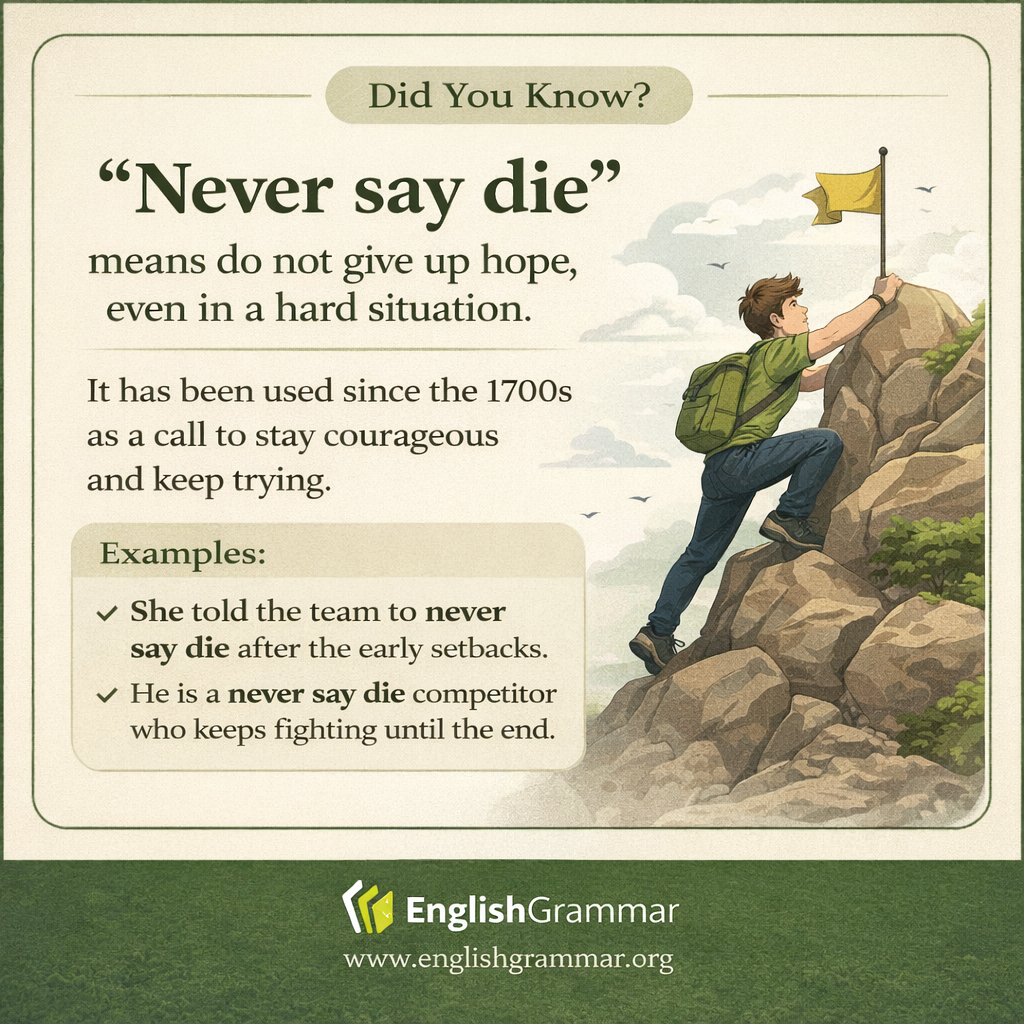
“Never say die” means do not give up or do not lose hope. People use it to encourage determination when a situation looks difficult, disappointing, or even hopeless.

The expression has been in English since at least the 1700s. The idea behind it is simple: if you “say die,” you are admitting defeat. If you never say it, you keep your courage and continue trying. Over time, the phrase became a fixed way to praise persistence and fighting spirit.

Today, it often appears in sports, work, and everyday challenges. It can describe a person, an attitude, or something said to encourage others.

  • Encouragement: “When the project ran into trouble, our manager said, ‘Never say die.’”
  • Description: “She has a never say die attitude when learning new skills.”

The phrase is positive and energetic. It suggests resilience, not denial. In other words, it does not mean pretending a problem is easy. It means refusing to quit just because the problem is hard.

Improve your English grammar, vocabulary and writing

We take you step by step from beginner to advanced, even if you struggled with English at school or have always had trouble remembering the rules.

  • 10 modules, 112 lessons and 730 questions
  • Just log in and learn anytime and anywhere
  • Your progress is saved in your account
  • Download the 2027 Grammar Guide (PDF)
Join free

Already have an account? Sign in

See what’s in the course

Primary Sidebar

2.4M760.9K165.9K

Free 2027 Grammar Guide

  • Download Grammar Guide (PDF)
  • Online grammar course, A1 to C2
  • Weekly exercises and vocabulary
  • Join over 3 million English learners

We respect your privacy. Unsubscribe anytime.

Already have an account? Sign in

Grammar Checker - Try Now

Latest Posts

  • 100 Best Synonyms for “Vary” November 3, 2026
  • 100 Best Synonyms for “Individuals” November 3, 2026
  • Temporary vs. passing vs. fleeting vs. transient vs. ephemeral vs. evanescent November 3, 2026
  • 100 Best Synonyms for “Restless” November 3, 2026
  • Hard, firm, solid, rigid, stiff and unyielding: How to choose November 3, 2026
  • The origin of “out of the blue” November 3, 2026
  • 100 Best Synonyms for “Individualised” November 3, 2026
  • 100 Best Synonyms for “Varied” November 3, 2026
  • Fewer vs. less: counting things and measuring amounts November 3, 2026
  • 100 Phrases for Starting a Meeting Confidently November 3, 2026
Home of English Grammar

Free English grammar exercises, rules and vocabulary lists, with new exercises every week. Join the leading English grammar site with over 3 million followers.

Join free

Learn

  • Exercises
  • Matches
  • Grammar rules
  • Vocabulary lists
  • Writing guides
  • Online tools

More

  • Top social media posts
  • Various posts
  • Contact

Account

  • Join free
  • Grammar Course
  • Free grammar guide (PDF)

Copyright © 2026 EnglishGrammar.org

  • Disclaimer
  • Privacy policy
  • Terms
  • Sitemap