
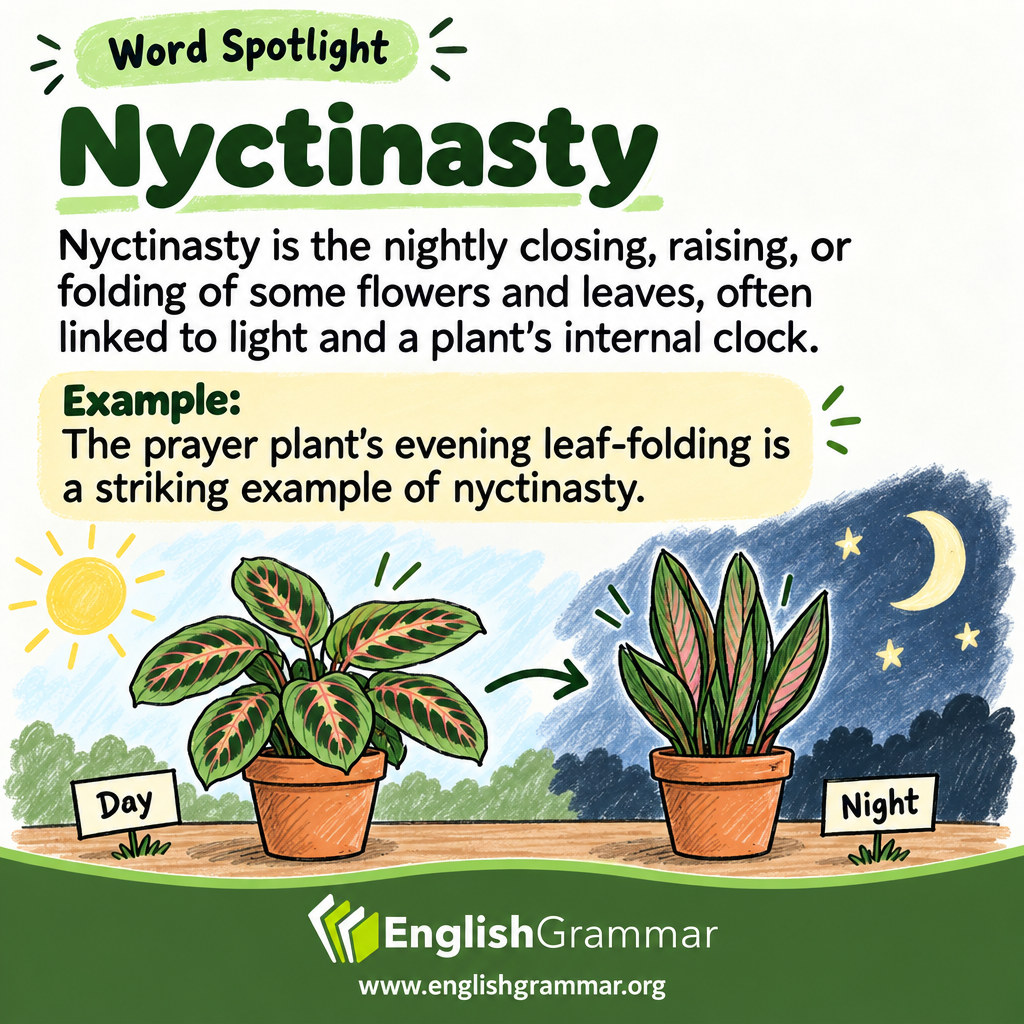
Nyctinasty is the regular movement of certain leaves or flowers as night begins. A plant may fold its leaves, raise them, lower them, or close its flowers. The movement is often reversed when daylight returns.
Changes in light help trigger nyctinasty, and a plant’s internal daily clock may also control the timing. This is why some plants begin moving at about the same time each evening. Temperature can influence nyctinastic movement in some species too.
The word is a technical botanical noun. It names a type of nastic movement, meaning that the movement’s direction does not depend on the direction from which the stimulus comes. In simpler terms, a leaf does not necessarily move toward or away from the fading light; it follows its own characteristic folding or raising pattern.
- Natural example: The prayer plant’s evening leaf-folding is a striking example of nyctinasty.
- Adjective form: Nyctinastic describes the movement or a plant that displays it, as in “nyctinastic leaf movement.”
People sometimes informally call these movements “plant sleep,” but the plants are not sleeping in the human sense. That phrase simply describes how leaves and flowers can appear to settle into a nighttime position. Use nyctinasty when you need the precise botanical term for this repeated day-and-night movement.