Home of English Grammar

Grammar Guide
  • Home
  • Exercises
  • Matches
  • Rules
  • Tools
    • Grammar Checker
    • Very Replacer
    • Word Counter
  • Top Social Media Posts
  • Various Posts
  • Vocabulary
  • Writing Guides
  • Contact

The origin of “raise Cain”

May 26, 2026 - pdf

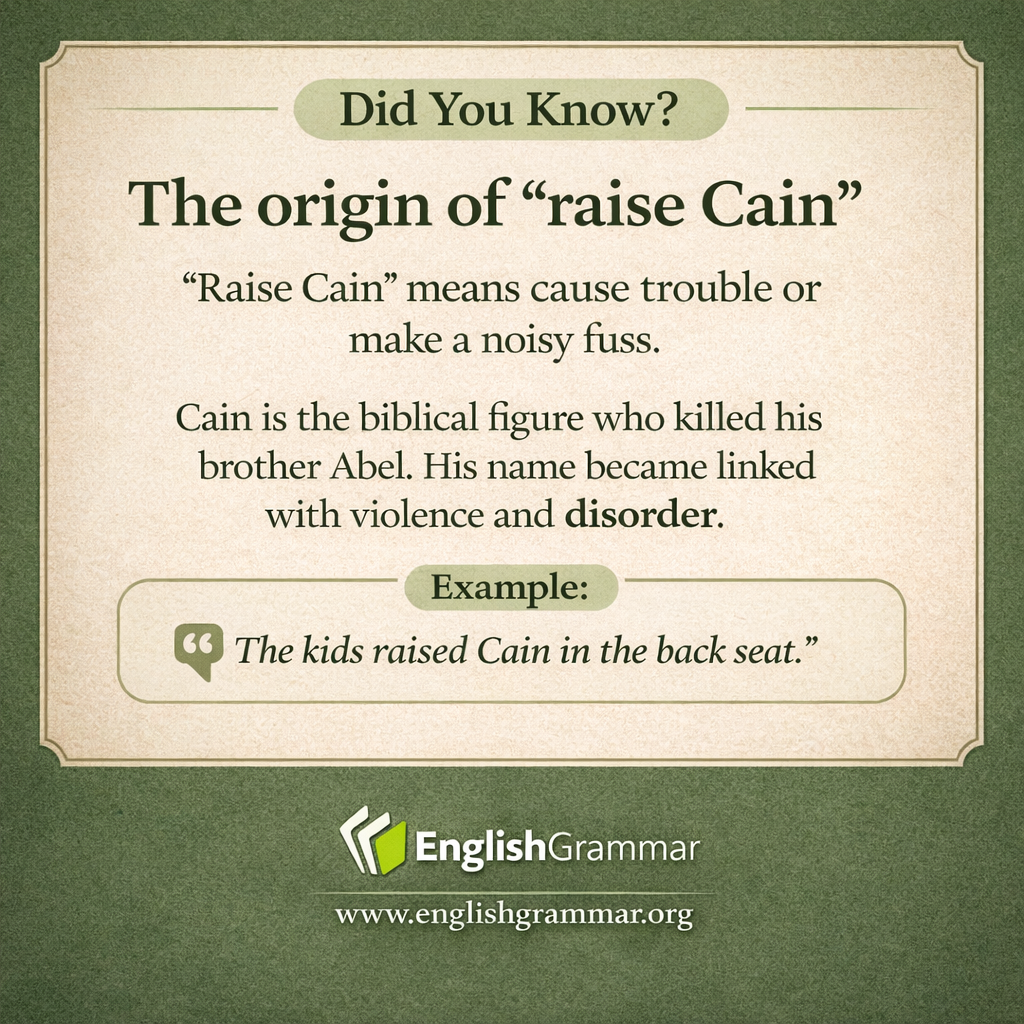
The origin of "raise Cain"

“Raise Cain” means to cause trouble, create a disturbance, or make a loud fuss. It is usually used for noisy, unruly behavior rather than calm disagreement.

The phrase comes from Cain in the Bible, the son of Adam and Eve who killed his brother Abel. Because of that story, Cain’s name became strongly associated with violence, wrongdoing, and disorder. Over time, English speakers began using raise Cain to mean stir up trouble.

For example, you might say, The crowd raised Cain after the concert was canceled. You could also hear, The kids were raising Cain upstairs. In both cases, the idea is commotion, not literally referring to the biblical person.

  • Meaning: cause trouble, make a scene, create a noisy disturbance
  • Tone: informal and often lively
  • Not literal: it does not mean physically lifting Cain

You may also see older or more playful uses where it simply means behaving wildly. The core idea stays the same: disorder, uproar, or rowdy trouble.

  • Share
  • Post
  • Post
  • Reddit
  • Email
  • WhatsApp
NEW: Try Matches, our daily vocabulary challenge. Pick a topic and level and match words with definitions to boost your vocabulary.
2,485,429 
761,532 
Improve Your Grammar
  • Download 2026 Grammar Guide (PDF)
  • Free Weekly Exercises & Vocabulary
  • Join over 3 Million English Learners
We respect your privacy. Unsubscribe anytime.

Grammar Checker

GrammarCheck.net - Try online
Hint → Bookmark GrammarCheck for future use.

Latest Posts

  • 100 Words to Describe Energy Levels June 21, 2026
  • 100 Best Synonyms for “Organized” June 21, 2026
  • 100 Best Synonyms for “Tasteful” June 20, 2026
  • 100 Best Synonyms for “Contribute” June 20, 2026
  • 100 Best Synonyms for “Acquire” June 20, 2026
  • Sequential vs. consecutive: what is the difference? June 20, 2026
  • Advanced Passive Structures Exercise June 20, 2026

Copyright © 2026 · EnglishGrammar.org
Disclaimer · Privacy Policy · Sitemap · Terms

Improve Your Grammar
  • Download 2026 Grammar Guide (PDF)
  • Free Weekly Exercises & Vocabulary
  • Join over 3 Million English Learners
We respect your privacy. Unsubscribe anytime.