
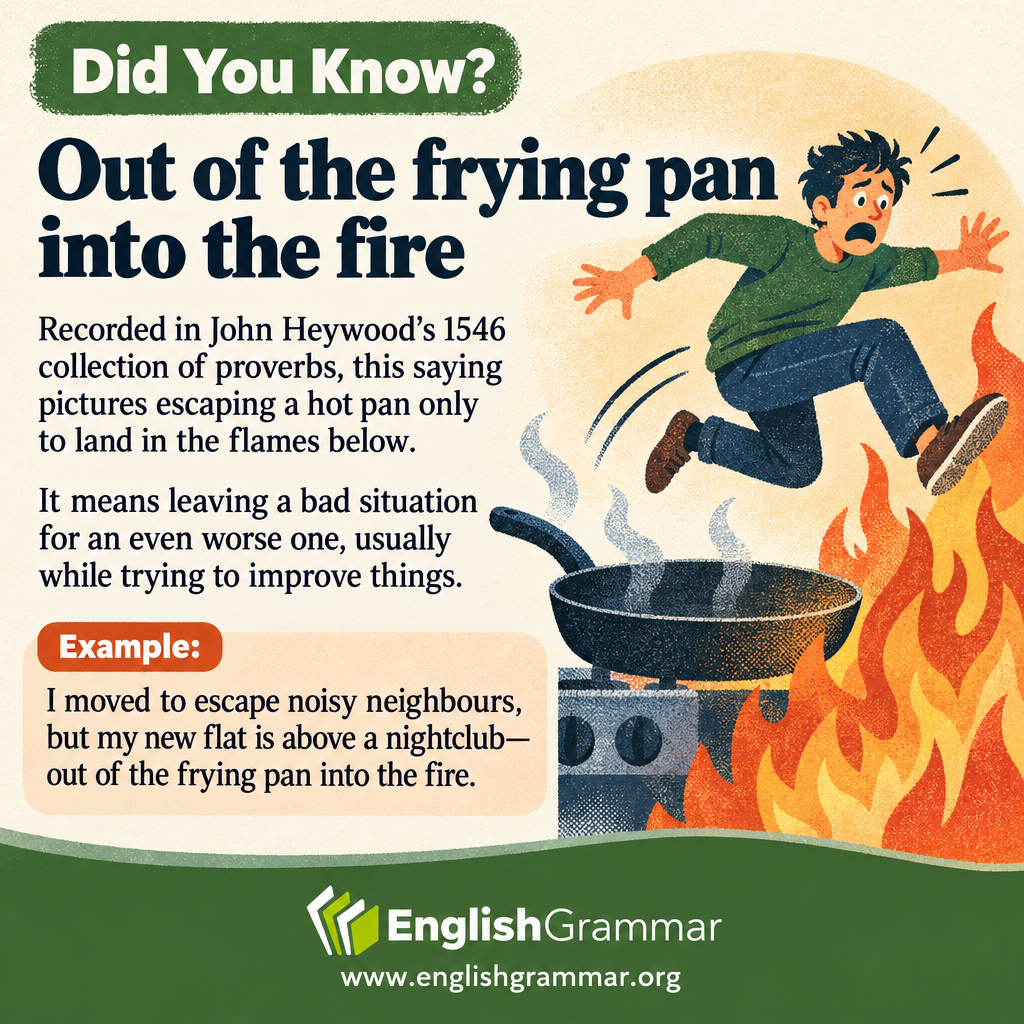
A change does not always solve a problem. This expression means leaving a bad situation and entering an even worse one, usually while trying to improve things.
The image comes from cooking over a fire. Imagine escaping from a hot frying pan only to land in the flames underneath. You have left one danger, but your new position is worse. That contrast explains the expression’s meaning.
The wording has a long history in English. It appears in John Heywood’s 1546 collection of proverbs. This is evidence of its early use, not proof that Heywood invented it. A proverb collection records sayings; it does not necessarily identify who first created them. There is no need to imagine a particular kitchen accident as its source.
Today, people use the expression for changes involving jobs, homes, relationships, or other everyday problems:
- I left a stressful job for one with longer hours and a worse manager—out of the frying pan into the fire.
- If we replace this unreliable car with an even older one, we might jump out of the frying pan into the fire.
You can use it to describe a disappointing change that has already happened or to warn someone before they make a decision. The key is the comparison: the second situation must be worse than the first, not simply different or equally difficult.