
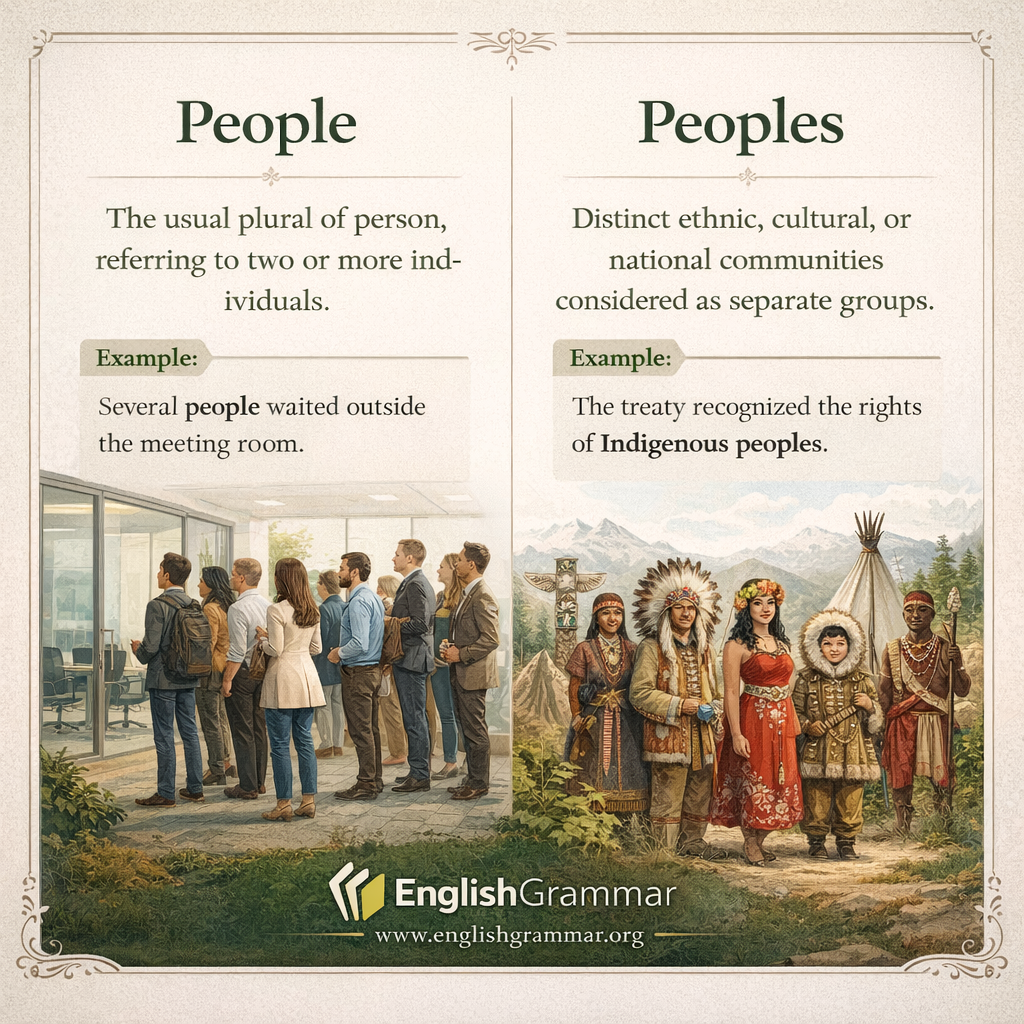
People is the normal plural of person. Use it when you mean more than one individual: “Six people joined the call.” It can also refer to human beings generally: “People need clean water.” In both uses, the focus is on persons, not on separate communities.
There is also a more specialized collective sense of people. A people is a cultural, ethnic, or national community considered as a unit. When referring to more than one such community, the plural can be peoples. This use appears most often in historical, legal, anthropological, and political contexts.
- “Representatives of three peoples signed the agreement.”
- “The exhibition examines the languages of Arctic peoples.”
These sentences emphasize distinct groups, not simply a number of individuals.
Do not use peoples merely because the crowd is large. “Thousands of people filled the square” is correct if the sentence counts individuals. Use peoples only when multiple communities are meant. Capitalization depends on the specific name and editorial convention; for example, Indigenous is often capitalized when it refers to Indigenous peoples.
When choosing, ask whether the noun means persons or distinct communities. If it means persons, choose people. If the sentence deliberately distinguishes several cultural, ethnic, or national groups, peoples may be appropriate.