
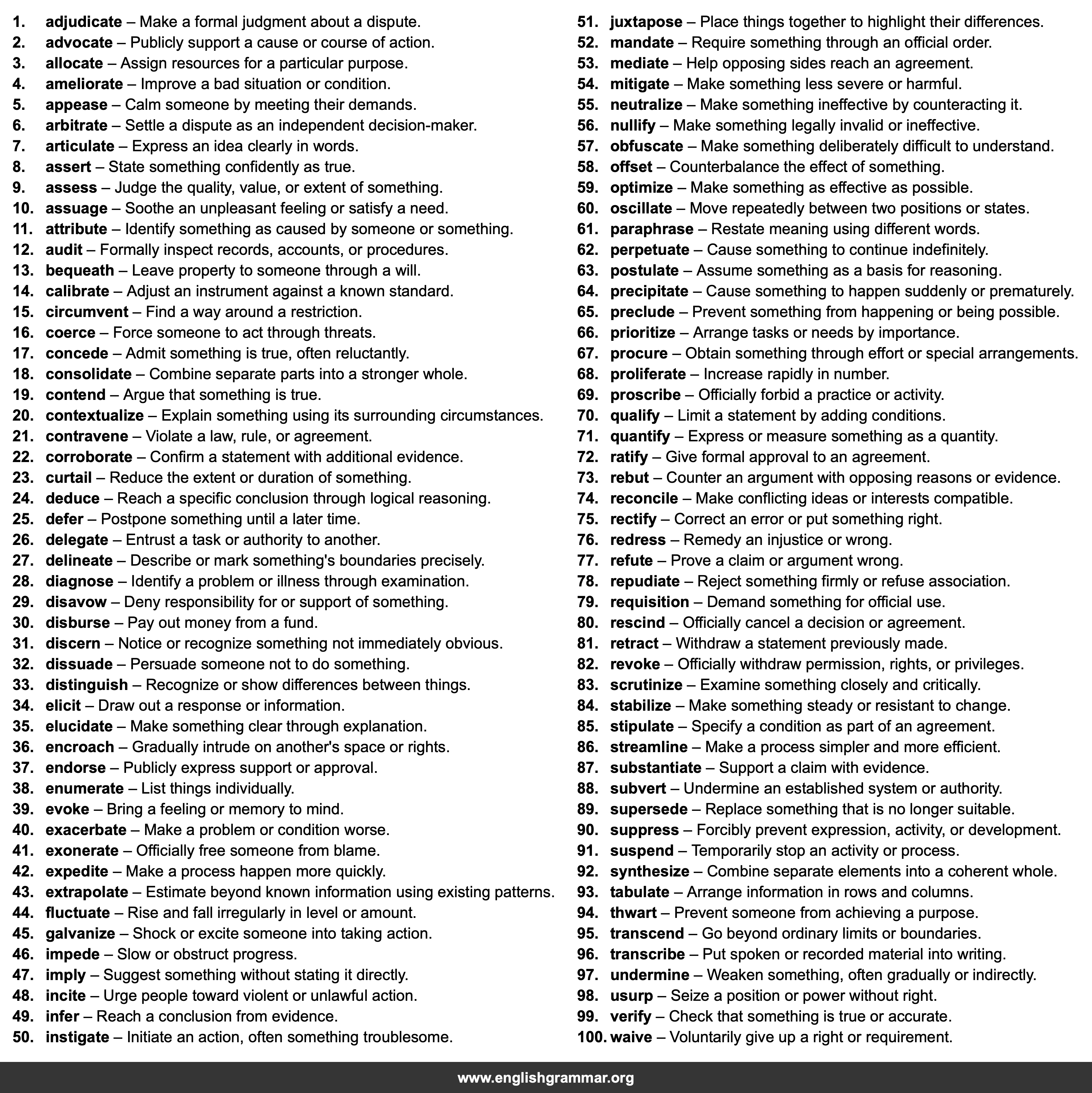
| No. | Item | Definition |
|---|---|---|
| 1. | adjudicate | Make a formal judgment about a dispute. |
| 2. | advocate | Publicly support a cause or course of action. |
| 3. | allocate | Assign resources for a particular purpose. |
| 4. | ameliorate | Improve a bad situation or condition. |
| 5. | appease | Calm someone by meeting their demands. |
| 6. | arbitrate | Settle a dispute as an independent decision-maker. |
| 7. | articulate | Express an idea clearly in words. |
| 8. | assert | State something confidently as true. |
| 9. | assess | Judge the quality, value, or extent of something. |
| 10. | assuage | Soothe an unpleasant feeling or satisfy a need. |
| 11. | attribute | Identify something as caused by someone or something. |
| 12. | audit | Formally inspect records, accounts, or procedures. |
| 13. | bequeath | Leave property to someone through a will. |
| 14. | calibrate | Adjust an instrument against a known standard. |
| 15. | circumvent | Find a way around a restriction. |
| 16. | coerce | Force someone to act through threats. |
| 17. | concede | Admit something is true, often reluctantly. |
| 18. | consolidate | Combine separate parts into a stronger whole. |
| 19. | contend | Argue that something is true. |
| 20. | contextualize | Explain something using its surrounding circumstances. |
| 21. | contravene | Violate a law, rule, or agreement. |
| 22. | corroborate | Confirm a statement with additional evidence. |
| 23. | curtail | Reduce the extent or duration of something. |
| 24. | deduce | Reach a specific conclusion through logical reasoning. |
| 25. | defer | Postpone something until a later time. |
| 26. | delegate | Entrust a task or authority to another. |
| 27. | delineate | Describe or mark something’s boundaries precisely. |
| 28. | diagnose | Identify a problem or illness through examination. |
| 29. | disavow | Deny responsibility for or support of something. |
| 30. | disburse | Pay out money from a fund. |
| 31. | discern | Notice or recognize something not immediately obvious. |
| 32. | dissuade | Persuade someone not to do something. |
| 33. | distinguish | Recognize or show differences between things. |
| 34. | elicit | Draw out a response or information. |
| 35. | elucidate | Make something clear through explanation. |
| 36. | encroach | Gradually intrude on another’s space or rights. |
| 37. | endorse | Publicly express support or approval. |
| 38. | enumerate | List things individually. |
| 39. | evoke | Bring a feeling or memory to mind. |
| 40. | exacerbate | Make a problem or condition worse. |
| 41. | exonerate | Officially free someone from blame. |
| 42. | expedite | Make a process happen more quickly. |
| 43. | extrapolate | Estimate beyond known information using existing patterns. |
| 44. | fluctuate | Rise and fall irregularly in level or amount. |
| 45. | galvanize | Shock or excite someone into taking action. |
| 46. | impede | Slow or obstruct progress. |
| 47. | imply | Suggest something without stating it directly. |
| 48. | incite | Urge people toward violent or unlawful action. |
| 49. | infer | Reach a conclusion from evidence. |
| 50. | instigate | Initiate an action, often something troublesome. |
| 51. | juxtapose | Place things together to highlight their differences. |
| 52. | mandate | Require something through an official order. |
| 53. | mediate | Help opposing sides reach an agreement. |
| 54. | mitigate | Make something less severe or harmful. |
| 55. | neutralize | Make something ineffective by counteracting it. |
| 56. | nullify | Make something legally invalid or ineffective. |
| 57. | obfuscate | Make something deliberately difficult to understand. |
| 58. | offset | Counterbalance the effect of something. |
| 59. | optimize | Make something as effective as possible. |
| 60. | oscillate | Move repeatedly between two positions or states. |
| 61. | paraphrase | Restate meaning using different words. |
| 62. | perpetuate | Cause something to continue indefinitely. |
| 63. | postulate | Assume something as a basis for reasoning. |
| 64. | precipitate | Cause something to happen suddenly or prematurely. |
| 65. | preclude | Prevent something from happening or being possible. |
| 66. | prioritize | Arrange tasks or needs by importance. |
| 67. | procure | Obtain something through effort or special arrangements. |
| 68. | proliferate | Increase rapidly in number. |
| 69. | proscribe | Officially forbid a practice or activity. |
| 70. | qualify | Limit a statement by adding conditions. |
| 71. | quantify | Express or measure something as a quantity. |
| 72. | ratify | Give formal approval to an agreement. |
| 73. | rebut | Counter an argument with opposing reasons or evidence. |
| 74. | reconcile | Make conflicting ideas or interests compatible. |
| 75. | rectify | Correct an error or put something right. |
| 76. | redress | Remedy an injustice or wrong. |
| 77. | refute | Prove a claim or argument wrong. |
| 78. | repudiate | Reject something firmly or refuse association. |
| 79. | requisition | Demand something for official use. |
| 80. | rescind | Officially cancel a decision or agreement. |
| 81. | retract | Withdraw a statement previously made. |
| 82. | revoke | Officially withdraw permission, rights, or privileges. |
| 83. | scrutinize | Examine something closely and critically. |
| 84. | stabilize | Make something steady or resistant to change. |
| 85. | stipulate | Specify a condition as part of an agreement. |
| 86. | streamline | Make a process simpler and more efficient. |
| 87. | substantiate | Support a claim with evidence. |
| 88. | subvert | Undermine an established system or authority. |
| 89. | supersede | Replace something that is no longer suitable. |
| 90. | suppress | Forcibly prevent expression, activity, or development. |
| 91. | suspend | Temporarily stop an activity or process. |
| 92. | synthesize | Combine separate elements into a coherent whole. |
| 93. | tabulate | Arrange information in rows and columns. |
| 94. | thwart | Prevent someone from achieving a purpose. |
| 95. | transcend | Go beyond ordinary limits or boundaries. |
| 96. | transcribe | Put spoken or recorded material into writing. |
| 97. | undermine | Weaken something, often gradually or indirectly. |
| 98. | usurp | Seize a position or power without right. |
| 99. | verify | Check that something is true or accurate. |
| 100. | waive | Voluntarily give up a right or requirement. |