
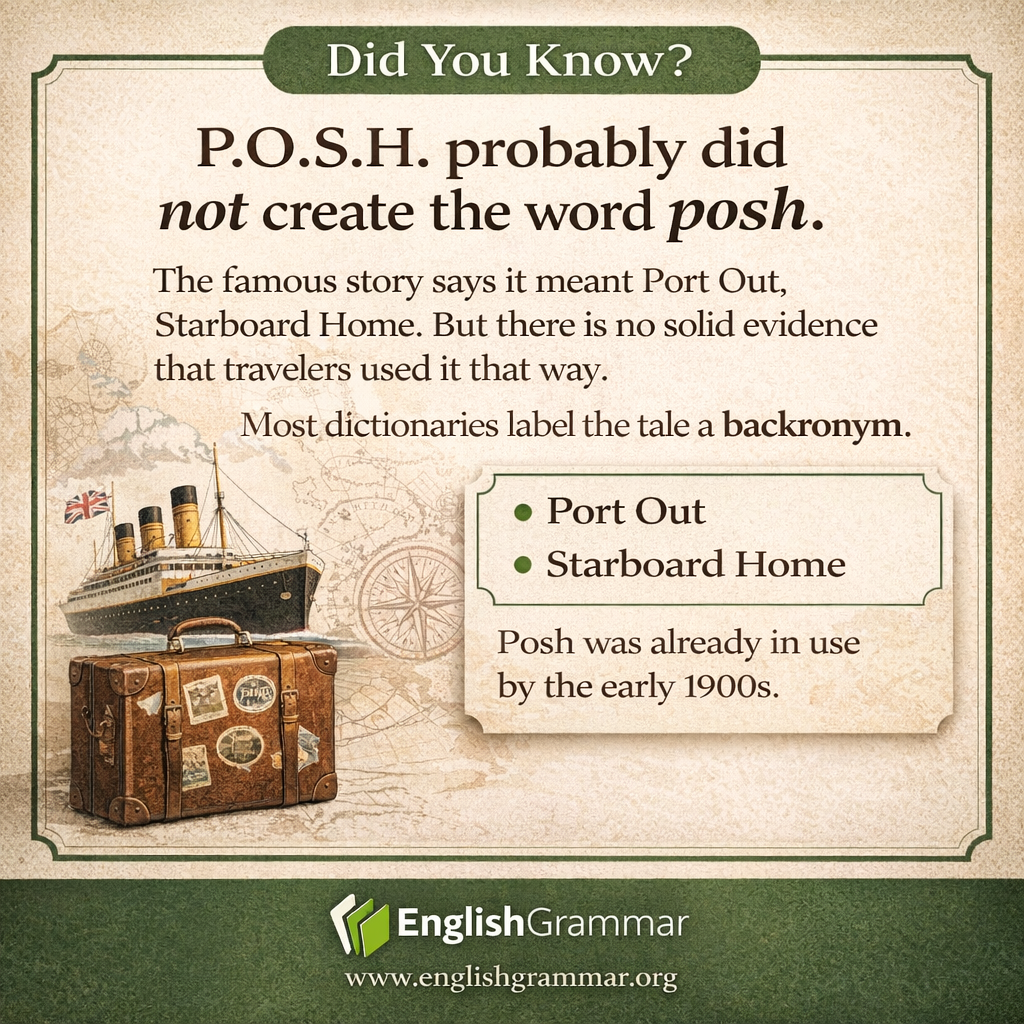
The story is memorable: P.O.S.H. supposedly stood for Port Out, Starboard Home, the shaded cabin side chosen by wealthy travelers sailing between Britain and India. According to the tale, those initials became the word posh.
The problem is evidence. Language historians have not found reliable contemporary proof that passengers actually used P.O.S.H. on tickets, luggage, or cabin labels in that way. Because the explanation appears later and fits the word so neatly, most dictionaries and etymology sources treat it as a backronym, a phrase invented after a word already exists.
Posh itself is recorded in the early 1900s with meanings related to luxury, elegance, or upper class style. That makes the acronym story doubtful, even if it remains popular.
- Popular tale: P.O.S.H. = Port Out, Starboard Home.
- Why experts doubt it: no strong historical documentation.
- Likely conclusion: the initials were attached later to explain an existing word.
This is a common pattern in word history. A clever explanation spreads because it is easy to remember, even when the documentary record does not support it. In this case, posh hotel or posh accent reflects the modern meaning, but not a proven acronym origin.
