
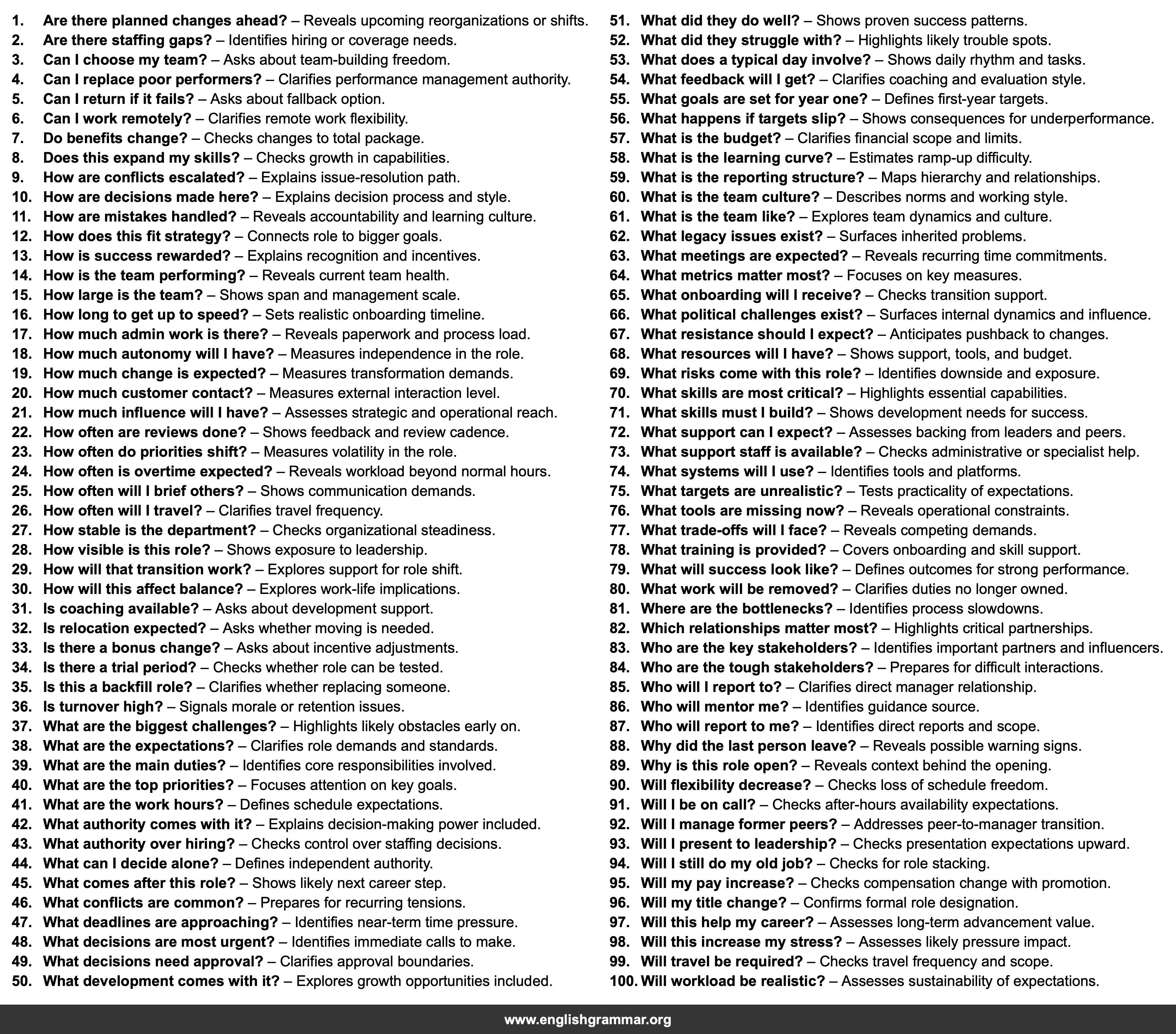
| No. | Item | Definition |
|---|---|---|
| 1. | Are there planned changes ahead? | Reveals upcoming reorganizations or shifts. |
| 2. | Are there staffing gaps? | Identifies hiring or coverage needs. |
| 3. | Can I choose my team? | Asks about team-building freedom. |
| 4. | Can I replace poor performers? | Clarifies performance management authority. |
| 5. | Can I return if it fails? | Asks about fallback option. |
| 6. | Can I work remotely? | Clarifies remote work flexibility. |
| 7. | Do benefits change? | Checks changes to total package. |
| 8. | Does this expand my skills? | Checks growth in capabilities. |
| 9. | How are conflicts escalated? | Explains issue-resolution path. |
| 10. | How are decisions made here? | Explains decision process and style. |
| 11. | How are mistakes handled? | Reveals accountability and learning culture. |
| 12. | How does this fit strategy? | Connects role to bigger goals. |
| 13. | How is success rewarded? | Explains recognition and incentives. |
| 14. | How is the team performing? | Reveals current team health. |
| 15. | How large is the team? | Shows span and management scale. |
| 16. | How long to get up to speed? | Sets realistic onboarding timeline. |
| 17. | How much admin work is there? | Reveals paperwork and process load. |
| 18. | How much autonomy will I have? | Measures independence in the role. |
| 19. | How much change is expected? | Measures transformation demands. |
| 20. | How much customer contact? | Measures external interaction level. |
| 21. | How much influence will I have? | Assesses strategic and operational reach. |
| 22. | How often are reviews done? | Shows feedback and review cadence. |
| 23. | How often do priorities shift? | Measures volatility in the role. |
| 24. | How often is overtime expected? | Reveals workload beyond normal hours. |
| 25. | How often will I brief others? | Shows communication demands. |
| 26. | How often will I travel? | Clarifies travel frequency. |
| 27. | How stable is the department? | Checks organizational steadiness. |
| 28. | How visible is this role? | Shows exposure to leadership. |
| 29. | How will that transition work? | Explores support for role shift. |
| 30. | How will this affect balance? | Explores work-life implications. |
| 31. | Is coaching available? | Asks about development support. |
| 32. | Is relocation expected? | Asks whether moving is needed. |
| 33. | Is there a bonus change? | Asks about incentive adjustments. |
| 34. | Is there a trial period? | Checks whether role can be tested. |
| 35. | Is this a backfill role? | Clarifies whether replacing someone. |
| 36. | Is turnover high? | Signals morale or retention issues. |
| 37. | What are the biggest challenges? | Highlights likely obstacles early on. |
| 38. | What are the expectations? | Clarifies role demands and standards. |
| 39. | What are the main duties? | Identifies core responsibilities involved. |
| 40. | What are the top priorities? | Focuses attention on key goals. |
| 41. | What are the work hours? | Defines schedule expectations. |
| 42. | What authority comes with it? | Explains decision-making power included. |
| 43. | What authority over hiring? | Checks control over staffing decisions. |
| 44. | What can I decide alone? | Defines independent authority. |
| 45. | What comes after this role? | Shows likely next career step. |
| 46. | What conflicts are common? | Prepares for recurring tensions. |
| 47. | What deadlines are approaching? | Identifies near-term time pressure. |
| 48. | What decisions are most urgent? | Identifies immediate calls to make. |
| 49. | What decisions need approval? | Clarifies approval boundaries. |
| 50. | What development comes with it? | Explores growth opportunities included. |
| 51. | What did they do well? | Shows proven success patterns. |
| 52. | What did they struggle with? | Highlights likely trouble spots. |
| 53. | What does a typical day involve? | Shows daily rhythm and tasks. |
| 54. | What feedback will I get? | Clarifies coaching and evaluation style. |
| 55. | What goals are set for year one? | Defines first-year targets. |
| 56. | What happens if targets slip? | Shows consequences for underperformance. |
| 57. | What is the budget? | Clarifies financial scope and limits. |
| 58. | What is the learning curve? | Estimates ramp-up difficulty. |
| 59. | What is the reporting structure? | Maps hierarchy and relationships. |
| 60. | What is the team culture? | Describes norms and working style. |
| 61. | What is the team like? | Explores team dynamics and culture. |
| 62. | What legacy issues exist? | Surfaces inherited problems. |
| 63. | What meetings are expected? | Reveals recurring time commitments. |
| 64. | What metrics matter most? | Focuses on key measures. |
| 65. | What onboarding will I receive? | Checks transition support. |
| 66. | What political challenges exist? | Surfaces internal dynamics and influence. |
| 67. | What resistance should I expect? | Anticipates pushback to changes. |
| 68. | What resources will I have? | Shows support, tools, and budget. |
| 69. | What risks come with this role? | Identifies downside and exposure. |
| 70. | What skills are most critical? | Highlights essential capabilities. |
| 71. | What skills must I build? | Shows development needs for success. |
| 72. | What support can I expect? | Assesses backing from leaders and peers. |
| 73. | What support staff is available? | Checks administrative or specialist help. |
| 74. | What systems will I use? | Identifies tools and platforms. |
| 75. | What targets are unrealistic? | Tests practicality of expectations. |
| 76. | What tools are missing now? | Reveals operational constraints. |
| 77. | What trade-offs will I face? | Reveals competing demands. |
| 78. | What training is provided? | Covers onboarding and skill support. |
| 79. | What will success look like? | Defines outcomes for strong performance. |
| 80. | What work will be removed? | Clarifies duties no longer owned. |
| 81. | Where are the bottlenecks? | Identifies process slowdowns. |
| 82. | Which relationships matter most? | Highlights critical partnerships. |
| 83. | Who are the key stakeholders? | Identifies important partners and influencers. |
| 84. | Who are the tough stakeholders? | Prepares for difficult interactions. |
| 85. | Who will I report to? | Clarifies direct manager relationship. |
| 86. | Who will mentor me? | Identifies guidance source. |
| 87. | Who will report to me? | Identifies direct reports and scope. |
| 88. | Why did the last person leave? | Reveals possible warning signs. |
| 89. | Why is this role open? | Reveals context behind the opening. |
| 90. | Will flexibility decrease? | Checks loss of schedule freedom. |
| 91. | Will I be on call? | Checks after-hours availability expectations. |
| 92. | Will I manage former peers? | Addresses peer-to-manager transition. |
| 93. | Will I present to leadership? | Checks presentation expectations upward. |
| 94. | Will I still do my old job? | Checks for role stacking. |
| 95. | Will my pay increase? | Checks compensation change with promotion. |
| 96. | Will my title change? | Confirms formal role designation. |
| 97. | Will this help my career? | Assesses long-term advancement value. |
| 98. | Will this increase my stress? | Assesses likely pressure impact. |
| 99. | Will travel be required? | Checks travel frequency and scope. |
| 100. | Will workload be realistic? | Assesses sustainability of expectations. |