
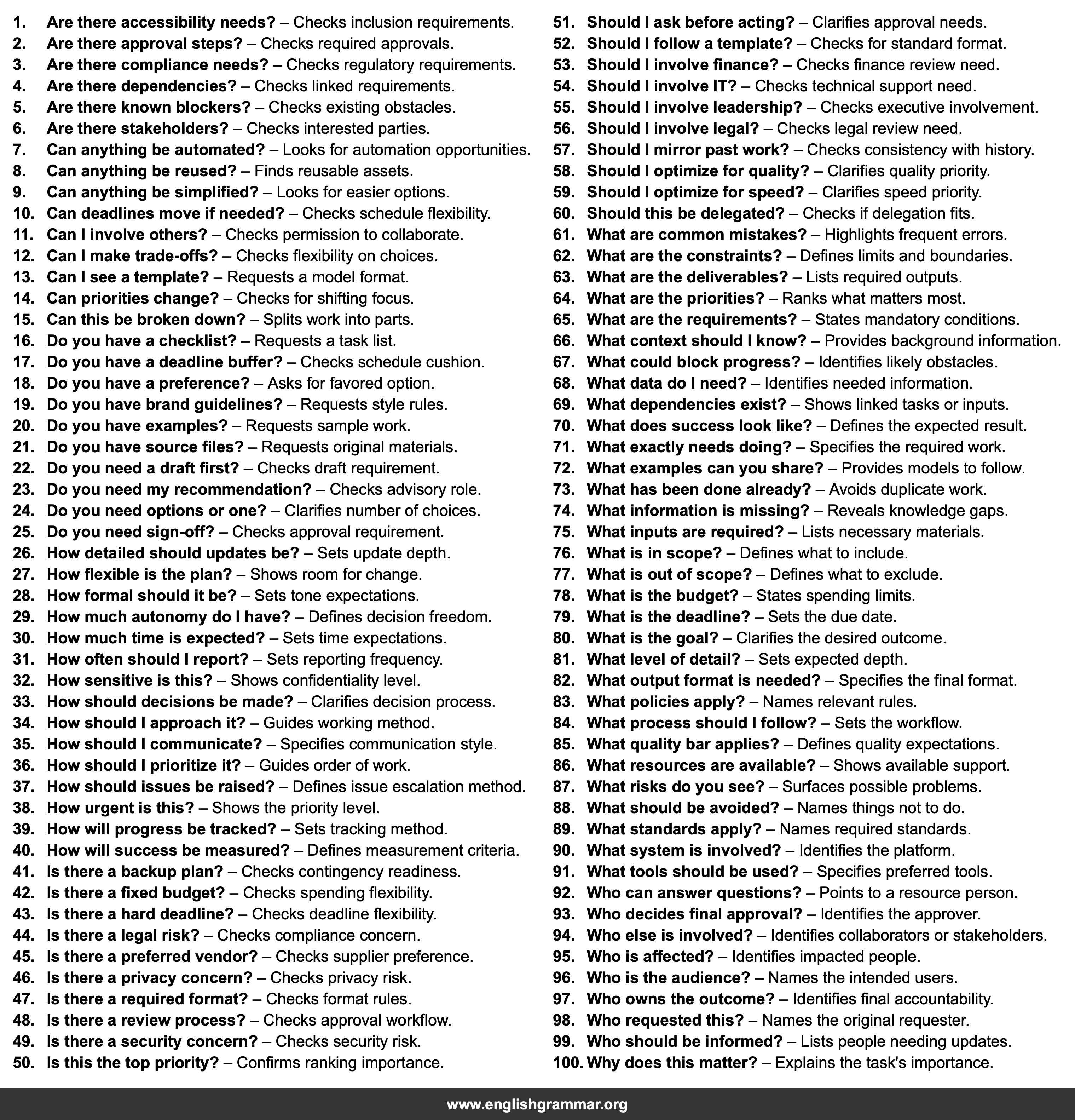
| No. | Item | Definition |
|---|---|---|
| 1. | Are there accessibility needs? | Checks inclusion requirements. |
| 2. | Are there approval steps? | Checks required approvals. |
| 3. | Are there compliance needs? | Checks regulatory requirements. |
| 4. | Are there dependencies? | Checks linked requirements. |
| 5. | Are there known blockers? | Checks existing obstacles. |
| 6. | Are there stakeholders? | Checks interested parties. |
| 7. | Can anything be automated? | Looks for automation opportunities. |
| 8. | Can anything be reused? | Finds reusable assets. |
| 9. | Can anything be simplified? | Looks for easier options. |
| 10. | Can deadlines move if needed? | Checks schedule flexibility. |
| 11. | Can I involve others? | Checks permission to collaborate. |
| 12. | Can I make trade-offs? | Checks flexibility on choices. |
| 13. | Can I see a template? | Requests a model format. |
| 14. | Can priorities change? | Checks for shifting focus. |
| 15. | Can this be broken down? | Splits work into parts. |
| 16. | Do you have a checklist? | Requests a task list. |
| 17. | Do you have a deadline buffer? | Checks schedule cushion. |
| 18. | Do you have a preference? | Asks for favored option. |
| 19. | Do you have brand guidelines? | Requests style rules. |
| 20. | Do you have examples? | Requests sample work. |
| 21. | Do you have source files? | Requests original materials. |
| 22. | Do you need a draft first? | Checks draft requirement. |
| 23. | Do you need my recommendation? | Checks advisory role. |
| 24. | Do you need options or one? | Clarifies number of choices. |
| 25. | Do you need sign-off? | Checks approval requirement. |
| 26. | How detailed should updates be? | Sets update depth. |
| 27. | How flexible is the plan? | Shows room for change. |
| 28. | How formal should it be? | Sets tone expectations. |
| 29. | How much autonomy do I have? | Defines decision freedom. |
| 30. | How much time is expected? | Sets time expectations. |
| 31. | How often should I report? | Sets reporting frequency. |
| 32. | How sensitive is this? | Shows confidentiality level. |
| 33. | How should decisions be made? | Clarifies decision process. |
| 34. | How should I approach it? | Guides working method. |
| 35. | How should I communicate? | Specifies communication style. |
| 36. | How should I prioritize it? | Guides order of work. |
| 37. | How should issues be raised? | Defines issue escalation method. |
| 38. | How urgent is this? | Shows the priority level. |
| 39. | How will progress be tracked? | Sets tracking method. |
| 40. | How will success be measured? | Defines measurement criteria. |
| 41. | Is there a backup plan? | Checks contingency readiness. |
| 42. | Is there a fixed budget? | Checks spending flexibility. |
| 43. | Is there a hard deadline? | Checks deadline flexibility. |
| 44. | Is there a legal risk? | Checks compliance concern. |
| 45. | Is there a preferred vendor? | Checks supplier preference. |
| 46. | Is there a privacy concern? | Checks privacy risk. |
| 47. | Is there a required format? | Checks format rules. |
| 48. | Is there a review process? | Checks approval workflow. |
| 49. | Is there a security concern? | Checks security risk. |
| 50. | Is this the top priority? | Confirms ranking importance. |
| 51. | Should I ask before acting? | Clarifies approval needs. |
| 52. | Should I follow a template? | Checks for standard format. |
| 53. | Should I involve finance? | Checks finance review need. |
| 54. | Should I involve IT? | Checks technical support need. |
| 55. | Should I involve leadership? | Checks executive involvement. |
| 56. | Should I involve legal? | Checks legal review need. |
| 57. | Should I mirror past work? | Checks consistency with history. |
| 58. | Should I optimize for quality? | Clarifies quality priority. |
| 59. | Should I optimize for speed? | Clarifies speed priority. |
| 60. | Should this be delegated? | Checks if delegation fits. |
| 61. | What are common mistakes? | Highlights frequent errors. |
| 62. | What are the constraints? | Defines limits and boundaries. |
| 63. | What are the deliverables? | Lists required outputs. |
| 64. | What are the priorities? | Ranks what matters most. |
| 65. | What are the requirements? | States mandatory conditions. |
| 66. | What context should I know? | Provides background information. |
| 67. | What could block progress? | Identifies likely obstacles. |
| 68. | What data do I need? | Identifies needed information. |
| 69. | What dependencies exist? | Shows linked tasks or inputs. |
| 70. | What does success look like? | Defines the expected result. |
| 71. | What exactly needs doing? | Specifies the required work. |
| 72. | What examples can you share? | Provides models to follow. |
| 73. | What has been done already? | Avoids duplicate work. |
| 74. | What information is missing? | Reveals knowledge gaps. |
| 75. | What inputs are required? | Lists necessary materials. |
| 76. | What is in scope? | Defines what to include. |
| 77. | What is out of scope? | Defines what to exclude. |
| 78. | What is the budget? | States spending limits. |
| 79. | What is the deadline? | Sets the due date. |
| 80. | What is the goal? | Clarifies the desired outcome. |
| 81. | What level of detail? | Sets expected depth. |
| 82. | What output format is needed? | Specifies the final format. |
| 83. | What policies apply? | Names relevant rules. |
| 84. | What process should I follow? | Sets the workflow. |
| 85. | What quality bar applies? | Defines quality expectations. |
| 86. | What resources are available? | Shows available support. |
| 87. | What risks do you see? | Surfaces possible problems. |
| 88. | What should be avoided? | Names things not to do. |
| 89. | What standards apply? | Names required standards. |
| 90. | What system is involved? | Identifies the platform. |
| 91. | What tools should be used? | Specifies preferred tools. |
| 92. | Who can answer questions? | Points to a resource person. |
| 93. | Who decides final approval? | Identifies the approver. |
| 94. | Who else is involved? | Identifies collaborators or stakeholders. |
| 95. | Who is affected? | Identifies impacted people. |
| 96. | Who is the audience? | Names the intended users. |
| 97. | Who owns the outcome? | Identifies final accountability. |
| 98. | Who requested this? | Names the original requester. |
| 99. | Who should be informed? | Lists people needing updates. |
| 100. | Why does this matter? | Explains the task’s importance. |