
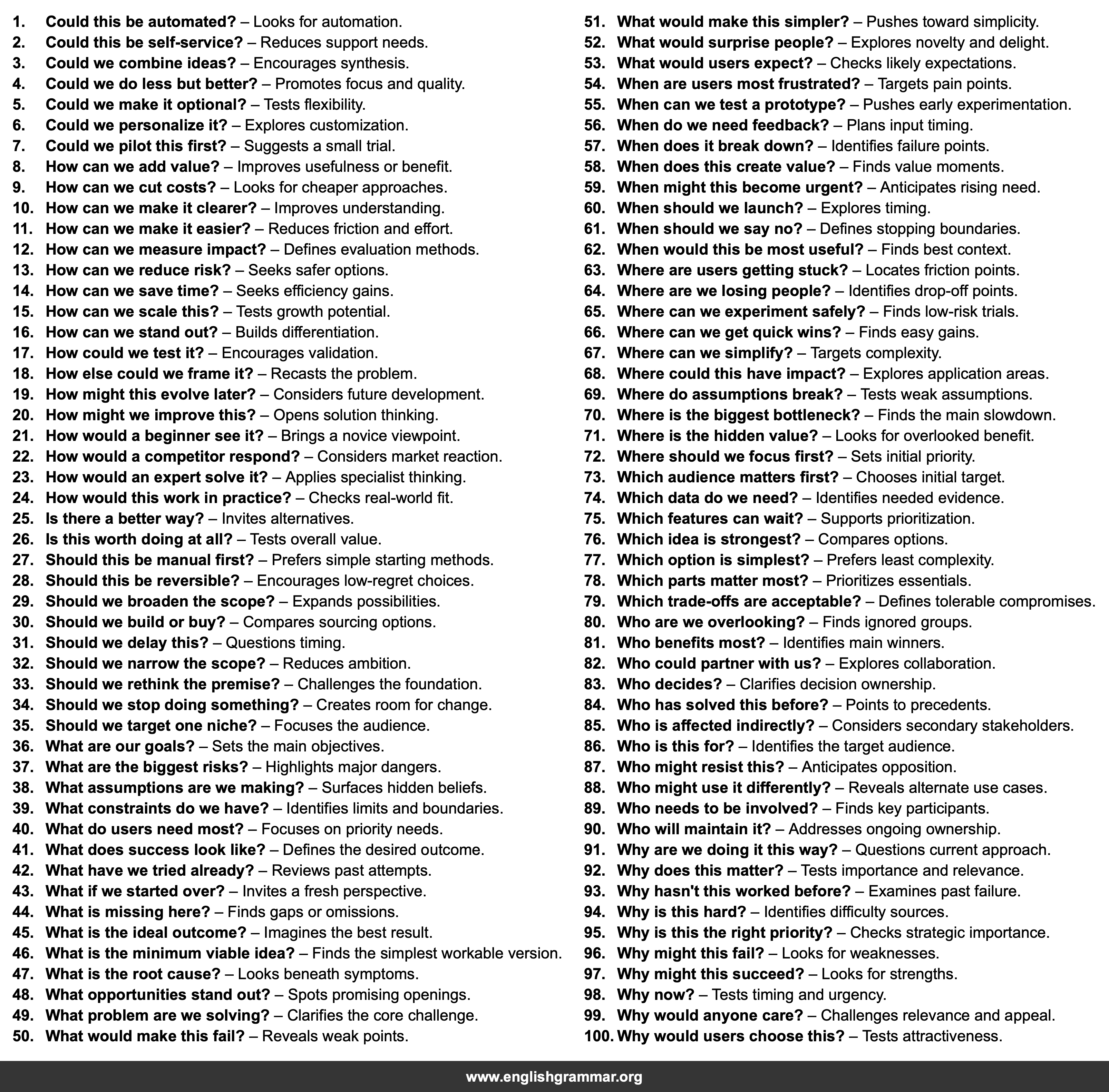
| No. | Item | Definition |
|---|---|---|
| 1. | Could this be automated? | Looks for automation. |
| 2. | Could this be self-service? | Reduces support needs. |
| 3. | Could we combine ideas? | Encourages synthesis. |
| 4. | Could we do less but better? | Promotes focus and quality. |
| 5. | Could we make it optional? | Tests flexibility. |
| 6. | Could we personalize it? | Explores customization. |
| 7. | Could we pilot this first? | Suggests a small trial. |
| 8. | How can we add value? | Improves usefulness or benefit. |
| 9. | How can we cut costs? | Looks for cheaper approaches. |
| 10. | How can we make it clearer? | Improves understanding. |
| 11. | How can we make it easier? | Reduces friction and effort. |
| 12. | How can we measure impact? | Defines evaluation methods. |
| 13. | How can we reduce risk? | Seeks safer options. |
| 14. | How can we save time? | Seeks efficiency gains. |
| 15. | How can we scale this? | Tests growth potential. |
| 16. | How can we stand out? | Builds differentiation. |
| 17. | How could we test it? | Encourages validation. |
| 18. | How else could we frame it? | Recasts the problem. |
| 19. | How might this evolve later? | Considers future development. |
| 20. | How might we improve this? | Opens solution thinking. |
| 21. | How would a beginner see it? | Brings a novice viewpoint. |
| 22. | How would a competitor respond? | Considers market reaction. |
| 23. | How would an expert solve it? | Applies specialist thinking. |
| 24. | How would this work in practice? | Checks real-world fit. |
| 25. | Is there a better way? | Invites alternatives. |
| 26. | Is this worth doing at all? | Tests overall value. |
| 27. | Should this be manual first? | Prefers simple starting methods. |
| 28. | Should this be reversible? | Encourages low-regret choices. |
| 29. | Should we broaden the scope? | Expands possibilities. |
| 30. | Should we build or buy? | Compares sourcing options. |
| 31. | Should we delay this? | Questions timing. |
| 32. | Should we narrow the scope? | Reduces ambition. |
| 33. | Should we rethink the premise? | Challenges the foundation. |
| 34. | Should we stop doing something? | Creates room for change. |
| 35. | Should we target one niche? | Focuses the audience. |
| 36. | What are our goals? | Sets the main objectives. |
| 37. | What are the biggest risks? | Highlights major dangers. |
| 38. | What assumptions are we making? | Surfaces hidden beliefs. |
| 39. | What constraints do we have? | Identifies limits and boundaries. |
| 40. | What do users need most? | Focuses on priority needs. |
| 41. | What does success look like? | Defines the desired outcome. |
| 42. | What have we tried already? | Reviews past attempts. |
| 43. | What if we started over? | Invites a fresh perspective. |
| 44. | What is missing here? | Finds gaps or omissions. |
| 45. | What is the ideal outcome? | Imagines the best result. |
| 46. | What is the minimum viable idea? | Finds the simplest workable version. |
| 47. | What is the root cause? | Looks beneath symptoms. |
| 48. | What opportunities stand out? | Spots promising openings. |
| 49. | What problem are we solving? | Clarifies the core challenge. |
| 50. | What would make this fail? | Reveals weak points. |
| 51. | What would make this simpler? | Pushes toward simplicity. |
| 52. | What would surprise people? | Explores novelty and delight. |
| 53. | What would users expect? | Checks likely expectations. |
| 54. | When are users most frustrated? | Targets pain points. |
| 55. | When can we test a prototype? | Pushes early experimentation. |
| 56. | When do we need feedback? | Plans input timing. |
| 57. | When does it break down? | Identifies failure points. |
| 58. | When does this create value? | Finds value moments. |
| 59. | When might this become urgent? | Anticipates rising need. |
| 60. | When should we launch? | Explores timing. |
| 61. | When should we say no? | Defines stopping boundaries. |
| 62. | When would this be most useful? | Finds best context. |
| 63. | Where are users getting stuck? | Locates friction points. |
| 64. | Where are we losing people? | Identifies drop-off points. |
| 65. | Where can we experiment safely? | Finds low-risk trials. |
| 66. | Where can we get quick wins? | Finds easy gains. |
| 67. | Where can we simplify? | Targets complexity. |
| 68. | Where could this have impact? | Explores application areas. |
| 69. | Where do assumptions break? | Tests weak assumptions. |
| 70. | Where is the biggest bottleneck? | Finds the main slowdown. |
| 71. | Where is the hidden value? | Looks for overlooked benefit. |
| 72. | Where should we focus first? | Sets initial priority. |
| 73. | Which audience matters first? | Chooses initial target. |
| 74. | Which data do we need? | Identifies needed evidence. |
| 75. | Which features can wait? | Supports prioritization. |
| 76. | Which idea is strongest? | Compares options. |
| 77. | Which option is simplest? | Prefers least complexity. |
| 78. | Which parts matter most? | Prioritizes essentials. |
| 79. | Which trade-offs are acceptable? | Defines tolerable compromises. |
| 80. | Who are we overlooking? | Finds ignored groups. |
| 81. | Who benefits most? | Identifies main winners. |
| 82. | Who could partner with us? | Explores collaboration. |
| 83. | Who decides? | Clarifies decision ownership. |
| 84. | Who has solved this before? | Points to precedents. |
| 85. | Who is affected indirectly? | Considers secondary stakeholders. |
| 86. | Who is this for? | Identifies the target audience. |
| 87. | Who might resist this? | Anticipates opposition. |
| 88. | Who might use it differently? | Reveals alternate use cases. |
| 89. | Who needs to be involved? | Finds key participants. |
| 90. | Who will maintain it? | Addresses ongoing ownership. |
| 91. | Why are we doing it this way? | Questions current approach. |
| 92. | Why does this matter? | Tests importance and relevance. |
| 93. | Why hasn’t this worked before? | Examines past failure. |
| 94. | Why is this hard? | Identifies difficulty sources. |
| 95. | Why is this the right priority? | Checks strategic importance. |
| 96. | Why might this fail? | Looks for weaknesses. |
| 97. | Why might this succeed? | Looks for strengths. |
| 98. | Why now? | Tests timing and urgency. |
| 99. | Why would anyone care? | Challenges relevance and appeal. |
| 100. | Why would users choose this? | Tests attractiveness. |