
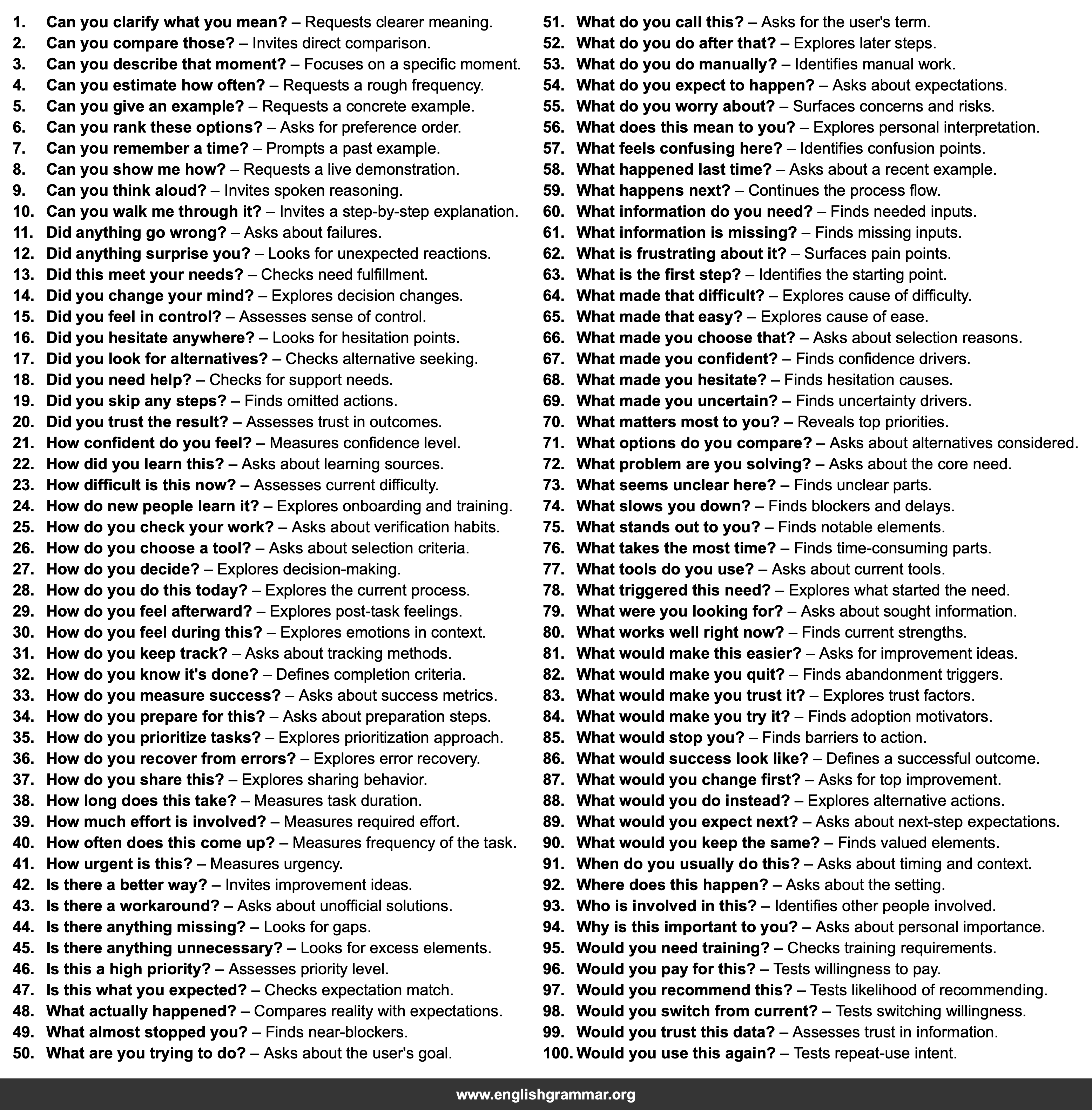
| No. | Item | Definition |
|---|---|---|
| 1. | Can you clarify what you mean? | Requests clearer meaning. |
| 2. | Can you compare those? | Invites direct comparison. |
| 3. | Can you describe that moment? | Focuses on a specific moment. |
| 4. | Can you estimate how often? | Requests a rough frequency. |
| 5. | Can you give an example? | Requests a concrete example. |
| 6. | Can you rank these options? | Asks for preference order. |
| 7. | Can you remember a time? | Prompts a past example. |
| 8. | Can you show me how? | Requests a live demonstration. |
| 9. | Can you think aloud? | Invites spoken reasoning. |
| 10. | Can you walk me through it? | Invites a step-by-step explanation. |
| 11. | Did anything go wrong? | Asks about failures. |
| 12. | Did anything surprise you? | Looks for unexpected reactions. |
| 13. | Did this meet your needs? | Checks need fulfillment. |
| 14. | Did you change your mind? | Explores decision changes. |
| 15. | Did you feel in control? | Assesses sense of control. |
| 16. | Did you hesitate anywhere? | Looks for hesitation points. |
| 17. | Did you look for alternatives? | Checks alternative seeking. |
| 18. | Did you need help? | Checks for support needs. |
| 19. | Did you skip any steps? | Finds omitted actions. |
| 20. | Did you trust the result? | Assesses trust in outcomes. |
| 21. | How confident do you feel? | Measures confidence level. |
| 22. | How did you learn this? | Asks about learning sources. |
| 23. | How difficult is this now? | Assesses current difficulty. |
| 24. | How do new people learn it? | Explores onboarding and training. |
| 25. | How do you check your work? | Asks about verification habits. |
| 26. | How do you choose a tool? | Asks about selection criteria. |
| 27. | How do you decide? | Explores decision-making. |
| 28. | How do you do this today? | Explores the current process. |
| 29. | How do you feel afterward? | Explores post-task feelings. |
| 30. | How do you feel during this? | Explores emotions in context. |
| 31. | How do you keep track? | Asks about tracking methods. |
| 32. | How do you know it’s done? | Defines completion criteria. |
| 33. | How do you measure success? | Asks about success metrics. |
| 34. | How do you prepare for this? | Asks about preparation steps. |
| 35. | How do you prioritize tasks? | Explores prioritization approach. |
| 36. | How do you recover from errors? | Explores error recovery. |
| 37. | How do you share this? | Explores sharing behavior. |
| 38. | How long does this take? | Measures task duration. |
| 39. | How much effort is involved? | Measures required effort. |
| 40. | How often does this come up? | Measures frequency of the task. |
| 41. | How urgent is this? | Measures urgency. |
| 42. | Is there a better way? | Invites improvement ideas. |
| 43. | Is there a workaround? | Asks about unofficial solutions. |
| 44. | Is there anything missing? | Looks for gaps. |
| 45. | Is there anything unnecessary? | Looks for excess elements. |
| 46. | Is this a high priority? | Assesses priority level. |
| 47. | Is this what you expected? | Checks expectation match. |
| 48. | What actually happened? | Compares reality with expectations. |
| 49. | What almost stopped you? | Finds near-blockers. |
| 50. | What are you trying to do? | Asks about the user’s goal. |
| 51. | What do you call this? | Asks for the user’s term. |
| 52. | What do you do after that? | Explores later steps. |
| 53. | What do you do manually? | Identifies manual work. |
| 54. | What do you expect to happen? | Asks about expectations. |
| 55. | What do you worry about? | Surfaces concerns and risks. |
| 56. | What does this mean to you? | Explores personal interpretation. |
| 57. | What feels confusing here? | Identifies confusion points. |
| 58. | What happened last time? | Asks about a recent example. |
| 59. | What happens next? | Continues the process flow. |
| 60. | What information do you need? | Finds needed inputs. |
| 61. | What information is missing? | Finds missing inputs. |
| 62. | What is frustrating about it? | Surfaces pain points. |
| 63. | What is the first step? | Identifies the starting point. |
| 64. | What made that difficult? | Explores cause of difficulty. |
| 65. | What made that easy? | Explores cause of ease. |
| 66. | What made you choose that? | Asks about selection reasons. |
| 67. | What made you confident? | Finds confidence drivers. |
| 68. | What made you hesitate? | Finds hesitation causes. |
| 69. | What made you uncertain? | Finds uncertainty drivers. |
| 70. | What matters most to you? | Reveals top priorities. |
| 71. | What options do you compare? | Asks about alternatives considered. |
| 72. | What problem are you solving? | Asks about the core need. |
| 73. | What seems unclear here? | Finds unclear parts. |
| 74. | What slows you down? | Finds blockers and delays. |
| 75. | What stands out to you? | Finds notable elements. |
| 76. | What takes the most time? | Finds time-consuming parts. |
| 77. | What tools do you use? | Asks about current tools. |
| 78. | What triggered this need? | Explores what started the need. |
| 79. | What were you looking for? | Asks about sought information. |
| 80. | What works well right now? | Finds current strengths. |
| 81. | What would make this easier? | Asks for improvement ideas. |
| 82. | What would make you quit? | Finds abandonment triggers. |
| 83. | What would make you trust it? | Explores trust factors. |
| 84. | What would make you try it? | Finds adoption motivators. |
| 85. | What would stop you? | Finds barriers to action. |
| 86. | What would success look like? | Defines a successful outcome. |
| 87. | What would you change first? | Asks for top improvement. |
| 88. | What would you do instead? | Explores alternative actions. |
| 89. | What would you expect next? | Asks about next-step expectations. |
| 90. | What would you keep the same? | Finds valued elements. |
| 91. | When do you usually do this? | Asks about timing and context. |
| 92. | Where does this happen? | Asks about the setting. |
| 93. | Who is involved in this? | Identifies other people involved. |
| 94. | Why is this important to you? | Asks about personal importance. |
| 95. | Would you need training? | Checks training requirements. |
| 96. | Would you pay for this? | Tests willingness to pay. |
| 97. | Would you recommend this? | Tests likelihood of recommending. |
| 98. | Would you switch from current? | Tests switching willingness. |
| 99. | Would you trust this data? | Assesses trust in information. |
| 100. | Would you use this again? | Tests repeat-use intent. |