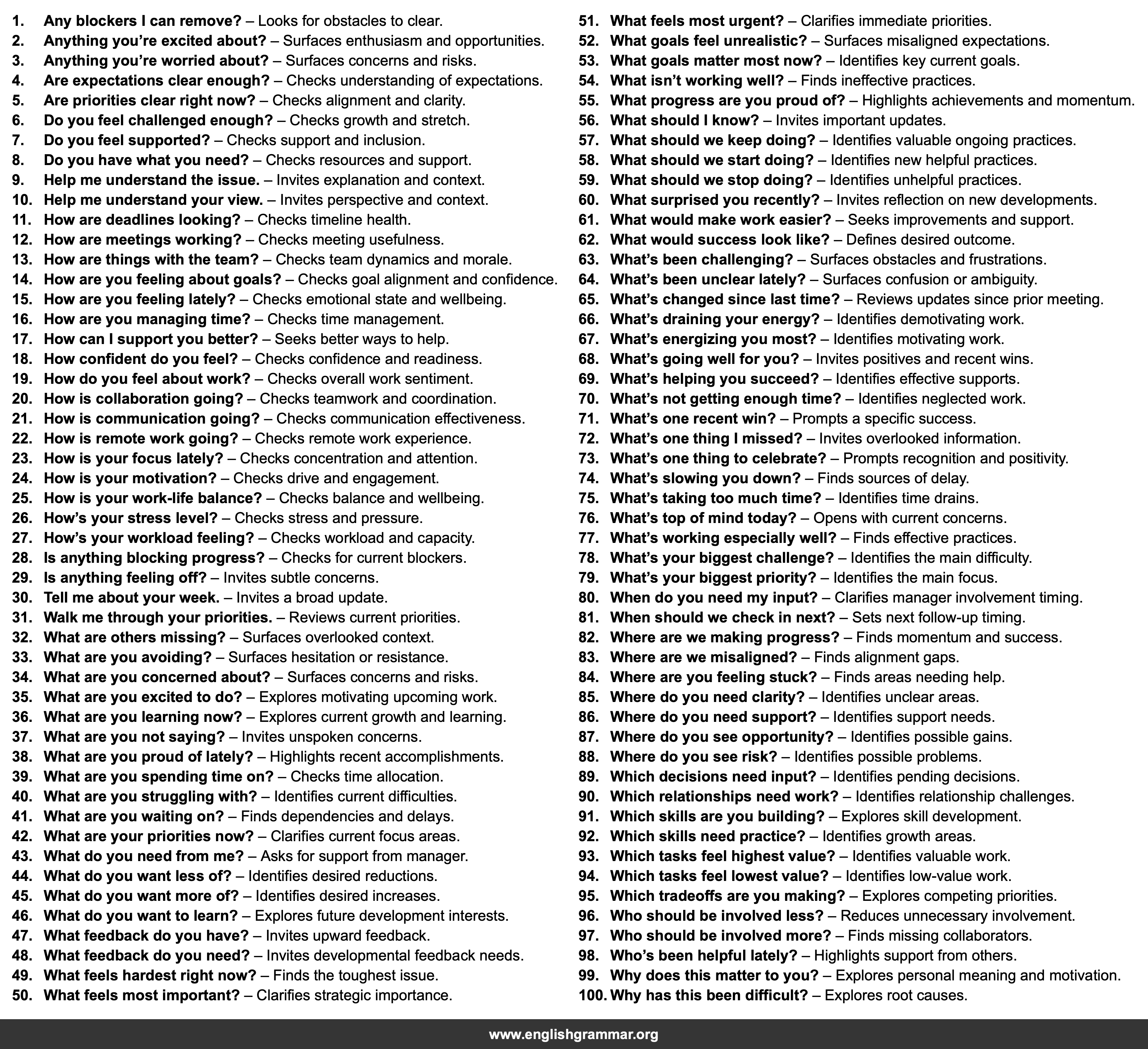
| No. | Item | Definition |
|---|---|---|
| 1. | Any blockers I can remove? | Looks for obstacles to clear. |
| 2. | Anything you’re excited about? | Surfaces enthusiasm and opportunities. |
| 3. | Anything you’re worried about? | Surfaces concerns and risks. |
| 4. | Are expectations clear enough? | Checks understanding of expectations. |
| 5. | Are priorities clear right now? | Checks alignment and clarity. |
| 6. | Do you feel challenged enough? | Checks growth and stretch. |
| 7. | Do you feel supported? | Checks support and inclusion. |
| 8. | Do you have what you need? | Checks resources and support. |
| 9. | Help me understand the issue. | Invites explanation and context. |
| 10. | Help me understand your view. | Invites perspective and context. |
| 11. | How are deadlines looking? | Checks timeline health. |
| 12. | How are meetings working? | Checks meeting usefulness. |
| 13. | How are things with the team? | Checks team dynamics and morale. |
| 14. | How are you feeling about goals? | Checks goal alignment and confidence. |
| 15. | How are you feeling lately? | Checks emotional state and wellbeing. |
| 16. | How are you managing time? | Checks time management. |
| 17. | How can I support you better? | Seeks better ways to help. |
| 18. | How confident do you feel? | Checks confidence and readiness. |
| 19. | How do you feel about work? | Checks overall work sentiment. |
| 20. | How is collaboration going? | Checks teamwork and coordination. |
| 21. | How is communication going? | Checks communication effectiveness. |
| 22. | How is remote work going? | Checks remote work experience. |
| 23. | How is your focus lately? | Checks concentration and attention. |
| 24. | How is your motivation? | Checks drive and engagement. |
| 25. | How is your work-life balance? | Checks balance and wellbeing. |
| 26. | How’s your stress level? | Checks stress and pressure. |
| 27. | How’s your workload feeling? | Checks workload and capacity. |
| 28. | Is anything blocking progress? | Checks for current blockers. |
| 29. | Is anything feeling off? | Invites subtle concerns. |
| 30. | Tell me about your week. | Invites a broad update. |
| 31. | Walk me through your priorities. | Reviews current priorities. |
| 32. | What are others missing? | Surfaces overlooked context. |
| 33. | What are you avoiding? | Surfaces hesitation or resistance. |
| 34. | What are you concerned about? | Surfaces concerns and risks. |
| 35. | What are you excited to do? | Explores motivating upcoming work. |
| 36. | What are you learning now? | Explores current growth and learning. |
| 37. | What are you not saying? | Invites unspoken concerns. |
| 38. | What are you proud of lately? | Highlights recent accomplishments. |
| 39. | What are you spending time on? | Checks time allocation. |
| 40. | What are you struggling with? | Identifies current difficulties. |
| 41. | What are you waiting on? | Finds dependencies and delays. |
| 42. | What are your priorities now? | Clarifies current focus areas. |
| 43. | What do you need from me? | Asks for support from manager. |
| 44. | What do you want less of? | Identifies desired reductions. |
| 45. | What do you want more of? | Identifies desired increases. |
| 46. | What do you want to learn? | Explores future development interests. |
| 47. | What feedback do you have? | Invites upward feedback. |
| 48. | What feedback do you need? | Invites developmental feedback needs. |
| 49. | What feels hardest right now? | Finds the toughest issue. |
| 50. | What feels most important? | Clarifies strategic importance. |
| 51. | What feels most urgent? | Clarifies immediate priorities. |
| 52. | What goals feel unrealistic? | Surfaces misaligned expectations. |
| 53. | What goals matter most now? | Identifies key current goals. |
| 54. | What isn’t working well? | Finds ineffective practices. |
| 55. | What progress are you proud of? | Highlights achievements and momentum. |
| 56. | What should I know? | Invites important updates. |
| 57. | What should we keep doing? | Identifies valuable ongoing practices. |
| 58. | What should we start doing? | Identifies new helpful practices. |
| 59. | What should we stop doing? | Identifies unhelpful practices. |
| 60. | What surprised you recently? | Invites reflection on new developments. |
| 61. | What would make work easier? | Seeks improvements and support. |
| 62. | What would success look like? | Defines desired outcome. |
| 63. | What’s been challenging? | Surfaces obstacles and frustrations. |
| 64. | What’s been unclear lately? | Surfaces confusion or ambiguity. |
| 65. | What’s changed since last time? | Reviews updates since prior meeting. |
| 66. | What’s draining your energy? | Identifies demotivating work. |
| 67. | What’s energizing you most? | Identifies motivating work. |
| 68. | What’s going well for you? | Invites positives and recent wins. |
| 69. | What’s helping you succeed? | Identifies effective supports. |
| 70. | What’s not getting enough time? | Identifies neglected work. |
| 71. | What’s one recent win? | Prompts a specific success. |
| 72. | What’s one thing I missed? | Invites overlooked information. |
| 73. | What’s one thing to celebrate? | Prompts recognition and positivity. |
| 74. | What’s slowing you down? | Finds sources of delay. |
| 75. | What’s taking too much time? | Identifies time drains. |
| 76. | What’s top of mind today? | Opens with current concerns. |
| 77. | What’s working especially well? | Finds effective practices. |
| 78. | What’s your biggest challenge? | Identifies the main difficulty. |
| 79. | What’s your biggest priority? | Identifies the main focus. |
| 80. | When do you need my input? | Clarifies manager involvement timing. |
| 81. | When should we check in next? | Sets next follow-up timing. |
| 82. | Where are we making progress? | Finds momentum and success. |
| 83. | Where are we misaligned? | Finds alignment gaps. |
| 84. | Where are you feeling stuck? | Finds areas needing help. |
| 85. | Where do you need clarity? | Identifies unclear areas. |
| 86. | Where do you need support? | Identifies support needs. |
| 87. | Where do you see opportunity? | Identifies possible gains. |
| 88. | Where do you see risk? | Identifies possible problems. |
| 89. | Which decisions need input? | Identifies pending decisions. |
| 90. | Which relationships need work? | Identifies relationship challenges. |
| 91. | Which skills are you building? | Explores skill development. |
| 92. | Which skills need practice? | Identifies growth areas. |
| 93. | Which tasks feel highest value? | Identifies valuable work. |
| 94. | Which tasks feel lowest value? | Identifies low-value work. |
| 95. | Which tradeoffs are you making? | Explores competing priorities. |
| 96. | Who should be involved less? | Reduces unnecessary involvement. |
| 97. | Who should be involved more? | Finds missing collaborators. |
| 98. | Who’s been helpful lately? | Highlights support from others. |
| 99. | Why does this matter to you? | Explores personal meaning and motivation. |
| 100. | Why has this been difficult? | Explores root causes. |
